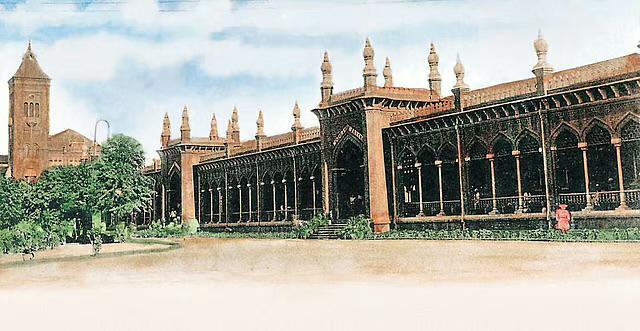
November 30, 2025 marked 125 years since the inauguration of one of the city’s most iconic landmarks until the 1980s, the Moore Market. The foundation stone had been laid in August 1898 by Lt Col Sir George Moore, President of the Madras Corporation and when completed, it was named in his honour (see MM, Dec 1-15, 2014). It was constructed by A Subramania Aiyar. Several references to the shopping experience, particularly from the 1960s and 70s have appeared in the pages of this magazine from time to time. Recently, a search on the internet related to the inauguration of the market led to results from The Surveyor And Municipal and County Engineer, Vol. XIX (Jan 4 to June 28, 1901) and The Building World. The note in the former appeared in the January 18, 1901 issue, within two months of the market’s inauguration and was accompanied by two images, one each of its interior and exterior. We reproduce the relevant portions from the journals and also the images, which make for interesting reading.
* * *
Moore Market As It Was
From The Surveyor And Municipal and County Engineer
“We are able to present our readers in this supplement with two excellent illustrations (reproduced from photos by Nicholas & Co of Madras) of the Moore Market which was formally opened by his Excellency Sir Arthur Havelock, the Governor of Madras, on 30th November last.
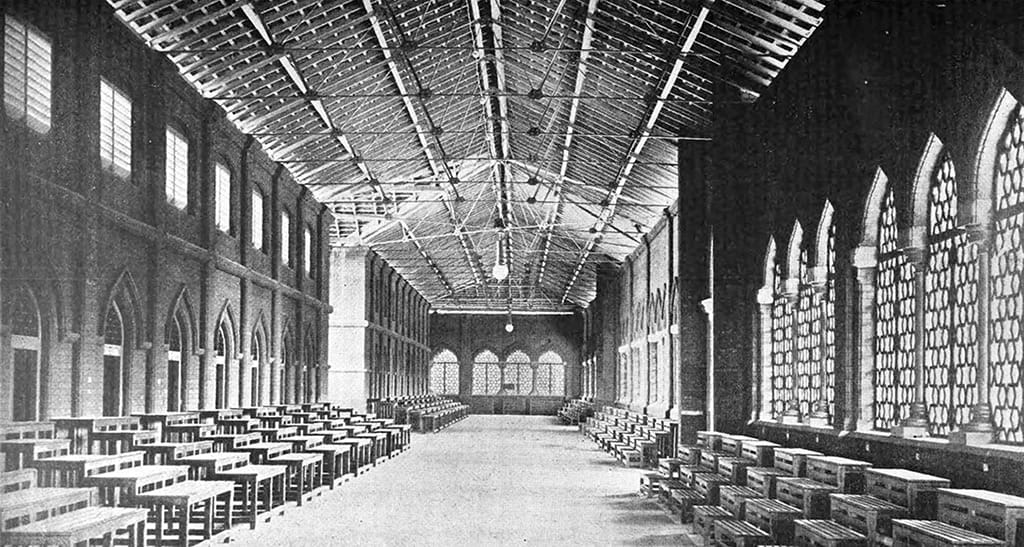
Moore Market interiors.
The building occupies a site 350 ft by 240 ft and was erected from designs prepared by Mr RE Ellis, M.I.C.E, until recently engineer to the Madras Municipality, but now engaged in private practice in London (70, Chancery-Lane, WC) with Mr HA Pryor, under the style of JC Chapman & Co. The style of architecture is mainly Indo-Saracenic. A verandah, 11 ft wide runs all around the building. There are ten entrances to the verandah from outside and six entrances from the verandah to the halls, which are 30 ft wide and run all around inside the verandah. Between the hall and the verandah there is a series of archways, filled in with tracery but not glazed, so as to allow free perflation of air, which is so necessary in a hot climate. From the hall there are four large archways leading into an open space in the centre of the market, measuring between 230 ft by 120 ft, where fountains will play. Between the hall and the open space there are fifty-two small store-rooms, about 10 ft. There are in all 291 stalls, but the market is capable of extension, should additional room be required. The cost of the building was about 26,000 pounds.”
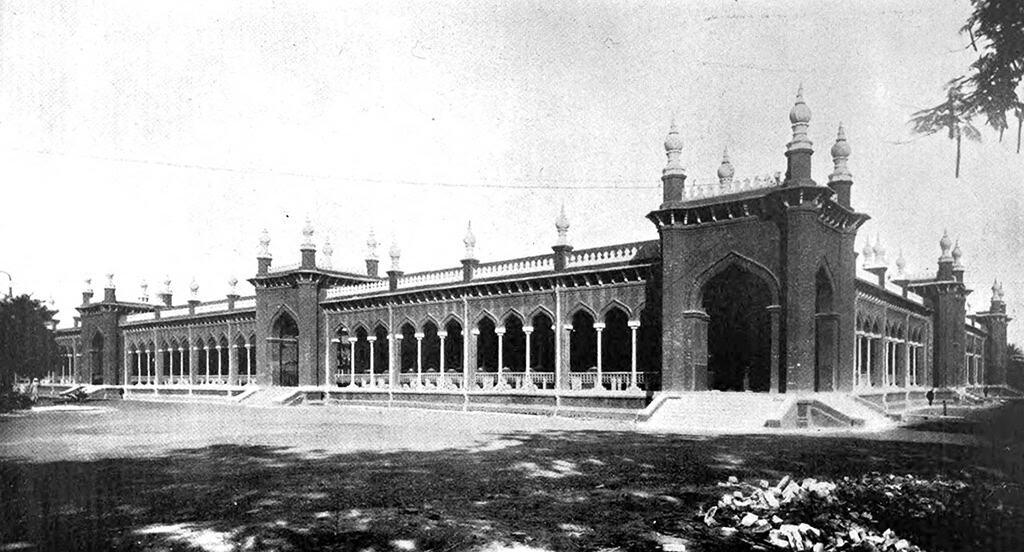
The exterior of the Market.
From the Building World
The note in the Building World journal (issue dated May 11, 1911) also gives a description of the newly-built market, largely covering all the points mentioned in the above note. It however adds a few more details, particularly with respect to the verandahs.
“The verandahs have wrought-iron railings on their outer sides. The gates, railings and trusses of the roof of the hall were manufactured at the local municipal workshop, while the cast-iron columns were obtained from England. The halls, four in number, corresponding to the four sides are each 30 ft wide, two are each 220 ft and two each 140 ft long. The roof is pent, and covered with Mangalore pattern tiles, manufactured by Arbuthnot and Co of Madras. The floors are of Cudappah stone (slate) in 6-in. concrete, and laid sloping from the centre to the sides, where there are U-shaped drains for carrying off all the washings.”
The razing of this iconic structure in a mysterious fire in 1985 remains one of the saddest episodes in the heritage history of the city.
— by Karthik Bhatt
* * *
Its Sights and Sounds
It would be difficult to imagine a more noisy, or characteristic scene than that presented by the large general market named after Lt. Colonel Sir George Moore, KCB, one-time President of the Madras Municipality. Despite much opposition, Colonel Moore succeeded in abolishing the old insanitary bazaar in George Town, and substituting the present imposing red structure designed by Mr RE Ellis, Municipal Engineer. The cost of erection was estimated at three lakhs of rupees. Quadrangular in shape, the edifice consists of outer verandahs and inner galleries erected about a central court open to the sky. The south side is practically devoted to bird fanciers and animal dealers. Booksellers congregate along the northern verandah, where the wary and persistent are occasionally rewarded by the discovery of a rare first edition. Vegetable stalls, butchers and vendors of every sort and description are well represented in other parts of the market.
– Reproduced from Madras – The Birth Place of British India by Lieut. Colonel H.A. Newell, FRGS., Indian Army, 1919.
* * *
Passing along the road by the General Hospital Bridge spanning Cochrane’s Canal, we come to a line of imposing buildings fringing the southern edge of the People’s Park. The first of these is the Moore Market named after Sir George Moore, a former popular President of the Corporation who took great interest in its foundation in the place of the congested and insanitary market that existed in Broadway which has since been converted into a park. The structure is a quadrangular in shape with an open space in the centre laid out as a garden and with arcades all around. The market is a convenience to the middle and upper classes of the population and is well ventilated and kept in a clean condition. To the east and north of the market are the supplementary structures called the hawker’s stalls, allotted to the vendors of worn-out and second-hand goods, who formerly vended their wares in what was known as Guzili Bazaar near the Memorial Hall.
– Reproduced from The Madras Corporation Handbook, 1950.
* * *
Being Cheated at Moore Market
The following is a passage from Thillana Mohanambal, the novel by ‘Kalaimani’ (Kothamangalam Subbu) and set in the South India of the 1920s, though it was written much later. This particular scene does not appear in the film based on the novel. Dharuman, the drone accompanist for nagaswaram maestro Shanmugasundaram, and Muthurakku, the tavil player, have come to Madras. They are attending on Shanmugasundaram who is undergoing treatment at the General Hospital. One day they decide to visit Moore Market and not knowing it is just opposite are charged exorbitantly for the ride by a wily rickshawpuller. They then alight outside the market and begin their exploration.
– Sriram V
Dharuman and Muthurakku entered Moore Market.
What struck Dharuman first was the strange orderliness of the town. Here, a mat bazaar stood alone; there, a flower bazaar by itself. Everything had its own place. Somewhere in this market, he was sure, they would also be selling good buttermilk, after all it was ‘More’ Market. The thought crossed his mind that he could buy a tumblerful and drink it. He walked around, looking eagerly.
Good heavens! What a sight!
Everything gleamed. Piles and piles of fountain pens lay stacked on one side, shining as though freshly born. On another side, old trousers were heaped together carelessly, as if someone had dumped a lifetime’s worth of clothing in one corner.
“Tavilkaarare,” said Dharuman, “shall I buy a pair of trousers?”
“That’ll be a dead man’s trousers, brother,” said Muthurakku calmly.
They went on peering into shop after shop. Just then, a man came straight at Dharuman and practically fell on him.
“What is this, man? Can’t you see where you’re going?” snapped Dharuman.
“Oh! Is it you?” the fellow exclaimed.
“I didn’t mean… ” he began, but before he could finish, another man who had been following him closely said, “Alright, I’ll give four rupees. Hand it over.”
Immediately, the first man turned pleadingly to Dharuman.
“Please tell me, sir. Just look at yourself – you look like a respectable gentleman. These spectacles belonged to my master, an Englishman. When he went abroad, he gifted them to me. London make, sir! There, they cost a hundred rupees, sir. I’m in need of some money now. And this man here is asking for a hundred-rupee spectacle for four rupees. Should I give it to him, sir? You tell me, sir!”
He kept addressing Dharuman as sir, repeatedly. With every sir, Dharuman felt his own importance growing.
Letting a hundred-rupee spectacle go for four rupees was plainly unjust, Dharuman decided, as a man of righteousness.
“Chi, chi! You shouldn’t sell it like that,” he said gravely, delivering his moral verdict.
At once, the spectacle-seller brightened up.
“I knew it, sir! People like you won’t speak wrongly. If I only had money in my hand, I’d have given this to you free, sir. Here, see for yourself,” he said, placing the spectacle case in Dharuman’s hand.
Dharuman examined it carefully. Soft leather on both sides. A shiny, glittering frame. Slightly curved lenses. His heart was completely won over.
“It’s very nice,” he said, reluctantly handing it back.
“Why don’t you keep it, sir? Just give me five rupees. I’ll return that money and buy the spectacle properly,” the man pleaded.
That a complete stranger should trust him so deeply filled Dharuman with happiness. Still, he said modestly, “No, no… that’s not necessary.”
“What, sir? You think I won’t return it? Alright then — give me ten rupees in hand. You keep it! Let this remain with a good man.”
Dharuman turned to look at Muthurakku. Muthurakku shook his head firmly.
That annoyed Dharuman. When such a fine object was available for ten rupees, why was this man obstructing it like an ill omen?
“Alright, sir. I’ll give six rupees,” said Dharuman.
No sir, keep it for seven rupees,” said the man promptly.
Dharuman paid seven rupees and bought the spectacles.
“Well, Tavilkaarare,” said Dharuman cheerfully, “whose face did I wake up seeing this morning?”
“Not mine,” said Muthurakku dryly.
“Not yours. I woke up seeing Nurse Mary’s face. That’s a lucky face. Otherwise, would I have got these spectacles so cheap?” said Dharuman happily.
On such an auspicious day, he suddenly felt an urge to buy a fountain pen as well and tuck it into his pocket. Muthurakku bought only a dozen hairpins. Meanwhile, Dharuman had managed to buy a fountain pen for three-quarters of a rupee.
“So, Dharuman,” said Muthurakku, “you’ve bought a pen. When are you planning to study?”
Dharuman laughed.
“The pen isn’t for studying. It’s for writing.”
“Well then, you need education first, no, to write?”
“What’s the difficulty? I’ll give it to someone who has studied and ask him to write for me,” said Dharuman, putting on the spectacles with great satisfaction.
They started walking.
Suddenly, ink leaked from his shirt pocket. A long blue streak appeared.
“What is this, brother? Is the pen leaking?” asked Muthurakku.
“Looks like he’s cheated me!”
“That doesn’t matter, Dharuman. Pour the ink out and keep it. You aren’t going to write anyway – it’s only for show!” said Muthurakku.
They began walking towards the hospital.
People who buy new shirts and new shoes naturally feel like wearing them and walking among others to show them off. But Dharuman proved that it is entirely wrong for someone who has just bought new spectacles to go walking around.
Wearing the spectacles proudly, Dharuman said, “Tavilkaarare, shall we walk a little further?”
“Even if I die, I won’t walk in this town.”
“Why? What will happen if we walk?”
“They’ve tarred the road. If it hits your feet, it’ll strike your eyes and ruin your health,” said Muthurakku.
Dharuman burst out laughing.
“What are you laughing at, Dharuman?”
“Now I understand why I bought these spectacles. Such coolness for the eyes!”
“It’s not coolness for the eyes. It’s only coolness for the sight. The moment you take them off, it’ll burn.”
“You’re saying that only because you’re afraid of the expense! Look – I’m wearing them. Is it burning? Tomorrow there’s a procession. Suppose Shanmugasundaram agrees to play the nagaswaram, I’ll wear these and walk all night listening to him.”
“Very good,” said Muthurakku. “No one will even notice that you’re asleep.”
Just then, Dharuman almost stumbled. Muthurakku caught him.
By then they had reached the market gate. Dharuman turned eastward and saw the General Hospital building. A sudden chill went through his stomach.
“Tavilkaarare… Tavilkaarare… I’ve been cheated.”
“Who? The spectacle fellow? Or the pen fellow?”
“No. The rickshaw man. He charged me one rupee just to come to that building opposite!”
“That’s alright. Walk carefully now. Don’t fall on the road.”
Once again, Dharuman stumbled. The road in front of him appeared like a deep pit. In a moment, he felt as though he had grown four feet taller. With every step, he feared he was stepping into a hollow. He lifted his dhoti and walked cautiously.
Muthurakku looked at him with suspicion.
“What is this, Dharuman? Are you on drugs or something? You’re behaving strangely.”
“No, no! I swear on God – nothing like that. These spectacles… why do they feel too cool? My whole body is shivering!”
“I can’t tell pits from mounds anymore. Mounds look like pits. I’m afraid if I remove these, my head will start spinning. He said these belonged to a ‘Durai’. But now it feels like they belonged to Duryodhana!”
“Does even level ground look like a pond now? Enough, enough – remove them and throw them away.”
“If I throw them, someone might step on them and get hurt. Let them be. I’ll give them to children.”
“So your eyesight going bad isn’t enough – you want to spoil children’s eyesight too? Come on!” said Muthurakku, crossing the road.
At that moment, Dharuman screamed “Aah!” and jumped back four feet.
The reason was simple.
Half a furlong away, a tram was approaching. Through the power of the spectacles, it appeared as though it were climbing straight over his head! In the force of his jump, the spectacles slipped and fell, breaking instantly.
Fortunately, his eyes were saved.
– Translated by V Nagarjun
* * *
Moore Market
— by Sa Viswanathan (SaVi). Translated by Sriram V
This article by Sa Viswanathan (SaVi) was published in Tamil in Ananda Vikatan in its issue of June 14, 1962. It offers an interesting view of the place as it was in that decade.
Pilot nib, Blackbird clip, Parker body and Sheaffer cap!
Having taken up various parts of pens of different brands, the seller at Moore Market manages to assemble a complete pen!
In the same way, Moore Market is the place where assorted items and shopkeepers come together and operate in a tightly integrated fashion. Old books, old hardware items, old clothes, old bottles, old vessels, and old gramophone players. There is no second-hand item that is not available in Moore Market. As the sun and the moon do not have any substitutes, they have not yet come up for sale here.
What Thiruvaiyaru is to musicians and Guindy is to race goers, Moore Market is to authors. From students at school to the weak-visioned elderly, everyone would have made at least one visit to Moore Market. The school student comes to buy a second-hand text book at half price while the weak-visioned elder comes to source an old pair of glasses. As crowds, congestion and commotion are integral to the place, there are plenty of pickpockets too. The police therefore keenly watch the market.
Having tied our wallets securely to our waists, we enter. We can hear many voices from the outer corridor of the market. One of these comes across clearly: “Let the poor eat what the Englishman once ate. Take it for one anna and two annas!” We walk to take a closer look at what mysterious food item is being sold. They are pears! Leaving them to the English to feast on, we walk ahead.
The harsh, grating voice of the fruit seller can be heard — “Orange one anna, Kamala six!”
Her oranges may be sweet but her cries are not. We have not walked on for ten feet when many vendors surround us. They are selling a variety of items — tooth powder, fountain pen, cockroach repellent, and plastic belts! What is not available here?
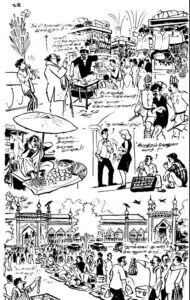 The name plate announcing that this is Moore Market comes within sight. The foundation stone for the place was laid in 1898 and it was completed in 1900. As the President of the city’s municipality was then Lt Col Sir George Moore, the market was named after him.
Let us first go around the outer corridor of this precinct.
We meet up and chat briefly with Shakespeare, Kamban, Kalidasa, Wodehouse, Somerset Maugham, Arnold Bennet, Hemingway, Agatha Christie, Maupassant, Tagore, Khandekar, Kalki and Karunanidhi. They are all there, at the second-hand book shop!
Having identified a book we want, we enquire about its price and are flabbergasted at the reply. “We were informed that we could buy books at half price here. But what you are quoting is even higher than the original cover price,” we say.
“What you say is true sir! But this book is out of print. As there is no fresh edition the one that I have is priced so high,” says the seller. Left with no option we purchase this old book at the price that is quoted.
In the inner courtyard what is on sale comprises largely clothes, cosmetics and costume jewellery meant for the modern woman. Looking at the items on sale and gazing at the women who are purchasing them we continue our round.
“Do you notice how that eardrop is glittering?” asks a woman of her husband who is clearly a blue-collar worker.
“All that is what people acting in theatre wear,” says her husband.
“I am sure that these can be worn by people like me as well,” she counters. “Why else do you think they have put up a shop for it over here?” Her husband however pretends not to hear and walks on. Crossing the hazards of the bangle shop, the slipper shop, the ribbon shop and the clothes shop, the husband suffers intensely. We commiserate with his predicament and taking the steps come down to the outer courtyard.
“Whatever you take, 75 paisa!” — thus screams a vendor as he pushes a cart laden with several articles. A crowd immediately surrounds him. Some distance away a woman is selling food. Around her are poor people, flies and dogs. What she is selling are the leftovers from the tiffin carriers that are delivered to the workers at various factories. These are combined into one dish and that is being sold!
“What the hell is this! It is so tasteless,” says a rickshaw puller who is wearing a hat on his head.
“How else do you expect it to be! After all it is second-hand food!” is the response.
“Catch him! Don’t leave him! Look at him running! Thief, thief…”
A pickpocket runs and five or six people give him chase. They catch hold of him. A constable arrives.
“Hand over the wallet you stole,” he thunders.
He examines what is handed over. Inside it is 75 paisa.
“Where did you get this from?” interrogates the constable.
“I took it in the crowd where the man selling anything for 75 paisa was,” was the reply.
“You can explain all that at the station,” says the policeman, as he propels the thief forward.
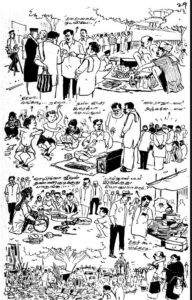 Another scene. A sailor on shore leave arrives. Seeing that he is a foreigner, the rickshaw pullers immediately surround him. “Welcome Sir! Rupees two for one round around Moore Market. Get into our vehicle.” The man gets into a rickshaw.
“Look at the good fortune of our Raju. For rupees two he has taken that foreigner all around the market.” This is the comment of another rickshaw puller at the stand.
“Right now, your mind is in turmoil, but you must not lose heart. There is no progress in your profession, and your education seems useless. The wealth line in your hand is weak. The mound of Venus is not all right,” a palmist is doing great business in one corner, watched by a huge crowd. We move on.
We overhear the conversation of two people coming towards us.
“Tomorrow, I swear to redeem the chit fund and pay the marwari to whom I have pawned my gold ring. I will then go and give it to my mother-in-law. If I don’t do this my name is not Arjunan,” says a man to his companion who responds, “That is all very well, but right now let me know where we should go.”
Suddenly a thundering voice asks, “O sinners! Where are you going? Where is your soul going? Tomorrow is not going to be yours; think about it! Pay 5 paisa and buy this book…”
An evangelist is making this announcement via a handheld loudspeaker. Arjunan and his companion are taken aback.
“Why this bird of ill omen just as we were starting out?” asks the companion.
A small crowd surrounds the preacher and his translator. They proceed to then deliver their sermon in alternating lines of Tamil and English.
“First my friend, you must realize you are a sinner.”
“Because you are a sinner you are condemned to die.”
“Ha ha haha! Dum dumdum,” an itinerant magician is calling us even while beating his drum, and we walk towards him.
“What I am going to do now is organise a fight between the snake and the mongoose, both of whom I have with me. However, I am not going to get them to fight. Dadum.. then what I’m going to do …Dadum… I told you that I will make the mongoose fight with the snake… Dadum…I will make you wait till the end… Dadum… I will then charge money from you… Dadum… but I will not do that… Dadum…if the mongoose was to fight with the snake everyday… Dadum… it will kill a snake every day… Dadum… will I then be buying a snake each day… Dadum… is it even possible… Dadum…therefore the fight between the snake and the mongoose is just humbug… Dadum… therefore all of you please listen to my speech… Dadum… you will now witness the snake and the mongoose, traditional enemies, listening to the words of a human and living together in friendship… Dadum… that is true magic… All the great and powerful men who have come here should watch this for some time. Now I request you all to clap loudly and for long… Dadum…ha ha haha!”
We then walk towards the hardware section taking in meanwhile the parrot astrology, the sale of traditional medicinal roots, medication for scorpion bites and a baby with two heads. In the hardware section are second-hand clockwork mechanisms, cycle parts, pump sets, old telephones, radio sets in short, parts for everything except a road engine. Two friends suddenly come across each other – one asks the other as to what he is doing in Moore market.
“The second hand of our clock is broken and that is why I have come here,” is the reply.
A woman selling buttermilk cries out, “More! More!”
A small boy asks of his father as to why More is being sold over here.
“This is after all More market,” is the reply.
Before coming out into the open we put our hands into our pockets to check if our wallets are there and find that they have vanished. We are startled for a moment and then realize that we had as a matter of abundant precaution tied them to our waists. We then heave a sigh of relief and proceed homewards.
* * *
Madras Nalla Madras and Moore Market
The song Madras Nalla Madras, which appeared in the 1967 film Anubhavi Raja Anubhavi is picturised on comedian Nagesh enacting the role of a villager who has just come to the city. It describes Madras as seen by a newcomer from the rural heartland. In the song appeared the line, Ooru Kettu Ponatharku Mooru Market Adayalam (Moore Market is symbolic of the degradation of the city) and there was a howl of protest from the shopkeepers there. They demanded an apology from Kavignar Kannadasan, the lyricist.
There was good reason for Kavignar penning that line. Moore Market being just next to the Central Station and opposite the General Hospital, was a magnet for visitors from outside the city. They were most often cheated by the vendors here. It came to such a pass that Moore Market was a byword for goods that appeared attractive but did not live up to expectations. A common example was talcum powder filled in near identical tins to the branded original. The top layer alone had powder and the rest was just chalk!
There were other problems as well. In case you touched a product, it was considered sold. And so the wary always made sure to enquire the price and then consider buying an item. In the words of Sir Lancelot Spratt in Richard Gordon’s Doctor and Son, eyes first and most, hands next and least, tongue never – the maxim for diagnosis of the sick, also held good at Moore Market. And in case you picked up an item on sale and put it back, you would be gheraoed by all the vendors nearby and forced to buy what you touched.
Kannadasan did not budge. The matter died down. The song can still be seen, on YouTube.
– Sriram V
* * *
Epitaph
If Koyambedu is a feast for the senses, Moore Market was a buffet for the soul – the kind of place where you could buy a second-hand Shakespeare, a vintage gramophone record, a star tortoise, and a sari all in one stroll.
It opened in 1900, thanks to Lt Col Sir George Moore, President of the Madras Corporation who had the noble idea of relocating the erstwhile Loane Square market to a modern and structured bazaar. And what a bazaar it was! Indo-Saracenic architecture, 40,000 square feet, and a layout with outer and inner circles of shops – it looked like someone had asked an artist, “What if Hogwarts sold antiques and pets?”
Moore Market wasn’t just a shopping destination – it was an experience. It was Madras’s quirkiest address. If you were a book lover, you didn’t just browse – you were examined. Sellers knew their wares down to the ISBN and could find you an out-of-print copy of Moby Dick faster than you could say “Call me Ishmael”.
Every item came with a story, and a price that was delightfully negotiable. After a round of haggling (and possibly acquiring a live monkey), people would relax on open platforms to eat, chat, and marvel at their eccentric purchases.
But alas, all good things are eventually eyed by the real estate department.
In the 1980s, Madras needed space, and the Railways were lurking nearby. In 1985, a mysterious fire (read: “Oh no, how terribly convenient!”) gutted the market. Vendors were shifted to a new complex built on the filled-in Lily Pond, but the magic simply didn’t migrate. The new space lacked the old market’s spirit – and possibly its monkeys too.
Today, the Moore Market Complex near Chennai Central station is more of a railway terminal than a cultural bazaar. Its soul lingers in the pages of history books and the hearts of nostalgic Chennaiites.
– TK Srinivas Chari