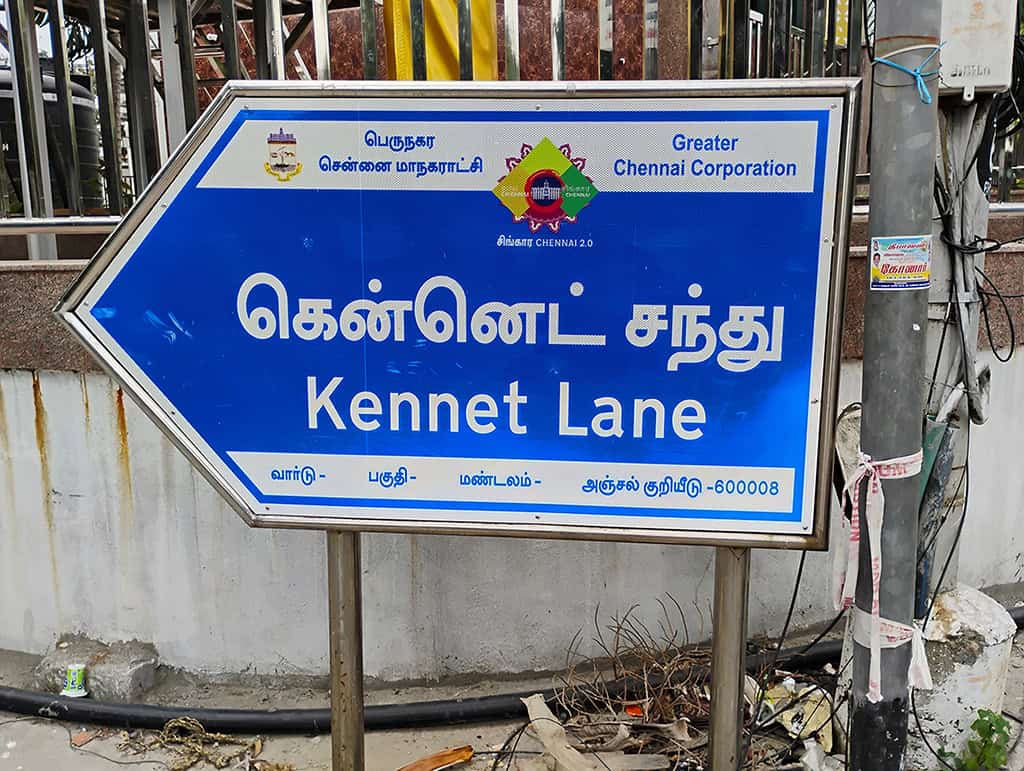
Sometime ago, I sought some information from the Madras Heritage expert Sriram V for my forthcoming biography on Michael Madhusudan Dutt, a pioneer of poetry and drama in Bengali language, much before Nobel Laurate Rabindranath Tagore. I asked him whether he knew anything about an old Madras resident during East India Company days namely Charles Egbert Kennet, who was a classmate of Michael at Bishops’ College, Calcutta. While replying in the negative, he asked me in turn, whether the Kennet Lane at Egmore is named after him.
I replied that it may not be so and said that it might have been named after his father Charles Kennet, who was a clerk in Madras Treasury and also the Secretary of Civil Orphans Asylum, Egmore. Subsequently, this asylum was shifted to St. George’s Anglo-Indian School at Poonamallee High Road after giving away its lands to the Railways in order to build the present Egmore Station terminal. As such, that Kennet lane would have been named after Kennet Senior during this transfer of the asylum’s property to the Railways. That was my reason at that time and I assured him that I shall go deep into the issue. Later on, I found that the transfer of the property of the Asylum was done in 1903-04 to the Railways and as Kennet Senior passed away in 1851 itself, my contention on this score was not a correct one.
Now let me present the eventful life of Rev. Kennet as I have gathered so far. Rev. Dr. Charles Egbert Kennet (21/09/1826 – 28/11/1884) was the second child of Eurasian parents namely Charles Kennet (1787-1851) and Charlotte Temasfield (1803-1841). Charles Kennet Sr., a clerk in the Treasury Office at Madras, was well known as the Secretary of the Civil Orphan Asylum. He was the one who offered teacher’s post at the Asylum school when Michael Madhusudan Dutt came to Madras in January 1848. Kennet’s mother and some other near relations were members of the Roman Catholic Church. As such, in his youth, he was brought up as a Roman Catholic. At the age of 16 or so, he joined the English Church. In his youth, he showed a love of books and study, and in early manhood earned the name of ‘Pundit’. He was educated first at Bishop Corries’ School, Madras. From there, he went to Bishop’s College, Calcutta. In both of these institutions, the education was of high order and students had time to master the subjects they studied. He was thus a scholar in the true sense of the word.
In 1847, he joined the Society for the Propagation of the Gospel (SPG) in Madras and worked for it in various capacities, with a short break between 1865 and 1868 (due to his wife’s health conditions), till the day of his death.1
In 1848, he passed both the examinations in Tamil as required by the Society and in 1849 he was appointed as Catechist (preacher) at Mudalur in Tirunelveli district. To highlight his expertise in Tamil language, it can be cited that his article on The Observations on the Languages of the Gonds, South of Nerbudda, was communicated by the Rev. W. Taylor and published in 1850 in The Madras Journal of Literature and Science.2 This article points out the relationship between the language of Gonds and Tamil. It has been mentioned that the article was sent on October 8, 1849 from Idaiyangudi where Rev. Robert Caldwell was functioning as a priest for SPG and also undertaking research on the Dravidian languages. It can be safely presumed that with his deep knowledge in Tamil, Kennet would have been helpful in this endeavour besides his missionary activities. On February 2, 1851, he was admitted to Deacon’s orders at Palayamkottai by Bishop Dealtry and was appointed at the same time as Assistant Missionary at Mudalur. On July 25, 1853, he was admitted to Priest’s orders at Courtallam by Bishop Dealtry and appointed Missionary In charge at Mudalur. In 1855, he was appointed to act for Bishop Dr. Caldwell, who was on furlough, at Idaiyangudi. From 1857 to 1865 he was in charge of missionary activities of Christianagaram in Tirunelveli District.3
In 1865, he was compelled to leave Tirunelveli owing to his wife’s health. He settled in Madras and for a short time, his connection with the SPG was discontinued. However, considering his erudition in Scriptures, Bishop Gell of Madras insisted on utilising his services. In 1868, he was appointed as Secretary of the Society for the Propagation of Christian Knowledge (SPCK), a post he held till 1878. During this period, he was instrumental in bringing out the Tamil translation of Holy Bible by Rev Dr Bower, which is being followed by the Protestant Church till today in Tamil Nadu.
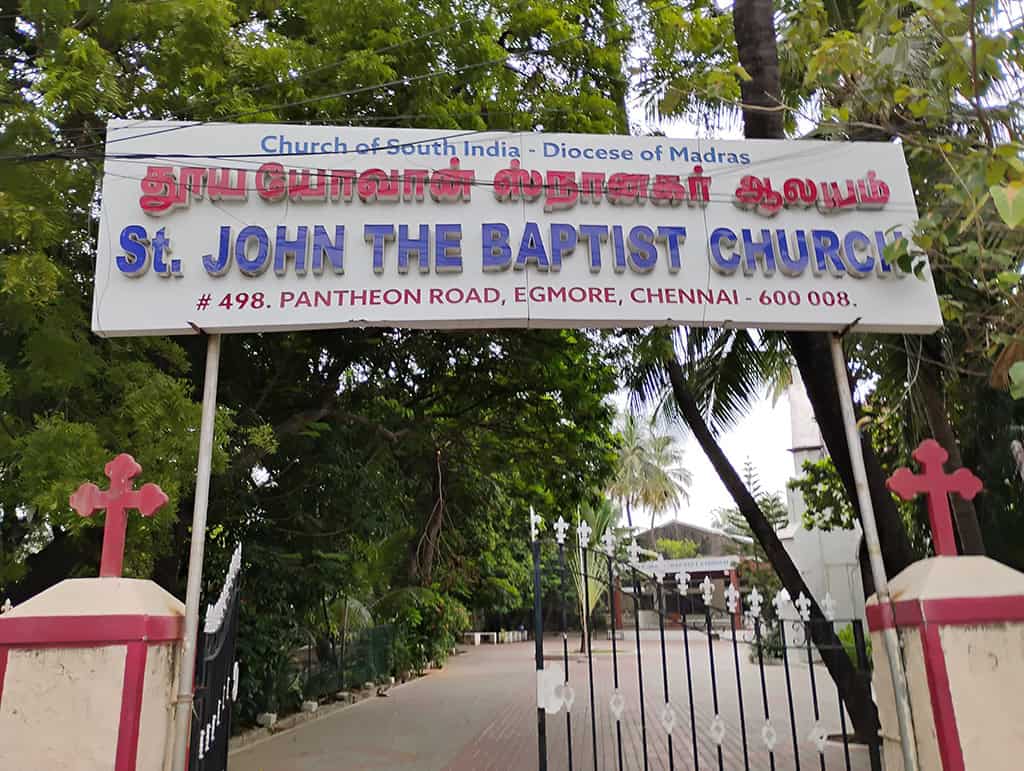
As he felt the need of more direct clerical work, the SPG was glad to utilise his valuable services, given without any remuneration, as the Incumbent of St. John’s, the Baptist church at Egmore. He served the congregation of this church for 16 years from 1868 to 1884 (till his death). A tablet in memory of Rev Dr CE Kennet has been put up in the church by the congregation. His name has also been inscribed in the (glass) pane of the rear side window of the altar of this church.4
The book The Claims of the Roman See to Supremacy: Disproved by an Examination of the Testimony of Catholic Antiquity written by Charles Egbert Kennet in 1869, is a critical examination of the claims made by the Roman Catholic Church regarding its supremacy over other churches. The author argues that these claims are not supported by the evidence of Catholic antiquity, which he examines in detail. Kennet provides a historical overview of the development of the Roman Catholic Church and its claims to supremacy, tracing the origins of these claims back to the early church. He then examines the testimony of Catholic antiquity, including the writings of the early church fathers and the decisions of church councils, to show that there is no clear evidence to support the claims of the Roman See. The author also addresses the arguments made by defenders of the Roman Catholic Church, and provides counter-arguments based on his examination of the evidence. He concludes that the claims of the Roman See to supremacy are not supported by Catholic antiquity, and that the church should abandon these claims in order to promote unity and cooperation among different Christian denominations. Overall, The Claims of the Roman See to Supremacy is a scholarly and well-researched work. It will be of interest to scholars and students of church history, as well as anyone interested in the relationship between different Christian denominations.
In 1872, Dr. Kennet began his connection with the Theological College, Sullivan’s Gardens when he was appointed as Divinity Lecturer under Rev AR Symonds, who incidentally was his teacher at Bishop Corrie’s School, Madras and who solemnised his marriage with Phoebe Kennet (nee Rodgers) in 1851. In October 1878, he succeeded Rev AR Symonds as Principal of the Theological College, Sullivan’s Gardens, a post he held until his death in 1884. All who knew him considered that he was eminently suited to this post.5
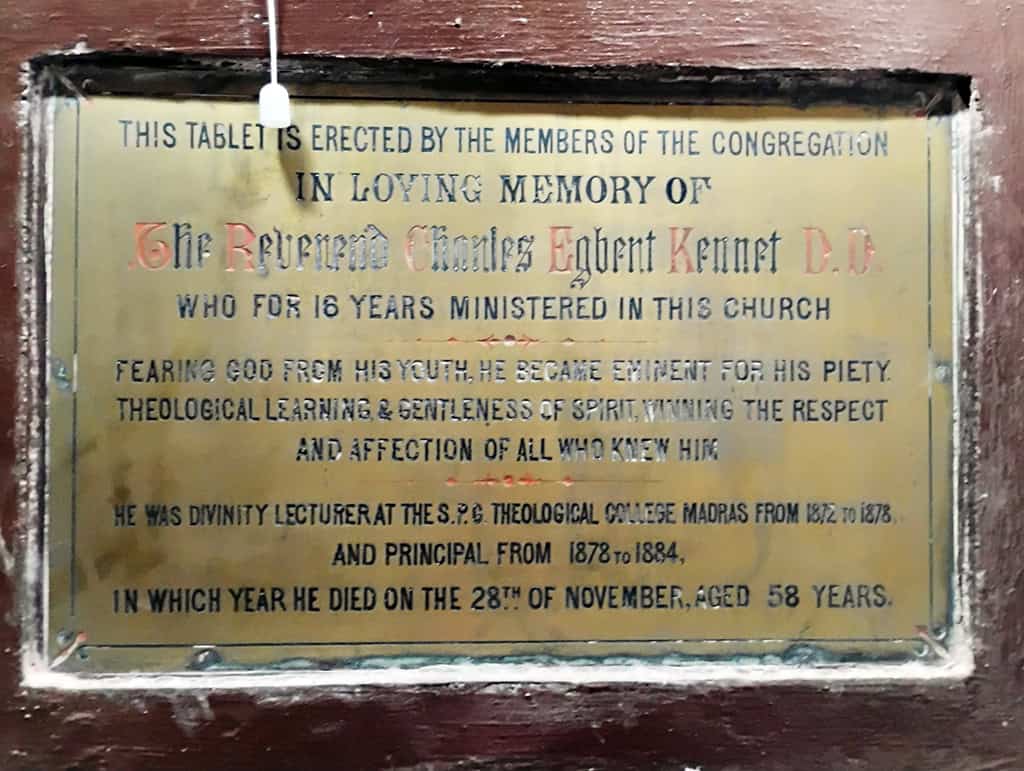
The Kennet Memoriam Tablet
He was by common consent accepted as the best theologian, in a technical sense. He was exceedingly well read in the writings of the early Christian Fathers and equally familiar with the books of the most eminent Anglican Divines. On all recondite questions, on Church history, Canon Law, or Theology, the usual custom was to “Ask Kennet” who from some corner of his well-selected library, or his well-stored memory, could nearly always throw light upon the subject placed before him. In this respect, his knowledge was often marvellous. The study of his life was that of theology and probably he had in that department no equal in India. 6
In Kennet’s time, the connection of the church with the University of Madras was advisedly brought to an end, and undivided attention bestowed on imparting a thorough theological training. With this end in view, Kennet obtained permission to present candidates for the Theological examination then popularly known as the Cambridge Preliminary, and the studies of the College were so arranged as to conform to the requirements of that examination, which as Kennet remarks, ‘has been in itself a great advantage, independently of any results of examinations, as furnishing a solitary teacher out here with a choice of subjects made by the most experienced teachers of Divinity in England.’ The first candidate for the Examination was presented in 1878 and passed in the Second Class. In 1883 the Principal was cheered, by the following words from Professor Westcott, the Chairman of the Board; in connection with the candidates presented by him in the previous year: “All have done intelligently and well, and their work shows careful and successful teaching. The papers of Pakkyanadan are excellent, and he comes among the first few in the whole examination of 123 men, and wins a First class, easily. The other men come very near to the minimum for a First [88/89] Class, and so stand at the head of the Second Class. We have now three classes.”7
During this period, he published some of his most important writings: Missionary Teaching Viewed in relation to the Conduct of the Controversy with Hinduism; The Doctrine of the Priesthood; The Claims of the Roman See to Supremacy disproved by an Examination of Catholic Antiquity. At the same time, he contributed articles to the Indian Church Quarterly Review. In 1880, the Archbishop of Canterbury conferred upon him the degree of Doctor of Divinity (DD) upon the recommendation of Bishop Gell. He died on November 28, 1884 after a brief illness.8
The Diocese perpetuated his memory by purchasing his library and establishing it for general use at Sullivan’s Gardens. He was a great scholar rather than a great missionary; but he used all his knowledge and intellectual gifts in the missionary cause and he raised many a native priest in the practice of using precise language in theological statements and in the pursuit of truth.9
Most Rev. Frederick Gell, the then Bishop of Madras in a letter to the Society’s Acting Secretary in Madras wrote as follows:
“I have received your telegram announcing the death of our valued brother, Dr. Kennet. I have lost a very affectionate and instructive friend, and all the diocese has lost one of its most distinguished ornaments – a clergyman of eminent learning, devoutness, and a large heartedness.
“The Theological College especially has suffered such a loss as cannot be adequately repaired for several years to come. But we must pray that God will raise up a duly-qualified man to occupy the vacant Principalship; and the Society at home must be earnestly requested to search and send out such a man.”10
The words of an old friend, the Rev. G.U. Pope (formerly Warden of Bishop Cotton School, Bangalore, Madras), most venerable Tamil scholar and translator of many Tamil classics including Thirukkural into English, brought out the ultimate quality of Dr Kennet as follows:
“He was full of gracious humility, often quite embarrassing to those who were brought into connection with him. From Professor Street (of Bishop’s College, Calcutta), he acquired a profound love for Catholic truth, and seldom is one to be found who so simply as by intuition, holds all Catholic Doctrine without any tinge of un-English theology, as he did. Truly evangelical, large-hearted, candid, tenderly conscientious, mighty in the Holy Scripture and in Patristic and old Anglican Divinity, he yet read and weighed most of our noteworthy modern productions.
“The last evening I was in India, we knelt in the College Chapel and commended each other to God; and so, I shall see him always, till, if God please, we meet and mingle our praises in the temple within the veil.”11
Rev. Bishop Robert Caldwell, the Dravidian Scholar who wrote the famous treatise Comparative Grammar of the Dravidian Languages under whom Dr. Kennet functioned as a missionary in Tirunelveli district from 1849 to 1865 wrote the following in his reminiscences:
“Dr. Charles Egbert Kennet was not in Madras when I arrived from England, though I became intimately acquainted with him some years afterwards in Tirunelveli where his first appointment was as Catechist under me at Idaiyangudi. He was at the time of my arrival a student in Bishop’s College, Calcutta where he imbibed from Professor Street’s teaching and influence, that attachment to the doctrines and practices of the High Church school, which he not only retained to the last, but which became deeper, stronger, and more fervid every year he lived.
“His course was very different from that of Dr. Bower, but they were men of equal intellectual gifts, and equally respected. The principal work of his life was as Principal of the SPG Theological College, Sullivan’s Gardens, Madras. His deep personal piety, and his earnest advocacy of what he believed to be the truth gained for him the sincere respect of those who differed from him and the unbounded esteem and confidence of those who shared in his theological views. He was consequently regarded, as long as he lived, as the undoubted head and leader of the High Church Party in the Diocese of Madras, if not also throughout India.
“He received from the Archbishop of Canterbury the honorary degree of Doctor of Divinity shortly after the same degree has been conferred on Dr Bower. Dr Kennet died in Madras at the close of 1884. It is sad to think that these two eminent men have left no successors in the community to which they belonged, and of which, each in his own way, they were such distinguished ornaments.”12
Dr. Kennet was survived by his wife Phoebe Kennet who passed away on March 29, 1910 at Perambur, Madras at the age of 78. Her funeral service was done by Rev. Yesadian of St. John the Baptist Church, Egmore where her husband served for 16 years and was most revered by the congregation.
After going through many sources as described above, now I am able to recover the working life of Rev C E Kennet to some extent and also able to confirm the query of Sriram V that the Kennet Lane, Egmore is indeed named after Rev CE Kennet, the Incumbent of St. John the Baptist Church, located adjacent to Kennet Lane, at Pantheon Road (presently Police Commissioner Office Road) for sixteen years from 1868 to 1884 (i.e. until his death) as an enduring memorial to his missionary activities13 and not after his father as I have suggested to Sriram earlier.
— by V B Ganesan, vbganesan@gmail.com
About the Author
VB Ganesan is a notable translator. He worked in different capacities in All India Radio, Information & Cultural Affairs Department, Govt. of West Bengal, and the Internet Editorial of The Hindu. Among his translations, notable is History will Absolve Me by Fidel Castro, Red Star over China by Edgar Snow (earned First Prize in Ki.Pa. Aravindan Memorial Award for the best translation appeared in Tamil between 2001-2020), History of the Working Class by Sukomal Sen and 20 Feluda Stories of Satyajit Ray.
Among his own writings, notable is Satyajit Ray – His Life and Times, Tagore – The Life Sketch of the Steward of Bengal and Tagore from a Multi-dimensional View (his contribution in various fields).
After preparing a short biography on Michael Madhusudan Dutt, he is currently into research on the families of Rebecca and Henrietta in Madras to write an authoritative biography of Michael in English and Tamil soon.
References
1. The Mission Field, In Memoriam, February 1885, p. 49-52.
2. The Madras Journal of Literature and Science, Madras Literary Society, Vol. 16, 1850, p. 33-54.
3. The Mission Field, In Memoriam, February 1885, p. 50.
4. Anglicanism in Madras, Rajalakshmi Theodore, p. 163.
5. The Mission Field, In Memoriam, February 1885, p. 50.
6. The Church in Madras, Vol. III. p. 373.
7. Our Oldest Indian Mission, A. Westcott -1897.
8. The Mission Field, In Memoriam, February 1885, p. 51.
9. Anglicanism in Madras, Rajalakshmi Theodore, p. 163
10. The Mission Field, In Memoriam, February 1885, p.52.
11. The Mission Field, In Memoriam, February 1885, P. 52.
12. Reminiscences of Caldwell, p. 62, 111 and 148
13. Anglicanism in Madras, Rajalakshmi Theodore, p. 163