The dawn of 2026 brings about with it several important developments with respect to transport in our city. The first, of course is the much-awaited commissioning of a portion of Corridor 4 of the Phase II of the Chennai Metro Rail (from Poonamallee Bypass to Vadapalani), which at the time of writing is likely to start operations in mid-February. The “better tomorrow” promised is to arrive shortly for travelers and residents of these areas, and let us hope it is on track to extend to other parts soon. The other is a project that has been a permanent fixture for long whenever matters relating to rail network in our city is discussed, that of the extension of the MRTS services from Velachery to St Thomas Mount. A completion time of more than 18 years for a small distance of 500 meters, bringing along with it a multi-fold increase in cost must be a record by any yardstick.
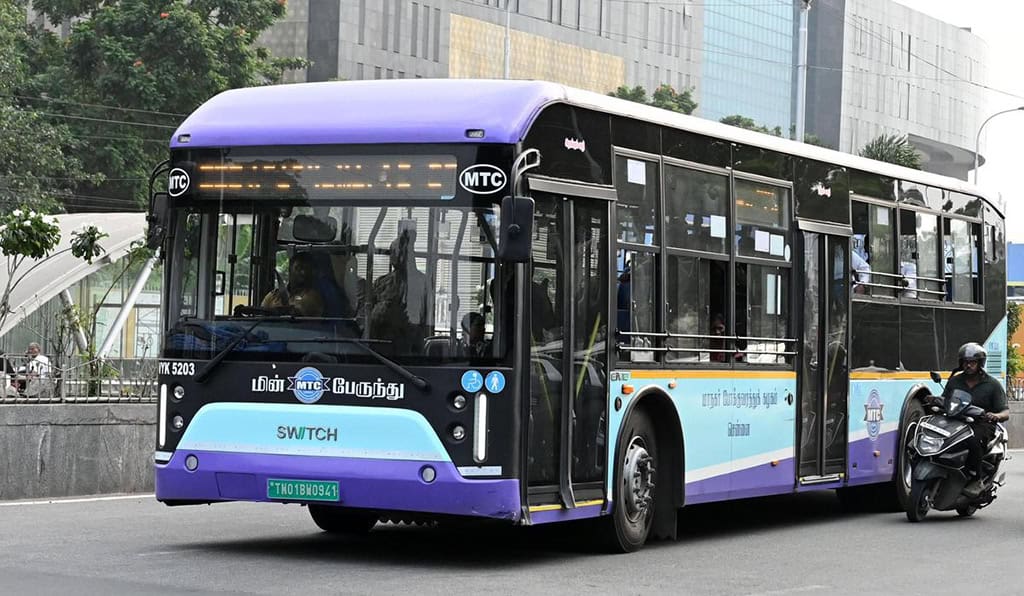
Modern transport services in operation. (Picture courtesy: The Hindu.)
The completion of the aforesaid service comes at a time when there is yet another important development on the anvil, that of the signing of the MOU to formalize the takeover of the MRTS by the CMRL. This is expected soon, with government officials stating a few weeks ago that it was in the final stages. Over the next couple of years, the takeover is expected to be completed in a phased manner. It would be interesting to see how the economics play out consequently, considering the respective organization structures and the differences in the rates charged. While understandably a corporate entity cannot be expected to charge the way the government-run entity did (and given the investments that CMRL proposes to make in terms of rehauling the existing infrastructure), it must be kept in mind that affordability is not compromised, for the MRTS was, as its name denoted seen as a lifeline for masses seeking quicker modes of transport. Any exercise that alienates them would be against the purpose for which it was envisioned.
There are positive tidings with respect to road transport as well, with a World Bank report lauding the Metropolitan Transport Corporation for creating a sustainable, dependable public transport service. Though buses have for long been the workhorses of the public transport system in our city, according to the above report, their mode share had declined from around 50 percent in the 1980s to just about 16 percent in 2023, thanks to a combination of factors such as outdated fleet, poor service quality, etc. Over the last few years, the corporation has embarked on a series of corrective measures to address the decline. These include replacing old fleets, introduction of E-buses, steps to improve last-mile connectivity by upgrading the mini-bus service, real-time information systems to track bus timings and the “Bus First” awareness campaign to prioritize use of buses for public transport. That these efforts have not gone unnoticed has been evidenced by the national award presented by the Union Ministry of Housing and Urban Affairs for the ‘city with the best public transport system’ late last year. The World Bank recognition further validates the efforts being made by the entity to reinvent itself. Also on the cards is an initiative to reintroduce double decker buses on the city roads after 17 years, this time in a completely electric avatar, in sync with the increasing push towards electrification of bus services. However, it is understandable that these can be run only on select routes due to infrastructural constraints.
In a city like ours, where the pressure on our roads is immense, thanks majorly to the increased reliance on private transport to commute, it is essential to have in place a robust public transport system which will assure people of faster, reliable, and safer modes of travel to their destinations. The next couple of years, when more parts of Phase II of the Chennai Metro Rail are commissioned, are especially crucial in the formulation and implementation of measures in this regard. The implementation of the Chennai One mobility app, which seeks to seamlessly integrate various modes of transport, is already a right step in this direction. Hopefully, 2026 will be a breakthrough year in the city’s quest to aid its citizens get rid of a daily hassle, that of commute. We wait and watch with hope.