Luz Church Road was one of the most prominent thoroughfares of the city in the early and mid-twentieth century. It was home to several legal luminaries and administrators, not to forget prominent institutions, some of which survive even today. Huge garden houses dotted the road, which began from what is today the Luz junction, as it snaked its way past the Luz Church and connected to Mowbrays Road.
With the efflux of time, several of the garden houses gave way to smaller residences and apartment units. This piece, which was found in an issue of the Swatantra magazine dating to the 1950s makes for interesting reading and captures the transformation. The writer, Capt RL Rau was one of the great-grandsons of noted administrator Sir T Madhava Rau, whose palatial residence Madhav Baug stood right at the beginning of Luz Church Road. RL Rau was a journalist associated with many newspapers such as The Leader of Allahabad and The Hindu. He also served as the P.R.O. in the British 14th Army and in the Home Ministry under Sardar Vallabhai Patel.
* * *
Failure, as Max Beerbohm once said, if it be plain, unvarnished, complete failure, has always a certain amount of dignity. Squalidity in such a failure, let me add, heightens its pathos.
The Luz Church Road in Madras, it seems to me, is a road that failed. Losing its individuality after over half a century of fame and content to end helplessly today as a mere street connecting Mylapore’s Cutcherry Road and Mowbray’s Road, its failure is complete. Its mute acceptance of its present status is a pathetic reminder of the inevitableness of things that befall men, women and roads.
But what chance can a stately old road or avenue like the Luz Church Road have when people have begun to prefer to have dwellings instead of residences, tenements instead of houses, terraced flats instead of comfortable, roomy houses and monotonous six-foot high compound walls as they call them, instead of hedges?
It can give only what it receives. Give it dignity, it will reflect it; give it a sense of quiet, it will give back a sense of repose. Leave it in peace, it will echo the spirit of deep solitude and the mellowness of age. Provide it with a stately avenue of trees, it will make the trees reach the stars; and when slumber and darkness steal over the landscape, it will make the stars peep through the leafy hollow of the trees gladdening the multitudes that pass under it.
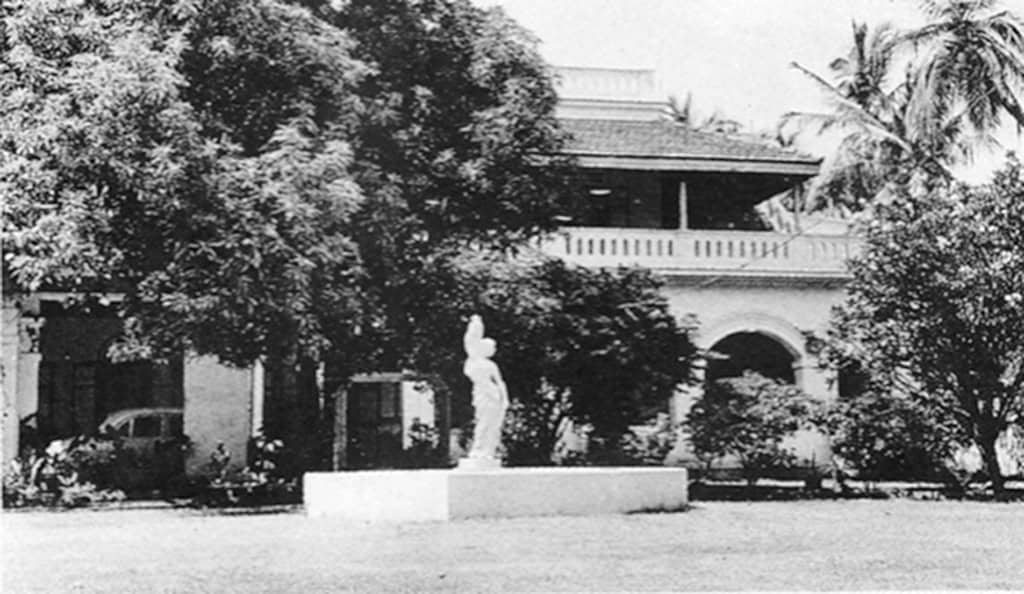
Ekamra Niwas, Luz Church Road, courtesy: The Alladi Diaries.
I do not know who constructed the Luz Church Road and when. I do not care to know. Somehow it became a part of my childhood many years ago. Like all childhood’s conceptions it had for me a permanence, a fixity of its own. The early memories I had of this pleasant old Madras road never faded. Fate took me to distant places, new pastures of endeavour and enterprise. I saw many roads, walked over them or past them in many countries. Many of them were statelier, grander, picturesque and better built than the Luz Church Road of my childhood, but I never could forget the Luz Church Road and the sheer romance it had for me.
This road of my childhood began with Madhav Baug, the old family residence of Rajah Sir T. Madhava Rau on the left and that of Justice Bashyam lyengar on the right as one entered it. The road forked into two as it approached the present park which was formerly a pond where lilies and lotuses grew in profusion. The fork on the right took one to the dingy old Luz Church, dingily built but with the peace of a century old sanctuary with a big wooden cross in front. The left fork ended in a lazy winding road with some more famous residences on its two sides and joined Mowbray’s Road.
There was a little municipal water pipe where the road forked into two. It had a terrible looking metal lion’s mouth for its spout out of which gushed forth an endless stream of cool water. It was enclosed by a lantana hedge and there used to be a boulder covered with grass, which was a paradise for some of us small boys.
No shabby looking electric posts defaced the then long and stately avenue of banyan trees that bordered the old Luz Church Road. Modern, minute looking houses were still uncommon. The road went past lovely old brick and mortar bungalows mellowed by the hand of time. Lantana bushes with their brick red blossoms and evergreen shrubbery ran riot along the ditches.
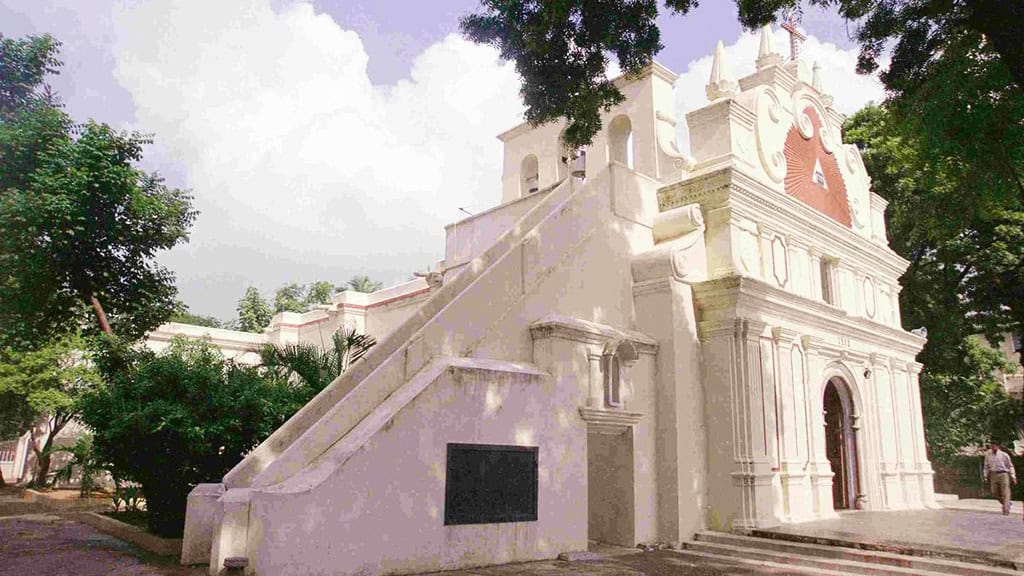
The Luz Church, also known as Kattu Koil, takes its Indian name from the fact that it was once in a dense forest. It still retains its baroque architecture. Photo Credit: The Hindu Archives.
Many men made this road famous. They were the finest products of the age they lived and flourished in. Most of their names too were household words in South India and the parents of young aspirants to fame and merit always mentioned these names as examples and for emulation. Most of them, the older among the lot had died already, but they had left an abiding impression on the manner and life of intellectuals in South India. I had the privilege of getting to know one or two of them in my time.
These men, great lawyers, great judges, great physicians, great administrators as nearly all of them became at some time or other of their lives, gave to Luz Church Road the dignity and individuality it came to have in the last half a century. Each one of them earned great wealth too and did much in his way, to help build a kind of community life.
Having studied under a generation of British educationists and having imbibed the spirit of liberal British institutions and traditions, the outlook of these men was of a Gladstonian quality. They were all believers in British parliamentary government and could not imagine a destiny for India that was not connected with England. To the end of their lives they remained, therefore, staunch supporters of British rule and British traditions. They were not afraid to speak the truth as they saw it and stand for it besides, whether it had to do with a matter or local corruption in municipal administration or Government policy. They said and wrote whatever they wanted to do with a great deal of restraint and dignity. To a man, nearly all of them refused to mix religion with politics or play to the galleries.
Some of them were deeply religious too in their own way and managed to give to their personal lives a spiritual background, making at the same time religion and orthodoxy an intensely personal affair. They scorned loose thinking and were never prepared to make virtue of a necessity. Simple, leading dignified lives, they died as they had lived in a splendour and dignity of their own.
What was the legacy they left to their children and progeny, these men who made Luz Church Road famous? Ask their descendants. They will tell you briefly this – One’s life was not to be fritted away in useless pursuits. One’s life was lived with dignity. There was no compromise between right and wrong. The spirit of human endeavour can never die.
* * *
I left Luz Church Road when I was a small boy. Thirty years later, I happened to pass along that familiar road once again. It was a lovely December evening, lovely and cool. All the old landmarks of my childhood had disappeared. The mellow atmosphere of content and peace I had always associated with Luz Church Road were things of the past. Instead I found a feverish, and what seemed to be perfectly unnecessary too, purposeless activity all along that stately old thoroughfare.
Government transport, as they called those shoddy looking motor vehicles with chattering loads of passengers, rushed along the main road in an undignified manner. Men and women passed along accompanied by sickeningly modern brats. Many of the old, aged bungalows gave way to new dwellings, all uniformly and stubbornly modern, ugly and undignified. Along the road itself from vulgar looking pavement shops blared out the noise and clamour of many full throated singers and performers of the gentle art of music through their respective cheap radio sets. A newspaper kiosk defaced one corner of a once stately mansion. Along its walls were shops where you could get or buy monstrosities of manufacture for six annas. Cinema posters stared you out of countenance, crudely exhibited, vulgarly displayed. Everywhere near the road was an atmosphere of a kind of cheap, shallow middle class life, and its misery, its characteristic low comedy and snobbery. On the porch of another old bungalow, undergoing a process of demolition, once the residence of a famous lawyer, I saw to my horror a bill board. It advertised in baleful letters the fact that it was a lodging and boarding house and that “meals” were ready. The tragedy was complete.
* * *
I think Luz Church Road should be renamed now after a cinema “star” or a politician or a minister. This would be in the fitness of things.
As it is today, I am afraid the Luz Church Road of my boyhood is no more. It is dead. It is a thing of the past. I mourn its passing as I would mourn the passing of some one dear to me.