East-India Companies
Most of us in Madras (Chennai) will be familiar with ‘East-India Company’. Hearing this, I am sure, we will immediately think of the English East-India Company (EEIC) founded in 1600 CE, which totally changed the geo-political complexion of the world. EEIC was a strong, British commercial conglomerate, established long before the concept of corporate companies was known. Thomas Roe and William Hawkins – representing James Charles Stuart, the King of England – met Jahangir (Nur-uddin Mohammad Salim) in Delhi and obtained a firman (royal decree) to establish trade posts (= ‘factories’) in Surat, Ahmedabad, Agra, and Barouch. The singular intent of the EEIC was procuring Indian spices for Britain, although in the next few decades due to poor understanding and co-ordination among the Indian native rulers, gradually EEIC’s hold widened and took control of large parts of the then India through military force, including the use of cannons and gun powder. Their success in winning India was achieved more through cunningness, exploitation, and political manipulations.
Critical will it be to remember that there was a Companhia do commércio da Índia (the Portuguese East-India Company, PEIC), a short-lived (1628–1633) commercial enterprise sponsored by the King of Portugal (Philip III, 1578–1621) to protect the trade interests of Portugal in India vis-à-vis that of the Dutch and English in India. The PEIC desired to control India as a ‘state’ of the Iberian Peninsula (Estado da Índia) but failed; therefore Indian outposts held by the Portuguese came to be seen as Casa da Índia. Another similar trade corporate was the French East-India Company (FEIC) (Compagnie française pour le commerce des Indes orientales), which was floated as a chartered company in 1664 upon the initiative of Louis XIV’s financial adviser and minister Jean-Baptiste Colbert. The FEIC, similar to their Portuguese and English counterparts, were interested in procuring spices, silk, and tea from India and other products from the rest of the East Indies that comprise the islands of Indonesia and nations in the Malay Archipelago. The FEIC stiffly challenged the EEIC and its army, particularly during the administration of Joseph, Marquis Dupleix in Pondichery. My readers know the remainder.
The Danish East-India Company (Det danske Ostindiske Kompagni) of the Danish empire that included parts of the present-day Norway and northern Germany further to Denmark was established by Christian IV in 1616 as a trade organisation in India, re-established and re-named as the Asiatisk Kompagni (Asiatic Company) in 1730. The first trade post was established in Tarangampadi (near Nagapattinam, Tamil Nadu) in 1620. The Dutch East-India Company (Vereenigde Oost-Indische Compagnie, VOC) established themselves first in Pulicat (Pazhaverkadu, Fort Geldria, 54 km from Chennai) in 1610, moved to Nagapattinam in 1690. The VOC maintained trading posts in Surat (Western Coast), further to Ceylon (Sri Lanka).
One other East-India Company, by name the Swedish East-India Company (Svenska Ostindiska Compagniet) was floated in Gothenburg, Sweden in 1731, which operated minimally in India with factories in Surat and Parangipettai (Porto Novo, Tamil Nadu) although their major interest lay with China for tea.
Oostendse Compagnie
I am certain that many of the present-generation Chennaites will be surprised to hear that another less-known East-India Company, named the ‘General Company established in the Austrian Netherlands for Commerce and Navigation in the Indies’ (Algemene Compagnie gevestigd in de Oostenrijkse Nederlanden voor Handel en Navigatie in de Indiën – Dutch; Compagnie générale établie dans les Pays-Bas Autrichiens pour le Commerce et la Navigation aux Indes – French; and shortly ‘Ostend Company’, ‘Oostendse Compagnie’) – an Austria-chartered corporate entity from Southern Netherlands (i.e., the present-day Belgium, Luxembourg, and some parts of the Netherlands) operated in India for close to 15 years (1715–1732). It held the name the ‘Ostend Company’, because it was first established in Ostend, a port town (presently, a major port-city) of the Southern Netherlands (Fig. 1). Ostend is presently a part of West Flanders, Belgium.
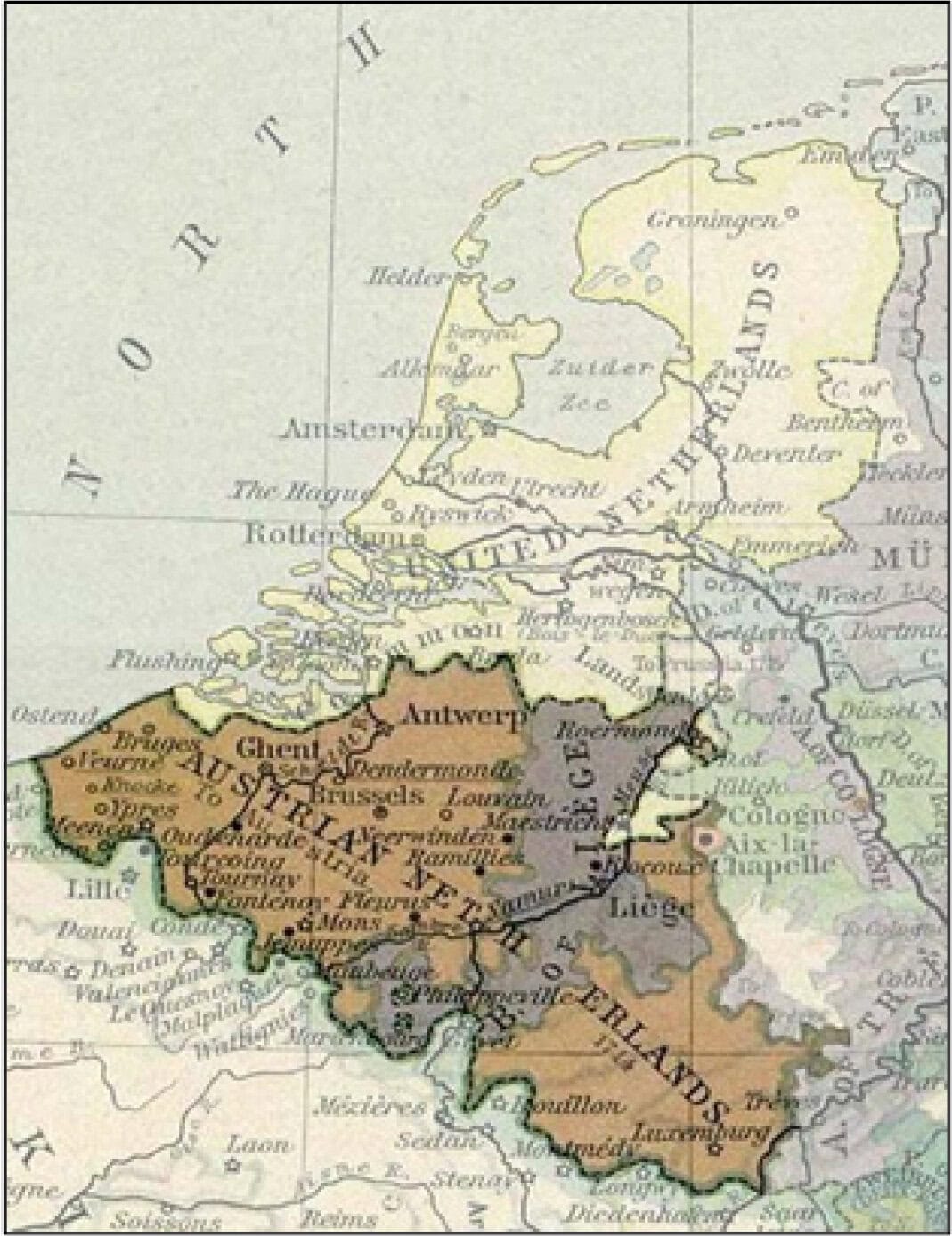
Fig. 1. Southern Netherlands (= the Austrian Netherlands), c. 1786. The coastal town of Ostend (blue arrow). (Source: https://commons.wikimedia.org/wiki/File: Southern_ Netherlands_map_003. jpg.)
The Oostendse Compagnie used large sea-crafts for a profitable textile and tea trade with Bengal and China, respectively. Their boats flew a standard featuring a sprawling double-head eagle in a yellow background with a centrally placed imperial Austrian flag as their company banner. The Oostendse Compagnie’s naval fleet included about 20 vessels, most of them heavily armed: e.g., the Empress Elisabeth (28 guns) and the Prince-Eugène (26 guns). Initially the Oostendse Compagnie sailed light (200–250 t) ships but in later times they used 600 t vessels. Their primary interest lay in Chinese tea – similar to the interests of the Swedish East-India Company – yet the Oostendse Compagnie established factories Bankipur (Bengal) and Cabelon (Kovalam on the Coromandel, close to Madras) to procure Indian products. We understand that the Oostendse Compagnie’s factory survived in Bankipur until 1745, but that in Cabelon was shut down earlier.
Why Cabelon
Unverifiable Internet sites indicate that during early days when the Oostendse Compagnie settled in Cabelon, they utilised a pre-existing ‘primordial’ structure as their factory. What the ‘primordial’ structure means is unclear. Most likely it must have been a structure similar to what existed in other 18th-century European trading posts in India, most likely crude but protected warehouses and temporary thatch-roof shed accommodation for their staff. Cabelon was a main trading post in 1724–1727. The Cabelon site enabled the Oostendse Compagnie’s staff to gain an easy entry into the Indian spice and textile markets.
The principal reason for the choice of Cabelon by the Oostendse Compagnie was its strategic location. Cabelon occurs at about 40 km south of Madras (now, Chennai) then occupied and commercially promoted by the Portuguese and English. Cabelon is also reasonably close to Pondicherry (c. 130 km), another commercial centre because of the French. The Cabelon landscape, positioned between Madras and Pondichery, in the perception of the administrators’ of the Oostendse Compagnie pitched it in a trade stronghold. Further and most likely the Cabelon stretch occupied by them was no man’s land, neither claimed by the British towards Madras nor claimed by the French towards Pondichery. Most importantly, being right on the coast, it substantially supported the Oostendse Compagnie’s broader goals of engaging in trade with Bengal and South-Asian and South-east Asian nations.
Between 1715 and 1720, several boats sailed from Ostend (Southern Netherlands) to China, Malabar, Coromandel coast (viz., Cabelon), Surat, and Bengal (Bankipur). These expeditions were funded by private companies, other than the Oostendse Compagnie, and owned by Flemish, English, Dutch, and French merchants and bankers. Frequent quarrels among the share-holding merchants and bankers on the profits triggered the formation of Oostendse Compagnie as a renewed effort. The capital funds ploughed into the newly established Oostendse Compagnie was 6,000,000 Dutch Guilders. Wealthy residents of Antwerp and Ghent (in modern Belgium) mostly bought shares.
The Southern Netherlands (a.k.a. the Catholic Netherlands) were a part of the Holy-Roman Empire, controlled by the Austrian Habsburgs until 1794, when the Revolutionary France annexed this landscape. The Austrian Habsburgs (for details see https://historycooperative.org/austrian-royal-family-tree/ accessed on 5 February 2026) controlled this segment of Europe (presently Belgium, Luxembourg, and some of the Netherlands) in 1714–1794 with the enforcement of the Treaty of Rastatt. Social upheavals resisting a six-percent tax levied on products sold by the Oostendse Compagnie and its consequent advantageous effect on its English and Dutch competitors, prompted this Company to procure products from overseas: the Oostendse Compagnie first considered products from India and China. Austrian King Charles VI funded for the development of infrastructure, via a loan, in Indian trading posts Bankipur and Cabelon. Thus the trading posts in India were established. However, by 1727, the Dutch and the English pushed for the abolition of the company. In 1727, negotiations occurred and the ban gradually took full effect in 1731, closing the Oostendse Compagnie for good: therefore, the Cabelon and Bankipur posts were shut down.
Conclusion
Tragically little is known about the Oostendse Compagnie in India, especially their operations in Cabelon (Kovalam), matching with what how little we know of the Swedish East-India Company and its operations in Parangipettai. We need to explore the details more to know whether any remnants of these companies occur in Kovalam and Parangipettai. Exciting and fascinating research opportunities for young amateur and professional historians lie buried in the context of the trade efforts of Oostendse Compagnie and Swedish East-India Company in Kovalam and Parangipettai, respectively.
— by Anantanarayanan Raman, anant@raman.id.au