It was the year 1957 when I first watched Kamala’s dance in a wedding concert at Calicut. I was swept away by the sheer beauty and joy of my first encounter, which was like a darshan. I had been learning Bharatanatyam and was familiar with the fundamentals of nritta and abhinaya. This was like immersing in Shakespeare and the romantic poets immediately after learning the rudiments of the language from Wren & Martin.
Kamala struck an immediate friendship with my mother Ananthalakshmi Sadagopan, an acclaimed musician and visited our home the very next day. Thereupon grew my infatuation with her unique art which made me eventually write her first biography for the Sruti magazine in 1988. She invited my mother to sing for her on her tour of Ceylon in 1969.We spent a week in Madras to learn the new songs we had to sing for her and her sister Rhadha. Kamala sang all the songs as my mother notated and taught me. Her rehearsals would last about four to five hours at a stretch with her Guru and orchestra. Swamimalai SK Rajaratnam and Kallidaikurichi KR Radhakrishnan sang for the first half with alarippu, jatisvaram, sabdam and varnam. Amma and I took over for the second half, including the short dance dramas of Andal and Aichiyar Kuravai choreographed by her Guru, the lion among natyacharyas, the Natya Kala Kesari Vazhuvoor Ramiah Pillai. The male duo would return for the tillana.
Some of the songs we sang for her were Oothukadu Venkata Subbier’s Paal vadiyum mugam, Bharathi’s Teeratha vilaiyaattu pillai, Kalki’s Malai pozhudinile, Natanam aadinar, Papanasam Sivan’s Ka va va, etc. These were some of the songs introduced to the Bharatanatyam repertoire by her Guru. Unlike today when dancers are forced to do the entire concert lasting about 90 minutes in the same sweat soaked costume, Kamala and Rhadha changed costumes several times with the backstage help of their versatile mother Rajam. Every entry on stage brought forth a gasp of admiration as they stood in the spotlight at the entry point from the wings. Rhadha was transformed into a mischievous Krishna or a vivacious Kurathi in a matter of minutes under the expert hands of her mother. There was no time lapse between items except for the 15 minutes interval. The total duration would be between two-and-a-half hours to three hours. And the audience stayed till the mangalam and hovered around to meet the dancers. They performed to packed auditoriums at all the venues in Ceylon.
During the December season, Kamala performed at Music Academy, Tamil Isai Sangam and Indian Fine Arts Society, each a houseful show year after year. People stood in a queue at 6 am at the Music Academy to buy tickets for Kamala’s concert that evening. Remaining at the top for four decades, Kamala was synonymous with Bharatanatyam. She carried her art to all parts of India and all over the globe.
Around 1967 I witnessed Kamala performing the entire Ramayanam as solo presentation, to Svati Thirunal’s Bhavayami Raghuramam. She just swept the audience off their feet. Many were in tears. The entire panorama of characters appeared in the twinkling of an eye and lived and breathed on the stage. This was choreographed by Kamala soon after she had parted ways with her Guru and it turned out to be a landmark innovation as the first solo Bharatanatyam dance drama. Leela Venkataraman who spoke on the occasion extolled the pristine purity of Kamala’s art and described it in superlatives.
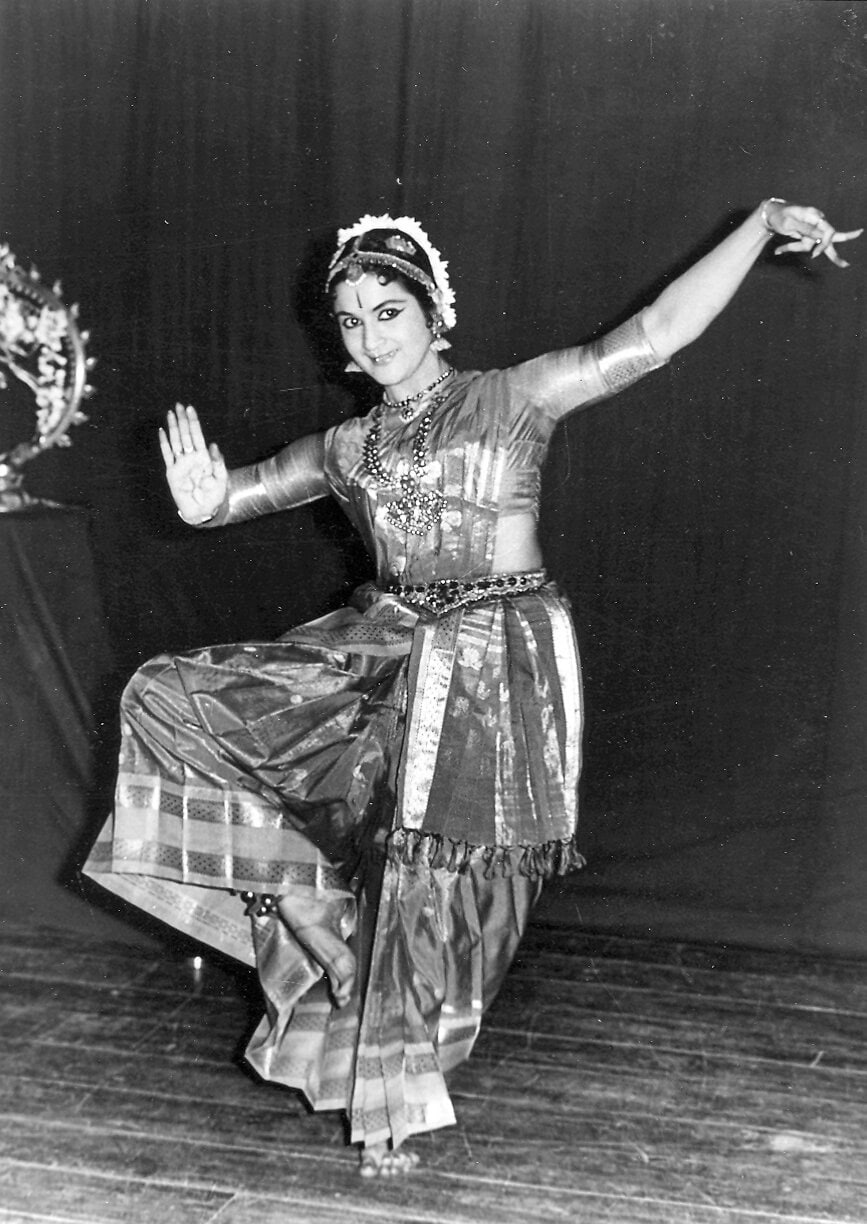
I continued my acquaintance with her after I settled down in Madras in 1969 and had occasions when I sang for a couple of her performances. Her search for new compositions remained fresh as ever. I found her teaching the theory of Bharatanatyam to her students, which was a new practice. She had also appointed a Sanskrit pundit to teach the language and verses to them.
When N. Pattabhi Raman, editor of Sruti asked whether I would do a profile of Kamala, I took it up with joy. She was happy to talk, recounting her early memories from the time when she was a three-year-old. For an artist of her eminence, she had a pitifully small collection of photographs, mostly black and white, haphazardly stored in envelopes and in a couple of old albums. Hardly any pamphlets or programme notices. “For a while my father tried keeping a record of my programmes and photos, but then he gave up when the programmes became too many,” she said. She gave details of her performances, memorable events, bitter experiences and tried to recollect her vast repertoire. Over a period of two years, I interviewed more than a hundred people, her musicians, friends, relatives, other dancers, rasikas, etc. Invariably their faces would light up when I mentioned her name and they poured forth all their experiences with her and their admiration for her art. “An article on Kamala? A whole book can be written about her” was the spontaneous reaction of her Guru Vazhuvoor Ramiah Pillai.
Sruti carried her profile in two issues and released the first one at the Landmark bookstore. Ramiah Pillai came eagerly despite his advanced age. As we were ascending the stairs from the basement shop after the function, a young girl rushed in and introduced herself as the reporter from a famous Tamil weekly. I stayed behind to give her some highlights. “Who is Kamala? Was she a film star?” queried the greenhorn. It came as a rude shock to me that the magazine which carried Kamala’s dance photos year after year in their special Deepavali issues would send a reporter who knew nothing about the art or the artist!
As new and younger dancers entered the field of Bharatanatyam, Kamala sensed that she was being sidelined. There had always been a lobby that tried to describe her dance and her Guru’s tradition as neo classic in a derogatory sense. One could find a parallel with the advent of GN Balasubramaniam in the field of Carnatic music. Some critics and opinion makers of those days did not know what to make of the phenomenon and tried to put him down until the GNB bani established itself and became the inspiration for future generations.
As long as Kamala was performing in India, all criticism against the Vazhuvoor bani, were rendered invalid. Her art was her vindication. Once she migrated to USA and many of her disciples moved to other Gurus, her name was slowly getting forgotten. She did come back a couple of times and perform with the same verve and vigour. Once after her performance at the auditorium of the Academy, I found several dancers in clusters sharing their awe and admiration of this legend whom they were witnessing for the first time. A senior dancer pronounced “Kamala is an all-time great.”
So she was, enriching the art which was her life’s breath. To her rasikas the greatest regret is that there is no recording of her performances at her prime. To them it was a boon and a blessing to have been her contemporary. The aura of her era will hold them in its spell for a lifetime.