And so, yet another Madras Day has come to a close, though at the time of writing, events are still on at a few places. What began as a day’s celebration in 2004 has grown extensively and has graduated from being Madras Day to Madras Week and now, a Madras Month. With officialdom too recognising the occasion over the last few years (with special messages from the Chief Minister and his immediate predecessor), it has moved out of the “why-should-we-celebrate-our-colonial past” question and has acquired a different dimension. While it is heartening to see the growth in the scale of celebrations, there is scope for some reflection on how it can be made better, especially as it moves towards its silver jubilee.
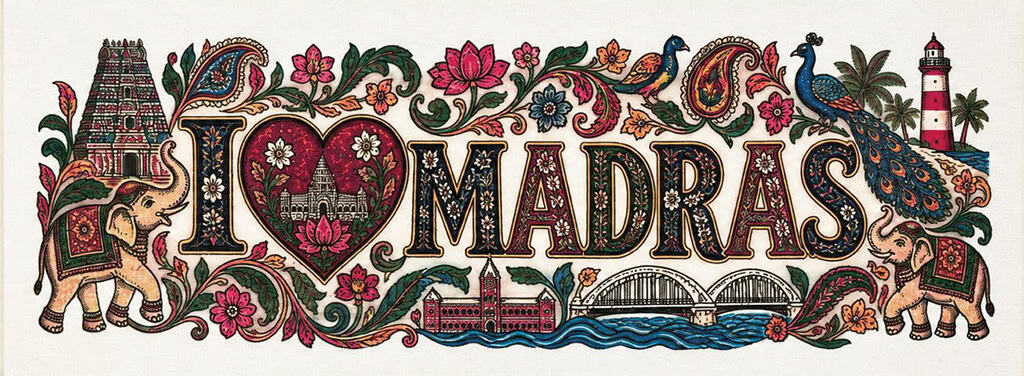
This I Love Madras artwork is an example of Karuppur Kalamkriya and was produced by the Tamil Nadu Handicrafts Corporation specially for Madras Day.
History has shown us that when a city grows, it is inevitably skewed in favour of the newer parts, with the older ones which have been the nucleus being left out in terms of development. The way the Madras Day celebrations have unfolded too has largely mirrored this pattern, with events being concentrated in venues across the southern and central parts of the city. While it must be acknowledged that awareness of the origins and the contribution of the oldest part of the city – the north, to its development is much better today than what it was when the concept of Madras Day was first thought of, it remains a matter of concern that there have been no consistent attempts at making them an integral part of the celebrations. While the concept of Madras Day celebration itself is purely a voluntary exercise, there must be a dedicated effort to encourage more institutions, schools and establishments based in North Chennai to showcase and celebrate their heritage. The Department of Tourism has in the recent past taken a special interest in the celebrations, and maybe to ignite young minds, they can think of organising special visits for school children regularly to various heritage buildings across the city and get them to learn about their history!
Over the years, the concept of Madras Day itself has metamorphosed from being a commemoration of the founding of the city to a celebration of its ethos and its spirit, as these columns noted a couple of years ago (MM, Aug 16-31, 2024). Social media has played an important role in this transition. However, a question that needs some introspection is, has the focus shifted away too much? While the transition and the variety of events have certainly brought to the fore aspects of the city’s growth as it constantly evolves, how much have the celebrations actually inspired dedicated individualistic efforts to learn of its historic past, of people, institutions and events that have shaped it and brought to light new findings? It is important to recognise that the concept itself was initially designed as a means to encourage people to learn more about our past, and losing sight of this would mean a body blow to that very purpose.
Another aspect of the celebrations that has been debated and commented upon in the past is that they largely cater to a niche, restricted audience, with almost the same set of participants seen at every event. Unfortunately, there has been little progress on expanding the audience base over the years. For this to change, there certainly needs to be more effort at the community level, for people to take ownership of conceptualising and organising events in their own way. Since the last time these columns wrote about this (MM, Aug 16-31, 2019), sporadic attempts have been made, but for the celebrations to be broad-based, there needs to be continuity. There is certainly no dearth of content to work with and all it requires is a constant, dedicated effort to keep the attempt going.
For all its laidback and conservative outlook, our city has been adept at constantly adapting to change, while ensuring that its roots to tradition and history are firmly in place. May this spirit continue to guide the celebrations in the years to come.
I think that the architects of the Madras Day celebrations should bask in the glow of a successful celebration. Flushed with pictures and a couple of articles, the September 1-15 issue is part testimony that the city came together to celebrate life in Madras, Chennai, call it what you will. I agree with Karthik Bhatt that the celebrations could be more widespread. I myself enjoyed my recent visit to two temples in Thiruvottriyur. More recently, I drove through narrow lanes of Kosapet to see the grandeur of Vigneshwara(s), the Remover of Obstacles. The place was originally called Kuyavar Pettai which means “Potter’s Locality”. In conclusion I would like to say that the multitude celebrate the city in their own way in their own time.