Vanishing Wall Posters
I read with interest your observation that the incidence of wall posters has come down under the present regime. I must however confess that I seem to be seeing a different Chennai.
A walk through many of our neighbourhoods reveals walls still covered with posters marking birthdays, extending greetings, offering congratulations, and celebrating every conceivable political occasion. If this is evidence of a decline, one wonders what abundance looked like!
The walls, it appears, have not received the memo that poster culture is on the wane. They continue to serve as free public notice boards for political enthusiasm, much to the detriment of the city’s appearance.
Perhaps the reduction exists only in statistics. To the ordinary resident, however, the visual evidence suggests that the tradition of plastering public walls is alive and well.
It would be refreshing if the same zeal displayed in putting up posters was channeled into keeping our public spaces clean. Until then, reports of the demise of wall posters seem rather optimistic.
Vinithra Anandh
vinithra.anandh@icloud.com
In Praise of Simplicity: A Visit to the Wallajah Mosque
Some buildings make an impression the moment you see them. Others take their time, revealing themselves slowly, almost as if they expect you to do a little work. The Wallajah Mosque belongs, quite firmly, to the second kind.
I arrived there as part of a study trip, armed with a notebook and the vague confidence that I knew how to “observe architecture”. It took only a few minutes to realise that the building was far more composed than I was.
Built in 1795 under the patronage of the Nawab of Arcot, the mosque carries a distinction that does not announce itself – it has been constructed without the use of wood or metal. One does not notice this immediately. But once known, it alters the experience of the space. The simplicity begins to feel intentional, the restraint quietly exacting. The entrance opens into an open courtyard that performs the architectural equivalent of a pause. There is no abrupt shift, no dramatic threshold. Instead, the space allows one to arrive gradually, easing into its rhythm without insistence.
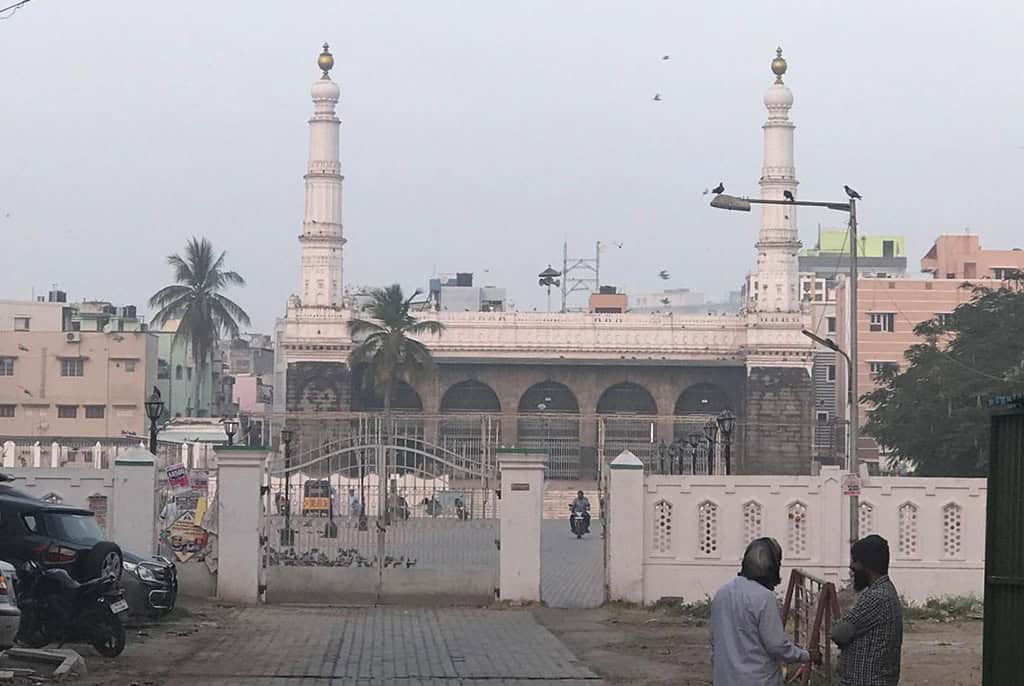
From here, the structure resolves into the covered prayer hall. The first impression is one of balance. The proportions are carefully measured, the arches understated, and the surfaces free of distraction. There is no attempt to impress through ornament. Instead, the design relies on clarity – on getting things right rather than elaborate.
At the far end lies the mihrab, indicating the direction of the Kaaba. Architecturally modest, it is nevertheless the organising centre of the space. Everything aligns towards it. There are no instructions, no markers – just a quiet, unwavering sense of direction embedded within the design. Nearby stands the mimbar, functional and unobtrusive. The minarets, rising above, do not compete for attention. They complete the structure without dominating it. Indeed, nothing here appears eager to be noticed.
What is most striking, perhaps, is what the mosque chooses not to engage through depiction; instead, it holds space with discipline. Geometry and proportion take precedence, creating an environment where the eye is guided rather than overwhelmed.
The layout suggests a shared rhythm. The uninterrupted expanse of the floor, the clarity of sightlines, and the openness of the hall all point towards gathering and alignment. Even in stillness, the space feels prepared – as though it carries within it the memory of collective presence.
At some point during the visit, I became aware of my own footsteps – slightly hurried, faintly out of step with the calm precision around me. It is not often that a building alters one’s pace without instruction. Here, it happens quietly, almost naturally.
As study trips go, this one offered more than expected. I arrived intending to observe. I left having adjusted – just a little – to the measured order of the space. The Wallajah Mosque does not attempt to impress or overwhelm. It simply holds its ground, in clean lines and quiet alignment.
And perhaps that is its most lasting impression: not grandeur, but clarity. Not display, but discipline. The kind that stays with you, long after you have left.
– Priyanka Soman
Rediscovering the Neighbourhood
The Thiru-Vi-Ka Park in Shenoy Nagar has been a binding force for its residents. In its recent history, residents came together to see that the park was restored after the underground Metro was commissioned there. At 5 pm on the last Sunday of June this year, about 80 residents (men, women and children) grouped into 23 teams there to set off on a quest of rediscovery of their neighbourhood. Wearing customised caps, they were spotted trooping purposefully through its streets with chits of paper, cracking stimulating clues. One of them went like this: “A word for a grand house or building (not in English), add a word that means pure joy or bliss (not in English), add the South Chennai neighbourhood home to the famous Theosophical Society. Once you have found the answers to the 3 clues, reverse the sequence and rush there to get your next clue.” If you are still puzzled, the answer is ‘Adyar Ananda Bhavan’ which has a small outlet outside the Thiru-Vi-Ka Park-cum-metro station. Each team had a set of six clues to decode leading to different landmarks. In all there were 20 clues to 16 locations. All the participants traversing the five routes completed and congregated at the Chintamani Vinayakar temple. Prizes were given, snacks enjoyed, friends were made and of course the community was strengthened.
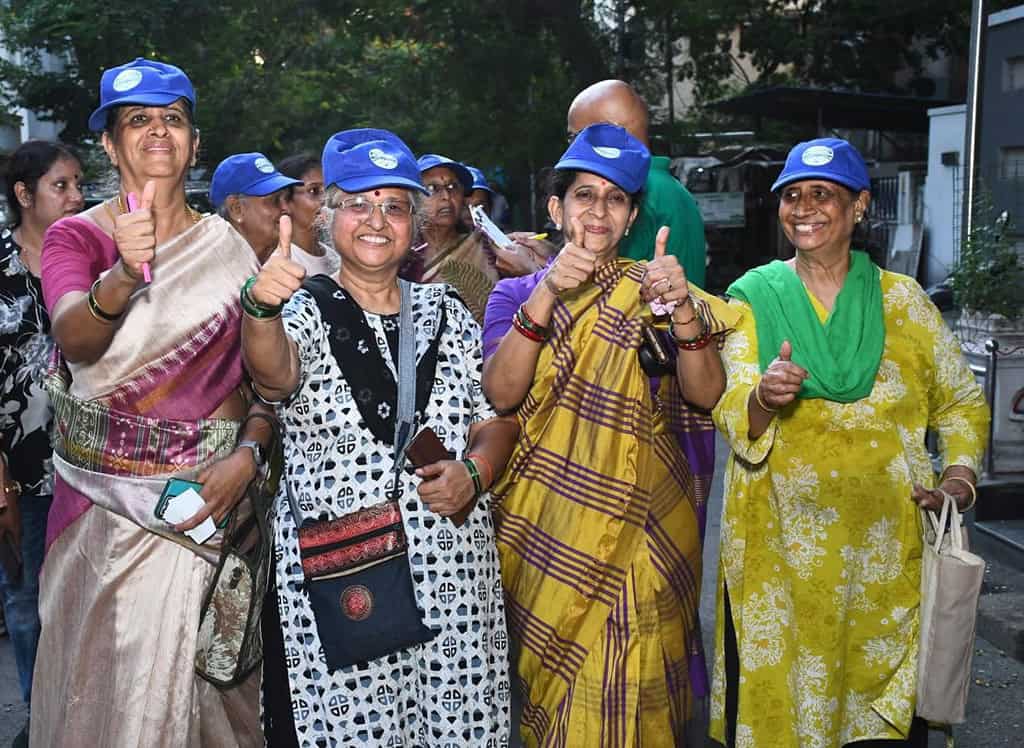
There were prizes for senior citizens, women and children. The prize for the ‘Best Team Name’ went to not Sherlock Holmes but ‘Shenoy Holmes’. A gift shop (Dyuti), a jeweller (Sri Chamundi), a gym (The Crew) and a food store (Bhavani Essence) – all local businesses, were the sponsors and Shweta, Thrivikram, Shrinika and Aashritaa of the Mukkala family, Sivakumar Selvarajan, Chinni Krishnan and M.E. Thyagarajan the organisers. There were 20 volunteers helping at the event.
T.K. Srinivas Chari
srinivaschar@gmail.com