Milestone birthdays often become points of reflection for artists, moments to assess what has been built and what still urges to be created. For Chitra Visweswaran, one of India’s most influential and intellectually rigorous Bharatanatyam artists, her 75th year is not a retrospective curtain call. Instead, it is a vibrant, searching, celebration of a practice that continues to evolve with clarity, courage, and curiosity.
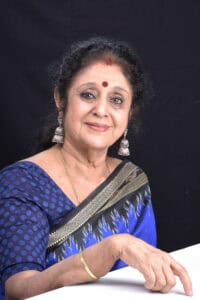
Chitra Visweswaran.
Dance Unbound, comprising the exhibition What Anchored Me Made Me Fly and the performance Panchali, offered audiences an intimate encounter with the artist’s world: her memories, tools, questions, and the restless imagination that has defined her journey. The event was not simply a tribute; it was an unfolding, a way of stepping into the texture of a life shaped by discipline and devotion, yet always reaching for new interpretations.
The exhibition at Alliance Francaise, was curated by Bhooma Padmanabhan. The title perfectly encapsulated the forces shaping Chitra Visweswaran’s artistic philosophy. Anchors – lineage, training, mentors, practice, ground her. But these very anchors also launched her into new terrain. This duality guided the curatorial approach, which sidestepped linear biography in favour of a constellation-like display of images, objects, notes, and video fragments.
The first gallery introduced the visitor to a series of striking black-and-white photographs. They captured the dancer not in grand poses but in moments of transition – the micro-pauses that define breath, intention, and the quiet intelligence behind movement. These were not decorative images; they were evidence of process. They revealed how a dancer thinks with the body, how gesture becomes text.
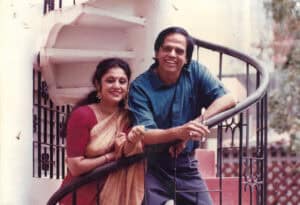
Chitra with her husband R. Visweswaran.
The pedagogy-focused section of the exhibition was perhaps its emotional centre. Photographs of teaching moments captured intimate exchanges: a hand adjusting a mudra, a quiet correction of footwork, a shared glance of recognition, between teacher and student. These images underscored how Visweswaran’s legacy is not simply housed in her performances but lives in the bodies of the many dancers she has guided. Archival video of performances further demonstrated her clarity as a teacher, her insistence on integrity of line, emotional truth, and the ethical responsibility of performance.
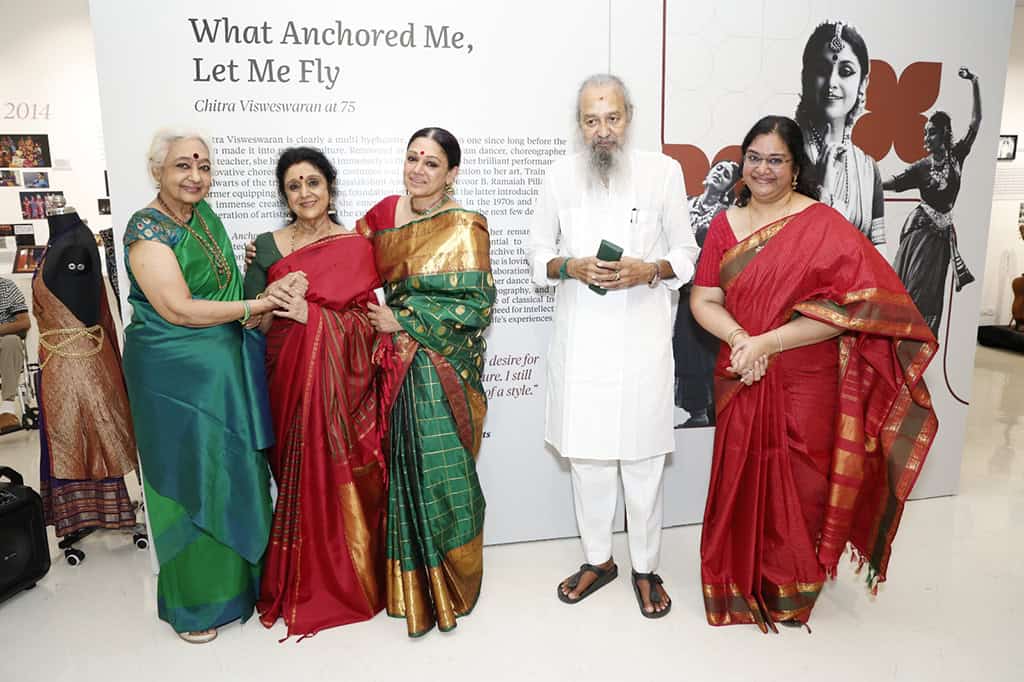
Sudharani Raghupathy, Chitra Visweswaran, Shobana, Thota Tharani and Sukanya Ravindhar at the inauguration of the exhibition.
Another space displayed costume fragments and jewellery. Some pieces were worn and frayed, accompanied by brief stories about how they shaped or were shaped by the choreography. Rather than presenting them as relics, the exhibition positioned them as tools, objects that influence movement, weight, balance, and silhouette. These displays illuminated her sensitivity to how material culture interacts with dance vocabulary.
Piecing together the exhibition felt like entering an active studio rather than a memorial archive. Sound installations featuring interviews, reflections from collaborators, and excerpts from reviews added layers of context. They reminded viewers that an artist’s journey is shaped by communities of musicians, designers, critics, institutions, and, crucially, students.
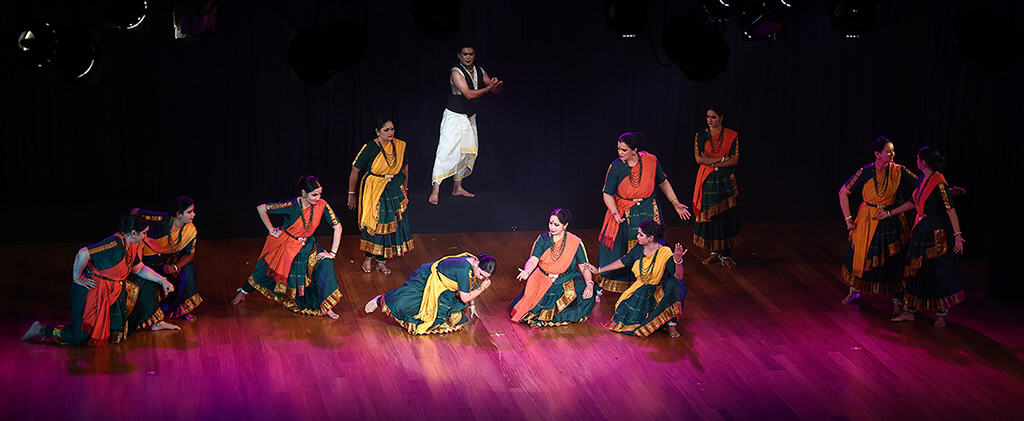
A scene from Panchali.
A particularly compelling corner displayed press clippings over the years and her being featured in covers of several magazines. The final wall was perhaps the most poignant, bridging the past and the future, where her life’s work, her bani,was given a name “Vichitra Bani” thus giving us a legacy to follow. This closed the loop: even at 75, Chitra Visweswaran’s creative engine remains restless and alive. What Anchored Me Made Me Fly ultimately framed her career not as a series of finished works but as an ongoing inquiry, one that continues to expand.
Panchali was a retelling rooted in power, vulnerability, and poetic imagination. If the exhibition gave us the scaffolding of the artist, Panchali gave us her dramatic heart. The performance re-centered Draupadi from the Mahabharata, not as a distant epic heroine but as a woman negotiating humiliation, desire, rage, and dignity within patriarchal and political systems. The choreography held the tension between classicism and contemporary resonance, making the piece both timeless and urgent.
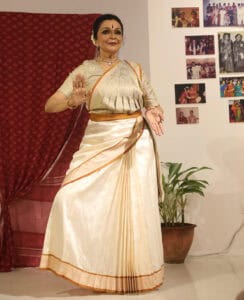
Anita Ratnam performing at the exhibition.
Chitra Visweswaran’s deep grounding in Bharatanatyam technique guided Panchali – clean lines, rich abhinaya, and intricate rhythmic phrasing. Yet the choreography expanded beyond tradition, incorporating theatrical stillness, spatial asymmetry, and gestures shaped by psychological nuance rather than narrative literalness. This layering created a Draupadi who was both myth and woman – an archetype and an intimate self.
Lighting and costume extended the dramaturgy. Rather than imitating period attire, the design abstracted certain elements, allowing for expressive freedom. Pools of light framed Draupadi alternately as solitary and as exposed – a visual metaphor for her shifting agency. The stage became a psychological arena: a place where emotion transformed into architecture.
This tension echoed Chitra Visweswaran’s long-standing interest in reinterpreting classical material not by dismantling its grammar but by excavating its emotional and ethical depths. In Panchali, technique served thought; thought served emotion; emotion served truth. The performance was directed by Sukanya Ravindhar and Anusuya Ghosh Banerjee and performed by four generations of students of Chitra Visweswaran. It was staged at Kalakshetra on October 12, Chitra Visweswaran’s 75th birthday.
Practice, pedagogy, and translation are the triad of Chitra Visweswaran’s legacy. Throughout Dance Unbound, one theme emerged consistently: the inseparability of practice and pedagogy. Chitra Visweswaran has shaped generations of dancers through her disciplined, intellectually engaged method of teaching. In the context of the exhibition and performance, this became evident not only in the archival material but also in the presence of younger artists who reflected her influence. Their clarity of technique and freshness of interpretation suggested a lineage built not on imitation but on inquiry.
This is perhaps the most significant thread in her legacy: a commitment to translating classical idioms for the present without diluting their rigour. Her dancers learn both the grammar and the spirit of the form. They inherit tools, not templates.
Dance Unbound illuminated this beautifully. The exhibition offered the blueprint; Panchali demonstrated the architecture.
A celebration of a senior artist often risks drifting into nostalgia or turning the artist into an unreachable icon. Dance Unbound avoided both. It centred curiosity over sentiment, making clear that Chitra Visweswaran’s artistic journey is still unfolding. The event invited audiences to reflect on the ecosystem of classical dance, how it relies on mentorship, experimentation, critical engagement, and structures of support.
For many viewers, the event prompted deeper questions: What does it mean to sustain a practice for seven decades? What must be preserved, and what must evolve? How do dancers carry forward the vision of their teachers while forging paths of their own?
In this sense, the celebration was not only for Chitra Visweswaran but also for the community that continues to uphold, challenge, and reimagine the classical arts.
Leaving the event, the audience carried with them the intertwined images of What Anchored Me Made Me Fly and Panchali – the candid rehearsal notes, the textured soundscape, the intense emotional landscapes, the lines of students absorbing and transforming knowledge. Together, they offered a portrait of an artist who has spent her life negotiating between discipline and imagination, tradition and innovation, anchoring and flight.
At 75, Chitra Visweswaran stands not at a culmination but at a threshold, still questioning, still creating, still finding new ways to make dance a language capacious enough to hold memory, myth, critique, and desire.
Dance Unbound was ultimately a reminder that legacy is not something inherited passively; it is something lived, shaped, and continually expanded. In celebrating her, we celebrate the enduring and ever-evolving possibilities of the classical arts themselves.
— by Sukanya Ravindhar & Shreya Nagarajan Singh. Pics: BRS Sreenag, Sathya, and Iyappan.