This being the 250th year of birth of Muthuswami Dikshitar the Carnatic composer, we bring extracts from an ongoing series that is being written by me in the classical arts magazine Sruti. This is to celebrate the December Music Season, the 250th year of Dikshitar, and the role our city played in his growth as a composer.
– Sriram V
The Vaggeyakarula Charitramu (VC) of Subbarama Dikshitar in the Sangita Sampradaya Pradarsini (SSP), 1904, is clear that it was the dubash Manali Muthukrishna Mudali who brought the Dikshitar family to Madras. In his critical introduction and notes to the undated and anonymous work Sarva Deva Vilasa (SDV), Dr V Raghavan has written based on his independent research that Muthukrishna Mudali died in 1792. This helps us establish that the Dikshitar family moved to Madras prior to this year. Even if we assume that the shift happened only that year, we can see that Muthuswami Dikshitar would have been around 17, and his youngest brother, Balaswami, just six. After Muthukrishna Mudali’s passing, his son Venkatakrishna aka Chinnayya Mudali took over the administration of the estates and patronage of musicians. From the fact that Ramaswami Dikshitar uses the mudra Venkatakrishna in several of his songs and has none dedicated to Muthukrishna Mudali, we can assume that the majority of the years in Manali patronage were with the son and not the father.
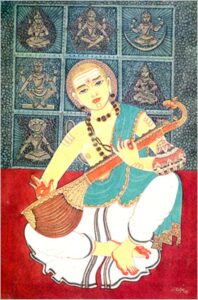
Muthuswami Dikshitar. Painting by S. Rajam.
Where did the Dikshitars live while in Madras? The VC gives no clues. Further details emerge from Bharanidharan’s book Dikshitar Padiya Thiruttalangal (Kalaignan Pathippagam, 1988). This was the compilation of a series he wrote under the same title in the 1970s for Ananda Vikatan. As part of his research, Bharanidharan met with Ramakrishna Mudaliar, a descendant of the Manali family and the latter confirmed to him that the Dikshitar family was accommodated at No 63, Sannidhi Street, Tiruvottriyur.
This seems logical given that that village had a temple for Shiva that was in many ways similar to Tiruvarur. Sundaramurthy Nayanar, a subject of one of Muthuswami Dikshitar’s compositions (Sundaramurtim Ashrayami, Takka/Rupaka) was closely associated with both shrines, having a consort at each with Lord Shiva playing a key role in the respective unions. The main deity in both places is an anthill and the processional icon is Tyagesa. The Dikshitars may have therefore opted to stay at Tiruvottriyur. Outside of the SSP is the kriti Adipuriswaram (Arabhi/Adi), attributed to Muthuswami Dikshitar, dedicated to the deity at this shrine. It however suffers from prosodical weaknesses.
We also know for sure of two other locations that the Manali family was associated with and which the Dikshitars must have visited. The details of the first are from Bharanidharan. He went to Manali as part of his quest and there at one end of Tiruvalluvar Salai First Street, he was taken to a vast compound in which a ruined building and a derelict swimming pool replete with ornate tiles stood. This was Meddai Thottam, the Manali residence of the Mudaliars. Today all of this has vanished without a trace. The other was Manali House on Govindappa Naicken Street. A double-storied classical building with an arched frontage, this survived till the 2000s and was then demolished to make way for a parking lot.
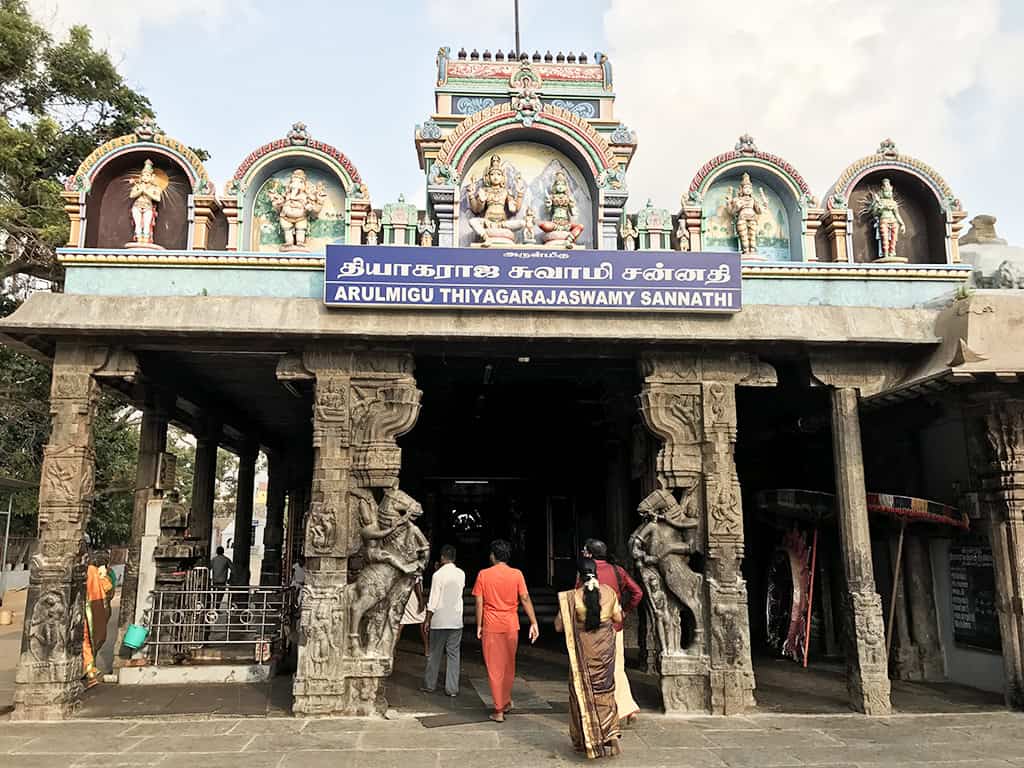
Entrance to the Tyagesa sanctum, Tiruvottriyur.
Reverting to the SDV, we read of how the dubashes of that era had musicians and dancers in their retinue. The Dikshitars were clearly the Manali Mudali family’s musicians. But there were other itinerant scholars and musicians who called and were rewarded after a test of their abilities. We know that when Arunachala Kavi completed his Rama Natakam, Muthukrishna Mudali was one of the patrons he called on to present his work. That was long before the Dikshitars came here. He was richly compensated. Likewise, another visitor was Govinda Dikshita, a great-grandson of the 17th century scholar Venkatamakhin whose Chaturdandi Prakasika (CDP) was a work of importance for Ramaswami Dikshitar. Subbarama Dikshitar gives two conflicting versions of what happened next. As per the first, given in the VC, realising that the visitor had with him a manuscript of the CDP and other works, Venkatakrishna Mudaliar expressed a desire to see them. The visitor decided to test if the patron was worthy of this. He gave a murchana in a raga, and asked for it to be identified. Ramaswami Dikshitar immediately composed a pada, Nannu Parikshinchanela in that raga, which was Tanukirti, incorporated the murchana in it and making it out as if Venkatakrishna Mudaliar had composed it, got his sons Chinnaswami and Balaswami to perform it.
The other version, given under the section of Tanukirti in the SSP, has it that it was Ramaswami Dikshitar who got Venkatakrishna Mudaliar to request for the treatises. And when challenged, Mudaliar, who in this account “was a scholar in musical literature and other branches of knowledge,” composed this pada and Ramaswami Dikshitar, along with Chinnaswami and Balaswami, performed it.
The outcome was the same however – Govinda Dikshita was delighted. He recognised that the composer (whoever it was) was from the Venkatamakhi tradition and parted with the treatises. In later years, these would become the mainstay of Muthuswami Dikshitar’s composing style and also be the musical wealth of the Dikshitar family. It is interesting to note that Muthuswami Dikshitar had no role to play in this incident.
The Sarva Deva Vilasa
Another day, another visitor, equally distinguished. The SDV says that Sonti Venkataramanayya, son of Sonti Venkatasubba was escorted on an elephant by the Dubash Kalingaraya to a sadas in Tirunirmalai. We all know that Venkataramanayya was the guru of Tyagaraja. His father too seems to have been a familiar figure in Madras circles. And he too called on Manali Venkatakrishna Mudali. On this occasion, Venkasubba played gita and tanam in Takka raga and said it was his family property. This time, the reply came from young Balaswami who immediately sang the piece Aramajhja Aparadha (attributed to Venkatamakhin in the SSP) in the same raga, in Jhampa Tala. He was rewarded with a pearl necklace and pair of shawls. The composition is given in the SSP.
The association with Venkatakrishna Mudali was musically very propitious. It was he who arranged for an Englishman to teach young Balaswami the fiddle. Soon the latter had become an expert and pleased his patron and other connoisseurs by performing English and Indian music on it. Could this statement, as given in the VC in the portion pertaining to Balaswami’s life, hold the secret to Muthuswami Dikshitar’s Nottuswara sahityam-s?
Both Ramaswami Dikshitar and Venkatakrishna Mudali died the same year – 1817. Their association seems to have been very close, and apart from using his patron’s name as mudra, Ramaswami Dikshitar also honoured him with what is today recognised as the longest composition in Carnatic Music – a 108 ragatalamalika. Natakadi Vidyala, available in the SSP and having only 60 ragas and talas is said to be this piece, with several sections missing. In what is printed too, among the talas, the details of five are not available and Subbarama Dikshitar says they need to be sung as cycles of Adi Tala. What is not clear is whether there were 48 other ragas in this composition or whether it did end the way it does now. A more recent query that has been raised by Dr RS Jayalakshmi is whether this ragatalamalika is entirely different from the 108 ragatalamalika that Subbarama Dikshitar mentions as being composed by Ramaswami Dikshitar on his patron. Perhaps this is another and restricted to just sixty ragas and talas. This will remain a puzzle for all time to come.
Venkatakrishna Mudali showered Ramaswami Dikshitar with gold for the 108 ragatalamalika. While the father was thus being busy in the Mudaliar retinue, his eldest son was not idle. Subbarama Dikshitar writes that by the age of sixteen, Muthuswami Dikshitar had completed the learning of “veda, kavya, nataka, alankara, Kaumudi, jyotisha sastra, mantrasastra, tantra and commentaries of music.” This means that even when the family moved to Madras, Muthuswami Dikshitar was ripe for greater achievements.
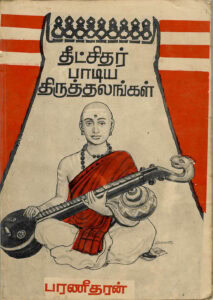
Bharanidharan’s (TS Sridhar) book on Dikshitar that offers new information on his Madras years.
He also seems to have been married by the time he moved to Madras with his parents. Intriguingly, Dikshitar had two living wives. This can only be indirectly gleaned from the SSP. Bharanidharan has explanations for this but does not cite sources. The first marriage he says was finalised very early, but Muthuswami Dikshitar did not show any interest in conjugal life, filled as his hours were with learning. His parents felt that this indifference was due to the wife being dark and unattractive. And so he was married again, with possibly the same results.
It is very doubtful if such an explanation holds water, apart from the fundamental indifference to married life that is. Dikshitar, if indeed he was a realised soul, and a Devi upasaka, could have never been disappointed by looks. And later in life, he seems to have been above prejudice when it came to teaching women of the Devadasi order. Could such a person have been swayed by more mortal considerations? We need not add to the speculation on what led to his two marriages. Suffice it to say that he had two living wives.
Life in Madras may have continued its peaceful course had not yet another distinguished visitor come calling. This was Chidambaranatha Yogi and he had come to the Manali household enroute to Varanasi. Subbarama Dikshitar says he stayed in Manali for a few days, which indicates that acquaintance with the Dikshitar family was fleeting at this stage. He was pleased with the devotion of Muthuswami Dikshitar and initiated him into the Srividya Mahamantra. Hereafter, Dikshitar would become a follower of the Srividya cult, with the Srichakra being an important element in his puja. This still survives as a Meru icon, along with an idol of the Goddess, another of Vallabha Ganapati and a Thanjavur portrait of Lord Subrahmanya on a peacock and accompanied by consorts. They are all with Subbarama Dikshitar’s descendants.
But Chidambaranatha Yogi was not just satisfied with this. He desired that Muthuswami Dikshitar accompany him to Varanasi, a journey fraught with many risks and no guarantee of a return to Madras.
(Dikshitar journeyed forth to Varanasi from Madras with his Guru and returned after five years in 1799. He then embarked on his career as a composer, beginning with songs at Tiruttani. He seems to have left Madras for Tiruvarur in 1802 or so. A life of remarkable amount of travel and music, ended at Ettayapuram in 1835 – Sriram V)