Reg. A Magazine Devoted to Agriculture
Dear Editor, I would appreciate it if you could kindly forward this message to Karthik Bhatt. Kudos for writing A magazine devoted to agriculture, (MM, Vol. XXXIV No. 22, March 1-15, 2025).
I recently came across your article in Madras Musings about my great grandfather Rao Bahadur Dharmaranga Raju. It was a great read. We only had a vague idea of his contributions to society. My 84-year old father was thrilled to learn about our past.
Hats off to your efforts. I would love to know more about how you did it. Thank you for documenting this part of our collective and personal history.
Rakesh Raju
rakesh@raju.net
The Delhi Tamils
The write up about the Tamils in Delhi by MR Narayanaswamy was an excellent one accounting vividly the realities faced by the early Tamil settlers and the present state of their second and third generation. Having lived in Delhi for around 10 years I vouchsafe the fact the Tamils have established themselves as an important group due to their honesty and hardwork. It is a fact that North Indians especially the Punjabis prefer Tamils as their tenant.
It happened to me when I first went to Delhi in 2005. The real estate owner who was a Sindhi lady, on my first meeting itself said that I can get a house easily. She said a Punjabi owner will prefer to give it to us than persons from his own community. Now a good number of Tamils are settled in Mayur Vihar Phase I, II, III where I stayed. It is a mini Mylapore with our people casually walking on the roads in veshtis. There are at least five South Indian Temples in this area.
Parantharami Mani
F8, Krishna Kutir
18/11, Justice Sundaram Road
Mylapore, Chennai 600004
* * *
The riveting article brought back a flood of memories of what may be called the ‘Delhi Chalo’ times, decades ago. Beginning in the late 1950s, many young graduates from Chennai and other parts of Tamil Nadu got selected as Assistants and Stenographers in the Central Secretariat, New Delhi, after cracking competitive examinations conducted by the UPSC. Clerks and junior stenographers were also recruited by the Staff Selection Commission much later for filling posts in Government offices in the Capital. Add to this Central Government officers like me who got posted in Delhi from other places.
Thousands of persons in this cohort (1960-90) may roughly be called the second or third generation of the earlier Tamil migrants mentioned in the article. Economically, they were better off than their predecessors. Most of them got routine promotions and retired as Under Secretary or Deputy Secretary-level officers. Some among them who came out successful in the Departmental Competitive examination for selection of Section Officers, went up the ladder faster to retire as Director or Joint Secretary.
Only a limited number of employees got Government accommodation in RK Puram, Sarojini Nagar, and other areas. The rest lived in rented houses or in housing society flats in Janakpuri, Mayur Vihar, Munirka, etc. Their children were well educated and were employed within the country or abroad. After retirement, a majority of them settled down in places like Chennai, Bengaluru, etc., where they owned houses or apartments.
Running parallel to the Tamil people’s white collar migration stream of the 1960s was the major migration of the labouring class from Tamil Nadu. Due to adverse agricultural conditions and yarn scarcity, cultivators and weavers looked for pastures new. Those who had contact with earlier settlers did not mind going to far-off Delhi with their support, to earn their living. A majority of such migrants who belonged to the backward or reserved categories were from Salem, Madurai, and Dharmapuri. Men among them took up jobs like cleaners, loaders, rag pickers, scrap collectors, etc., or ran small grocery stores, sold vegetables and fruits, or were involved in other petty trades. Skilled among them worked as electricians, plumbers, or automobile mechanics. Women migrants mostly worked as domestic maids.
All of them felt satisfied in their new roles and wished to continue in Delhi. In the course of time, some got better jobs in the organised sector. Initially, they lived in slum settlements in Karol Bagh, Moti Bagh, etc. Later, under the Slum Clearance Programme, they were shifted to resettlement colonies in Trilokpuri, Kalyanpuri, etc. Their children who studied in Tamil Schools got well settled in life.
N. Rama Rao
1A, Sri Kripa Apartments
44,Third Main Road
R.A. Puram, Chennai 600028
Road Name Apathy
Procrastination does not pay. I have been wanting to raise an issue (even prepared a draft); Ramesh C. Kumar (Distortion of a Street Name, MM Oct 16-31) beat me to it.
Inspired by the Bard who said ‘A Rose by any other name . . .’, this writer avers ‘A Street by any other name (spelling) shall contain the same number of potholes’. So why bother? But it does bother this writer to the extent of putting pen to paper or rather finger to keyboard.
The manner in which street signs are ‘prepared’ (I do not know what word to use; earlier they were painted) clearly reveals that records are maintained only in the vernacular. And so, when it is time to create a new signage, presumably the concerned person in the corporation writes (or rather scribbles) the name and hands it over to the person preparing the signage.
This leads to two errors. First, error made while ‘translating’ Tamil to English. Secondly, error in deciphering the scribble. Let us consider the second error first. The painter or ‘preparer’ who didn’t take the trouble to get a degree in English literature mistakes a C for G, V for U and so on. This leads to Wheatgrofts Road (Wheatcrofts Road), DSilua Road (D’Silva Road), Gaudna Mutt Road (Gaudia Mutt Road) and so on (errors since corrected).
The first error leads to spellings such as Dr. Basant Road (Dr. Besant Road), Vengatachalam Street (Venkatachalam Street), Conron Smith Road (Conran Smith Road) and Kandran Smith Lane (Conran Smith Lane; Smith must be turning in his grave). (I look forward to the day when the Road is ‘renamed’ Kaanraan Smith Road.) Another example is ‘my’ road (Wallajah Road, see pictures). Even simple names are misspelled – Adayar (Adyar), Aavadi (Avadi), etc. What takes the cake is of course Muresh Gate Road (Murray’s Gate Road). Since this was highlighted in the city’s newspaper, the error was fixed. (This raises the fundamental issue – How much ‘clout’ or influence does MM have? Not for nothing did I suggest in an earlier mail that MM be made compulsory reading for all IAS officers based in Chennai.)
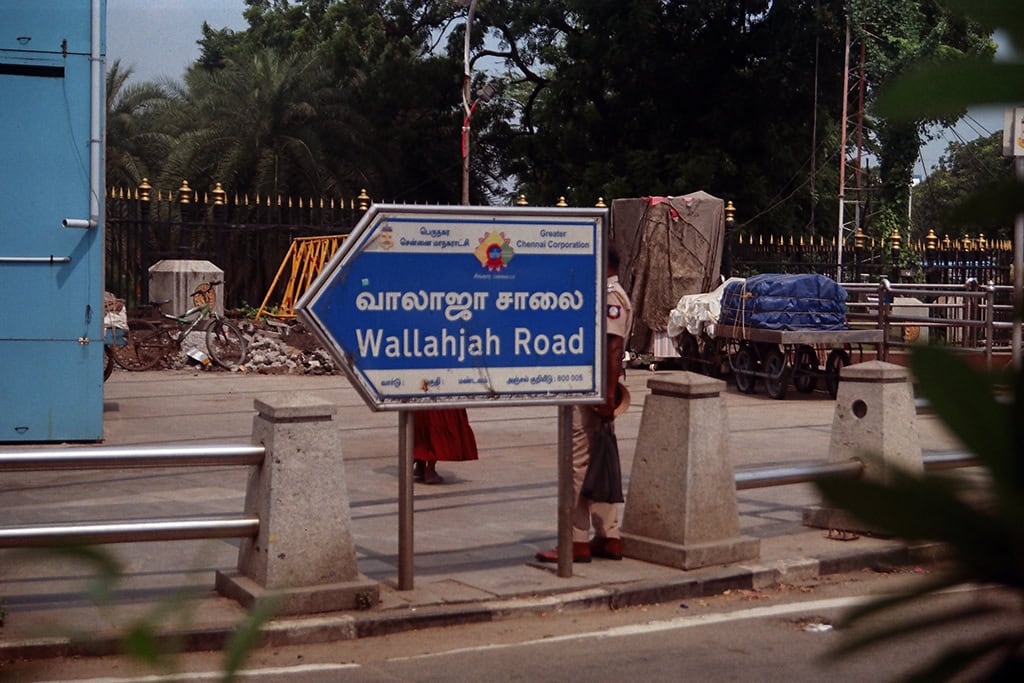
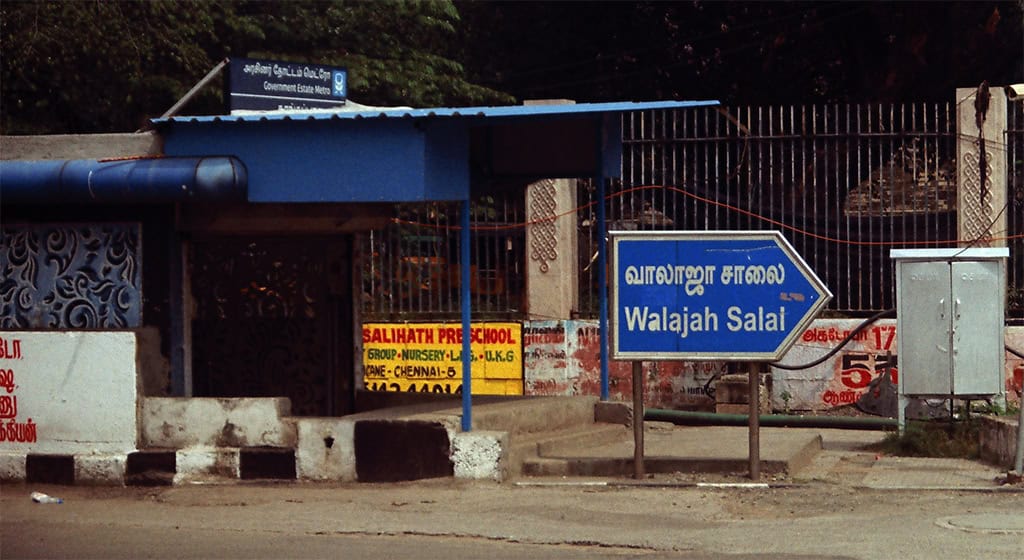
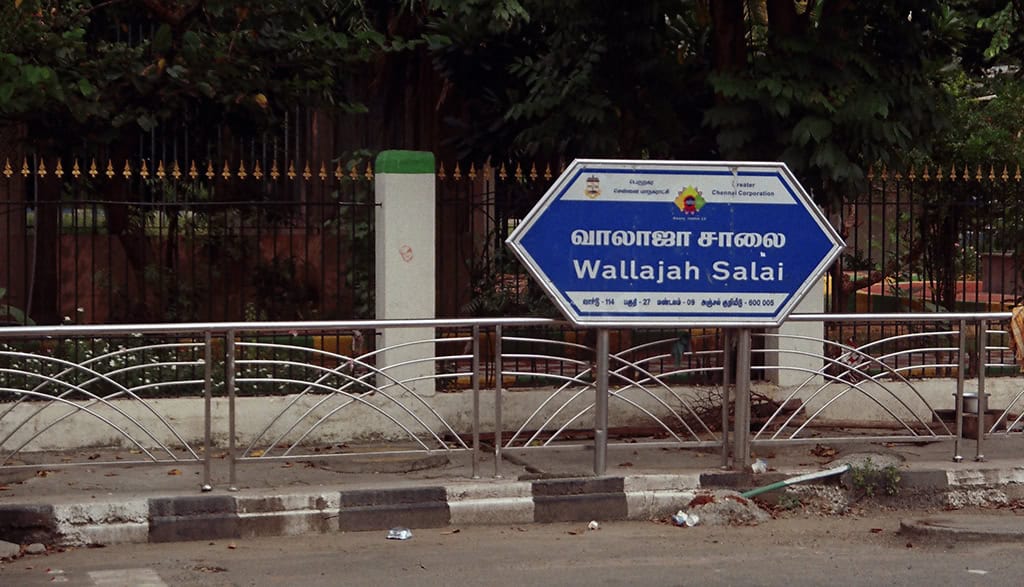
An interesting sidelight is the remarkable consistency regarding the spelling of several roads bearing the same name. All these roads have an Ambal Temple whose name the wife of the Pandavas bears. These roads or rather narrow streets are all called Throwpathi Amman Koil Street.
Misspellings spill over to other areas such as addresses displayed in shop signs and even Metro signage.
How difficult is it for the Corporation to prepare a list of street names in English which is just a one-time exercise? Sadly, such issues do not seem to bother us, may be because there are other pressing issues such as potholes, stagnant rain water, mosquitos, and more. As a society, we just accept mediocrity, sloppiness, incompetence, inefficiency, etc. How sad.
Finally, and to end on a positive note, I am elated that there is at least one other person, Ramesh C. Kumar, who believes that such issues should be raised and takes the trouble to snap a few photographs and compose a letter. May his (our!) tribe increase!
B. Gautham
137 Wallajah Road
Chennai 600 002