In its history of 135 years or so, VP Hall’s tenant for the longest tenure was the Suguna Vilasa Sabha (SVS). Beginning with 1891, the association continued for forty unbroken years, ending only in 1931, when the SVS acquired its own property on Mount Road and moved out.
Among the leading lights of the SVS was Rao Bahadur Pammal Sambanda Mudaliar, one of the original seven signatories to its founding. At the invitation of CR Srinivasan of the Swadesamitran, Mudaliar in 1930 began writing Nataka Medai Ninaivugal (Memories of the Stage), which is partly an autobiography but more importantly a history of the SVS. The series of articles was published in the Swadesamitran till 1936 and provide a year-by-year account of the SVS from inception. And from a reading of it, VP Hall emerges as a live and vibrant venue where plays invariably ran to full houses. In addition it also comes across as a social hub of Madras, resounding to music, speeches, fun and laughter.
The following article, based on the original, and written by me, was published in Madras Musings (Vol. XIX No. 20, February 1-15, 2010), in two parts. We now reproduce an abridged version.
– Sriram V
* * *
The birth of SVS was itself partly due to VP Hall. The original seven, including Pammal Sambanda Mudaliar heartily despised native theatre, considering it to be cheap and vulgar entertainment. They were to change their minds when, as young college students, they witnessed a dramatic performance in the summer of 1891 at the VP Hall by the Bellary Sarasavinodhini Sabha. This was the brainchild of D Krishamacharlu, a lawyer practising at Bellary who ran an amateur dramatic society comprising his friends. The play that Sambanda Mudaliar watched was the last of a series, all of them in Telugu. Each one was a sell-out and Mudaliar writes that he was thankful that his father had arranged a reserved ticket for him, for otherwise it would have been impossible to gain admission into the Hall. Following this play, Mudaliar and his friends decided to form a similar amateur dramatic society themselves and thus the SVS was born on 1st July 1891. It had Raja Sir Savalai Ramaswami Mudaliar as its first President and Poondi Ranganatha Mudaliar as its first Vice-President. Under its auspices Sambanda Mudaliar was to emerge as a playwright, better known today in this capacity than as a lawyer which he was by profession. He wrote 94 plays during his long association with the SVS besides translating several from other languages.
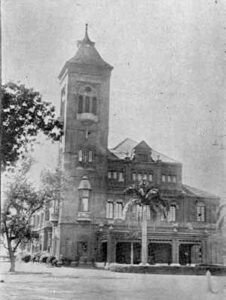
Victoria Public Hall, Madras – the home of the Suguna Vilasa Sabha.
In 1891, following the successful reception of a private staging of Mudaliar’s first play Pushpavalli, the SVS decided to make bold to hire VP Hall for two nights for public performances. At that time, the VP Hall expected the hirers to bring their own stage curtains and props and the SVS did not have the money for such items. Last minute donations by patrons such as Savalai Ramaswami Mudaliar and Koonichampet Lakshmanaswami Chettiar ensured that this gap was bridged. So was the money required for renting VP Hall – Rs 50 for each night. When the curtains were made, the SVS ensured that a picture of Senate House was put on the main stage curtain, this to indicate to the audience that the dramatic society comprised university graduates.
In order to publicise the first performance sufficiently, 25,000 handbills were printed and a retired sepoy was hired to go on horseback from street to street and distribute them. The man carried a bugle which he blew at each street entrance and when a sufficient crowd had collected, he gave away the handbills. On the day of the first staging, the two gates of VP Hall sported decorative arches and were embellished in the traditional way with plantain stems and flags. A band was hired to perform at the gate from 4 to 9.00 pm when the play would begin. All these publicity measures had their effect and a vast crowd descended on the Hall and stayed for the full duration of the play, which lasted six hours and ended at around 3.30 am. Mudaliar writes that this was the duration of the average play in those days.
VP Hall, according to Mudaliar, was much in demand at that time despite being completely unsuitable for the staging of plays! He states that the Hall was built for the public to gather on certain occasions and not for dramatic entertainments. He writes (in 1930) that in his forty years of acting in plays, he feels that the VP Hall is the most inferior among all venues when it comes to acoustics. He also notes that the first dramatic society to ever stage plays in VP Hall, The Madras Dramatic Society, soon packed its bags and moved over to the Museum Theatre. The SVS however, decided to experiment with various measures to improve the acoustics. The members first tried a network of metal wires above the proscenium. Later they attempted to lower the height of the ceiling by stretching a cloth canopy across it. None of these methods really worked and then, as Mudaliar writes, they came to the conclusion that only those with buffalo-like vocal chords could really survive in VP Hall. The SVS, whatever be the vocal capabilities of its members, certainly did and encouraged by the response to the first performance of Pushpavalli, made VP Hall the venue for all its plays.
At the VP Hall, the SVS presented many new ideas and innovations, many of them being attempted for the first time in Madras. One of these was Kalvar Talaivan, which according to Mudaliar was the first tragedy ever to be written in Tamil. The Hall resounded to the sniffs and at times open weeping and wailing from members of the audience. Applause was also received but at the end of the play there was complete silence. The assembled throng had never witnessed a play where everyone on stage died and left with heavy hearts. Another pioneering attempt was the staging of the mythological Rukmangada Charittiram entirely as tableau vivantes, a series of scenes, without any dialogues. This was done as a play within a play – during the staging of Sarangadhara, another great hit from the SVS. An innovation brought into Tamil plays by the SVS, and displayed for the first time at VP Hall, was the practise of having two intermissions during which complicated backdrops were moved and successfully positioned for subsequent scenes. This was directly inspired by the way in which the Parsi Company, then touring Madras and staging its plays at the Esplanade Theatre, managed its backdrops.
In 1896, the joys of English theatre were introduced to native audiences by the SVS, when Julius Caesar was staged at VP Hall. From 1897, Telugu plays were also taken up by SVS. In 1902, yet another pioneering entertainment for Indians was offered – fancy dress competitions.
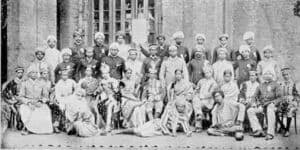
A group of S.V. Sabha actors in 1895.
Among the plays that were to be repeatedly staged was Manohara, a creation of Sambanda Mudaliar which premiered at the VP Hall on 14th September, 1895. Though it was to later become a play much in demand and also be made into an enormously successful film, its first staging did not see much of an audience and ticket sales amounted to only Rs 200. The climactic scene in the play is where Manoharan, the hero, breaks free from the chains that bind him to a pillar. Sambanda Mudaliar, during the first staging did it with so much of force that the noise woke up Ellis, the Superintendent of the VP Hall, who was sleeping in his private quarters at one end of the building. He immediately rushed in thinking that a riot was in progress and VP Hall was in danger.
The SVS took its responsibilities to society very seriously and often staged charity performances. The first was for the Indian Famine Relief Fund in 1897 and this was a staging of Mudaliar’s Pittham Piditta Veeran. The staging netted the fund Rs 214-4-8 and among those who sat in the audience to witness it was Sir George Moore, President of the Madras Corporation. In 1902 the SVS had to bail out the VP Hall itself for the building was constructed with what was thought to be a monetary gift from the Maharajah of Vizianagaram which later transpired to be a loan. The SVS staged Virumbiya Vithame, which was inspired by Shakespeare’s As You Like It. Presided over by Justice Boddam, the proceeds of Rs 200 were handed over to the VP Hall Redemption Fund. An interesting aside about the play is that as in the original, it is largely in a forest setting. The SVS members therefore desired to see it being performed in a garden. The play was performed once in the grounds of Government House with Lord Wenlock in attendance and much later in 1904, in the gardens of the Ranade Public Library and Mylapore Club.
V Krishnaswami Iyer, the noted lawyer, was at first irritated and later curious to know how a hallowed play of Shakespeare’s could be acted out in Tamil. He witnessed the staging at the Ranade Hall and was so impressed that he became the President of the SVS! Another interesting fallout of this play was that the SVS began translating and reworking on several of Shakespeare’s plays to suit an oriental setting. Arising out of this came plays such as Jwalita Ramanan (Romeo and Juliet), Vaanipuratthu Vanikan (The Merchant of Venice), Sarasangi (Cymbeline) and Amaladityan (Hamlet). In 1905, the SVS began the practice of celebrating Shakespeare Day at VP Hall. This gradually expanded into a Shakespeare Week, with the increasing crowds necessitating an outdoor staging of the plays. A stage was put up at the tennis courts at the rear of VP Hall and the plays were enacted there.
The practice of holding night-long plays was soon felt to be an impediment as many members and guests were government servants, professionals and businessmen who needed to report for work early the next day. The SVS pioneered the concept of evening shows when for the first time on 21st October 1906, the play Kaadalar Kangal was staged at the VP Hall within three hours, beginning at 6.00 pm. At that time it was a novelty and several criticised the SVS for its new timings fearing that it would result in the loss of patronage. It however soon became the norm and when cinema came to Madras, it followed the same timings.
VP Hall became home to the SVS in 1902 when the latter began renting a small room on the western side of the Hall. The society had till then managed its activities at various places in North Madras. Space was rented in Chintadripet for storing the props and curtains. By this time the SVS was also blossoming as a social club, providing cards and reading room facilities. A central location like the VP Hall became an asset. Gradually, the SVS expanded its occupation of the VP Hall. In 1910, the Cycles Club and the Mercantile & Marine Club, which were occupying the entire lower floor of the Hall became defunct and the SVS took over the space at a rent of Rs 125 a month. The legal luminary Sir VC Desikachariar expressed worry over the move as in his view no organisation that had rented the VP Hall till then had flourished! A new acquisition by the SVS that year was a billiards table which was housed in the ground floor of VP Hall.
In between, in 1908, the SVS also inaugurated its library, which was perhaps the only one in the city dedicated to books on theatre. Begun with a collection of 180 books, it expanded by 1930 into a vast horde of 1,680 books which included works in English and the four South Indian languages. The SVS also felt that a Hall named after Queen Victoria ought to have her portrait in it and commissioned one at a cost of Rs 200. Unveiled in 1910 by Sir Arthur Lawley, the Governor of Madras, it was later put up on top of the stage and is probably the one that still survives in the Hall. (It no longer does in 2025 – SV)
By this time the SVS was the preferred agency for organising entertainments whenever any important personage visited Madras. Viceroys and Governors witnessed its plays and on one occasion the Viceroy, Lord Minto, refused to believe that the women on stage were actually men in drag. Sir Arthur Lawley however, was not fortunate to be entertained by the SVS. When approached to organise a suitable entertainment for the Governor’s farewell, the SVS chose to snub him by refusing, a decision that was warmly endorsed by V Krishnaswami Iyer despite his being a sitting High Court judge! When Krishnaswami Iyer passed away within a year, the SVS organised a commemorative meeting at the VP Hall and unveiled a portrait of his. It also contributed Rs 1,000 towards the statue that was later put up in front of the Senate House.
By then it was said in a lighter vein that if anybody desired to become a High Court judge, he ought to become a member of the SVS. V Krishnaswami Iyer, PR Sundara Iyer, TV Seshagiri Iyer, Sir CV Kumaraswami Sastri, K Srinivasa Iyengar, C Krishnan, Sir M Venkatasubba Rao, Sir Vepa Ramesam, Masilamani Pillai and VV Srinivasa Iyengar were but a few examples. Pammal Sambanda Mudaliar also became judge of the Small Causes Court.
Many women also became members of the SVS, though they did not take to acting. Dasara celebrations were particularly colourful at the SVS thanks to the women. The practice of kolu was initiated when a large Ganapati idol that was gifted to the SVS began to be worshipped before each performance. For Dasara, members would bring clay idols and these were duly arranged in steps in the large auditorium on the first floor. There were days during Dasara that were exclusively earmarked for children and women. The Ladies Day allowed only for women to attend and they were entertained by select scenes from plays, all enacted by men of course. On one occasion Sir T Sadasiva Iyer demanded to be allowed and an exception was made for him. He was allowed to sit on stage and witness the performance. For many years, it was the practice of Sir CP and Lady Seethammal Ramaswami Iyer to defray the expenses incurred on Ladies Day. Within a few years, Ladies Day had to be celebrated in a special pandal on the grounds belonging to the South Indian Athletic Association.
By 1915, the SVS had begun to outgrow the VP Hall. In that one year alone 363 new members were enrolled and it was commented that if all members of the SVS were to come in to attend a programme at the VP Hall, it would be impossible to accommodate them. One such instance was the staging of a play for the benefit of the warship HMS Madras. The demand for tickets was so high that the play was eventually enacted in a tent in neighbouring People’s Park. It was also the same year when the SVS perhaps pioneered the concept of a December cultural season. By way of commemorating its silver jubilee, the SVS hired the auditorium of the VP Hall for 45 evenings and staged plays on all days. Despite this there were days when sale of tickets had to be stopped early in the morning.
With all this, the SVS realised that it would have to move out of VP Hall. Funds had been systematically set aside since 1900 for the purchase of a suitable plot of land which in Sambanda Mudaliar’s words, “would accommodate an auditorium at least six times the size of VP Hall”. The Government agreed to lease the Napier Park (present May Day Park) for this purpose and on 31st January 1925, the foundation stone was laid for this by TV Seshagiri Iyer. Within three years, the stone was back in VP Hall, Napier Park being found unsuitable for the purpose. Money continued to accumulate, with performances in the mofussil, Colombo and Bangalore being particularly remunerative.
Ten years later, Pitty Tyagaraya Buildings on Mount Road, which had belonged to the Justice Party and which was keen on selling following its decline, were negotiated and purchased for Rs 95,000. The SVS finally had a new home but it never fulfilled its promise of being a dramatic society. Today it is a thriving social club though office-bearers still sport titles such as Tamil/Telugu Conductor, these being a throwback to the days when those occupying these posts really conducted plays, one of them being S Satyamurti.
The SVS did construct a theatre at its new premises, but this was leased out. It functioned as the Plaza Theatre for long and then, following litigation, was retrieved by the SVS and demolished – SV.
* * *
Host to Several Greats
VP Hall has hosted several greats from the 19th and 20th centuries. They were here at the behest of several organisations that hired the venue for their events. But undoubtedly, the track record of the venue as far as speakers/performers are concerned is truly unparalleled. We present here a partial list:
Swami Vivekananda
Mahatma Gandhi
Gopal Krishna Gokhale
Rabindranath Tagore
Iyothee Thas Pandithar
Rettamalai Srinivasan
S Satyamurti
Sir Pitty Theyagaroya Chetty
Dr TM Nair
C Natesa Mudaliar
The Rajah of Panagal
Calcutta Gauhar Jan
T Balasaraswati
Annie Besant
EV Ramaswami Naicker
CN Annadurai
In addition, the Hall played venue for events such as the public meeting following the Arbuthnot Crash, the golden jubilee of the Indian Fine Arts Society, early meetings of the Theosophical Society and the first display of cinema.