Two new business ventures have been launched recently in the city of Chennai and are expected to flourish by leaps and bounds in the near future.
One provides the engineering feat of raising existing buildings by 3 to 5 feet from their foundations.
The other builds temporary gates to prevent the rain floods from entering houses, buildings and compounds.
The main cause for the rise of such novel ventures is the alarming trend in raising the road levels by the Corporation of Chennai. Since the year 2000, road levels have been raised from 2 to 3 feet in all the areas. Now the roads have been raised like high bunds and all the rain falling on them runs immediately into the buildings and compounds on either side, which have been sunk below road levels.
Prior to the year 2000, road laying was labour intensive and time consuming for even a stretch of 100 ft length and 20 feet width. Jelly or crushed granite of 40 mm had to be manually spread and tar poured over it. And the road was levelled by a road roller run slowly back and forth over the surface. Once the road laying machines were introduced, a single machine mixed tar with jelly the size of sweetcorn, spread it, levelled and compacted the surface within a matter of a few hours overnight. Corporation was thrilled with this instant road laying and went on a spree. Every time the level was raised by six inches and before the public realised what was happening, the rains brought the floods right into their homes. Seethamma Colony and Venus Colony in Alwarpet had to empty out and the people had to seek shelter in hotels and houses of friends and relative.
Wells and rainwater harvesting are grossly inadequate to handle the volume of rain that can cause floods in a couple of hours.
A weak and pointless excuse is given by the Corporation that cold milling is mandated to be done before laying the roads. By this instruction the road surface is merely scratched for less than one inch and a six inches thick road material is slapped on it.
While the road laying activity is a very lucrative one with a heavy outlay of funds, there was more bonanza to follow. This was the construction of Storm Water Drains. The Corporation imagined that all the rainwater can be whisked away through storm water drains. No storm water drain can be large enough to carry all the rain that falls on the roads. To understand the volume, it is to be remembered that Chennai with hardly any soil space around buildings has become one vast concrete block, where all the rain ultimately needs to flow on the roads.
Prior to the year 2000 the roads were low and most of the water flowed on them toward the nearest canal by gravity. Residual water flowed through the SWDrains , which were unplanned, unconnected in several places and were already full of sewage flowing all through the year. That of course is another murky story that needs a chapter all by itself.
Storm water drains are built in an unplanned ad hoc manner. For instance, the waters around Stella Maris college area which should be channelled to the Mambalam canal just across the road, are taken on a wild detour through several residential areas with twists and turns, flooding all the areas to reach the Buckingham Canal near Mandaveli. That it could take the straight and royal path through Cathedral Road and RK Salai to the same canal near Hamilton alias Barbers alias Dr. Ambedkar Bridge, does not cut ice with the officials concerned.
Building of SWDs is another lucrative activity and the media is perennially full of stories of the irregularities. The prefab Storm Water Drains laid as an emergency measure, have an astronomical cost factor. A hydrologist has submitted a report in Karnataka court that the cost of laying such SWDs for a kilometre is a thumping 18 crores. Before the Pandora’s box of Storm Water Drains is opened, the lowering of roads needs to be dealt with.
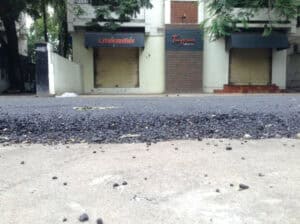 Chennai is like Anarkali with the walls being raised all around to choke the life out of the city. The rain floods mixed with equal or more volume of sewage enters every house and building after a heavy shower of two hours. Cyclones and heavy rain that pour in buckets will cause immeasurable and totally avoidable damage to life and property in the next few years unless the Corporation realises the impending man-made disaster and acts on a war footing to undo its blunders.
Undoing the blunder would mean lowering of road levels by one to two feet in most areas. It would mean enormous cost and effort and the work must start right away to be completed before the rains. If such work is classified as repairs no corporator or contractor would be interested in it. Unless there is a budget drawn and funds allocated, nobody would come forth to do it. Instead, they would all discourage such a move by drawing up a list of reasons against such work.
Let there be incentives to take up the work and to complete it in a short time. Nobody would grudge the money or expense if floods could be prevented. Let there be an emergency plan to remove layers of the roads and create a land reclamation from sea erosion with the debris. Let the roads be lowered below the levels of the buildings on either side. It would mean a big budget. So be it. Let it be an incentive to save the city from sinking and flooding.
I am living in Venus colony first street and is a victim of this periodical bitumen toppings os roads resulted in houses levels are less than road level. I am interested in lifting my house level by 3 feet. Ramachandra Rao 9444019276