I visited Adyar’s International Headquarters of the Theosophical Society (TS Adyar) on October 1, 2025, which was Annie Besant’s birth anniversary. She was their second president from 1907-1933. A special talk was delivered by Tim Boyd, President of TS Adyar, to commemorate the occasion. The campus remains out of bounds for visitors otherwise and is only opened to the general public on special occasions. Naturally, whatever is forbidden holds a special attraction, so I fully utilised this opportunity to immerse myself in its verdant tropical paradise. I went on an exploratory walk checking out various landmarks of the stunning campus (area of 250 acres) which is a heady combination of nature and heritage monuments.
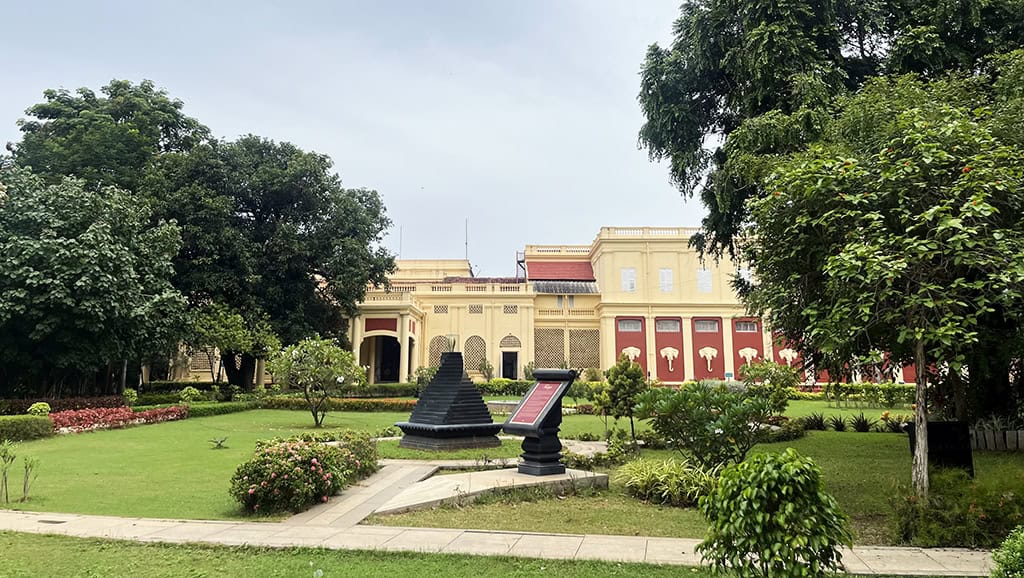
Headquarters building of TS Adyar.
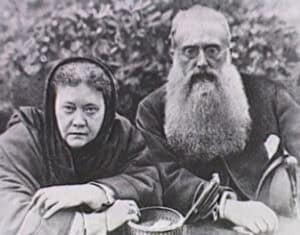
The Founders – Madame Blavatsky and Col Henry Olcott.
Going back in time, this organisation came into being in 1875 in New York. Madame Helena Blavatsky, Col Henry Olcott (Founder President until 1907) and others were its founding members. It has three aims of universal brotherhood, comparative study of religions/philosophies and to explore powers latent in men/nature.
They felt that from India ancient wisdom had gone out to the world through Hindu, Buddhist and Jaina faiths so the international headquarter was to be located in India. After landing in 1878 in Bombay, Olcott is said to have bent down to worship the soil of the ancient land of India. For a few years they traveled across India giving lectures on Theosophy and finally landed in Madras.
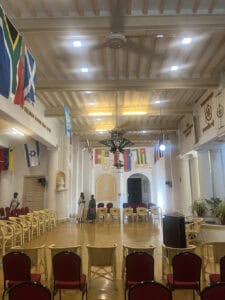
The Hall of Unity.
At first glance, in 1882, of the palatial colonial country home, then called the Huddleston Gardens, on the banks of Adyar river, Col Olcott said, “we knew our future home had been found”. Madame Blavatsky, in letters to her aunt describing the place, said, “it’s wonderful here, what air, what nights and gazing over an ocean sparkling and shoreless, as if alive”. And that is how TS Adyar found its new home in the lap of natural abundance, on the banks of a sparkling river and overlooking the vast expanse of sea.
Col Olcott (who converted to Buddhism) did a lot to preserve ancient Buddhist and Sanskrit texts, scrolls and palm leaf manuscripts. Earlier this library was part of the main headquarter building but soon it got too small for the burgeoning collection. So, in 1967, the foundation stone of the new library was laid and it now houses some of the rarest treasures in a temperature and humidity controlled environment.
Annie Besant, after she took over as president in 1907, went about acquiring a lot of land around the original 27 acres of Huddleston Gardens, to multiply the size of a campus befitting its international stature. She also acquired what is now called the Olcott Bungalow, once one of the private residences of the Nawab of Arcot and his zenana (ladies quarters). This bungalow also was home to the famous Maria Montessori, of the eponymous Montessori style of education, for a couple of years around 1939, as she conducted classes for children from across India.
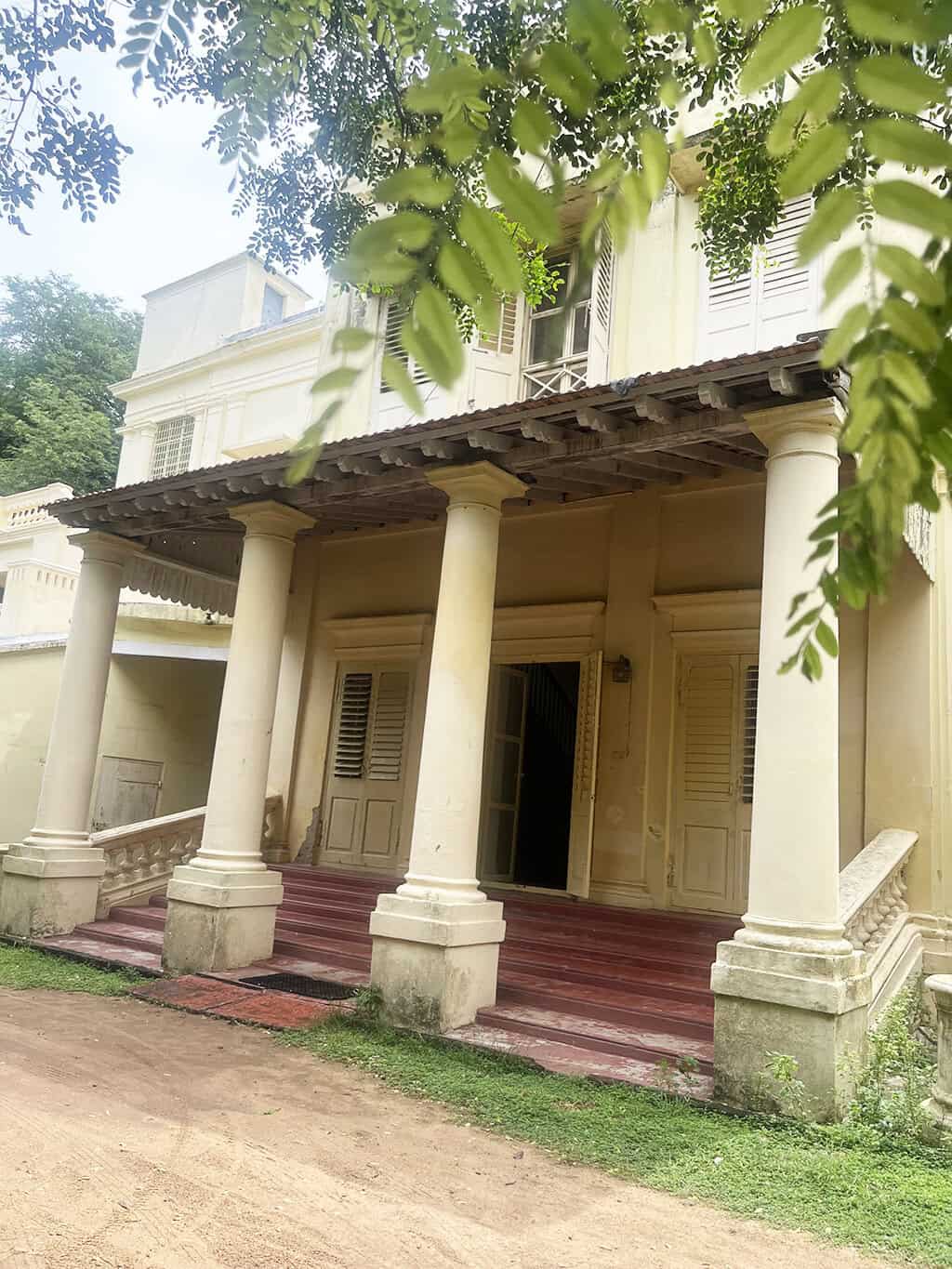
Olcott Bungalow at TS Adyar.
Olcott used to swim in the adjoining Adyar river and one day he noticed local children splashing about aimlessly
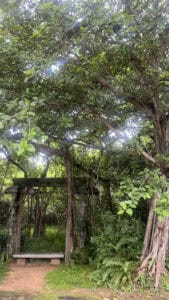
Adyar Ala Maram or Adyar Bodhi Tree.
instead of going to school. On interacting with them he came to know that they were not allowed into the schools as they were of lower caste. That prompted him to start Olcott School, a free school for the poor and marginalized children where they got two meals a day which was a huge success. This was a forerunner of the current mid-day meal scheme of the government.
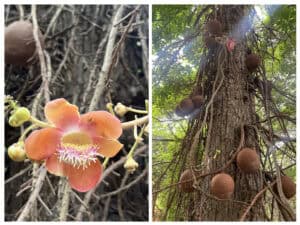
The Nagalingam/Sivalingam flower of Cannon Ball tree.
TS Adyar is also home to India’s second largest Banyan tree which is said to be about 500 years old. It is a landmark of Chennai, a true example of priceless heritage. The main trunk fell in a storm in 1989 but the widespread canopy of subsidiary trunks is a sight to behold for nature lovers. It occupies an area of 40,000 square feet. I also spotted huge Cannon Ball trees. They are called Nagalingam or Sivalingam flower trees because of the distinctive shape of its flowers which look like hooded Naga over a lingam.
Olcott, in 1905, got imposing temple pillars (trilithons) transported from the ruined Vijaynagar era fort temple at Krishnagiri and installed them at five locations here as he wanted such religious iconography to find a respectable place instead of an abandoned location.
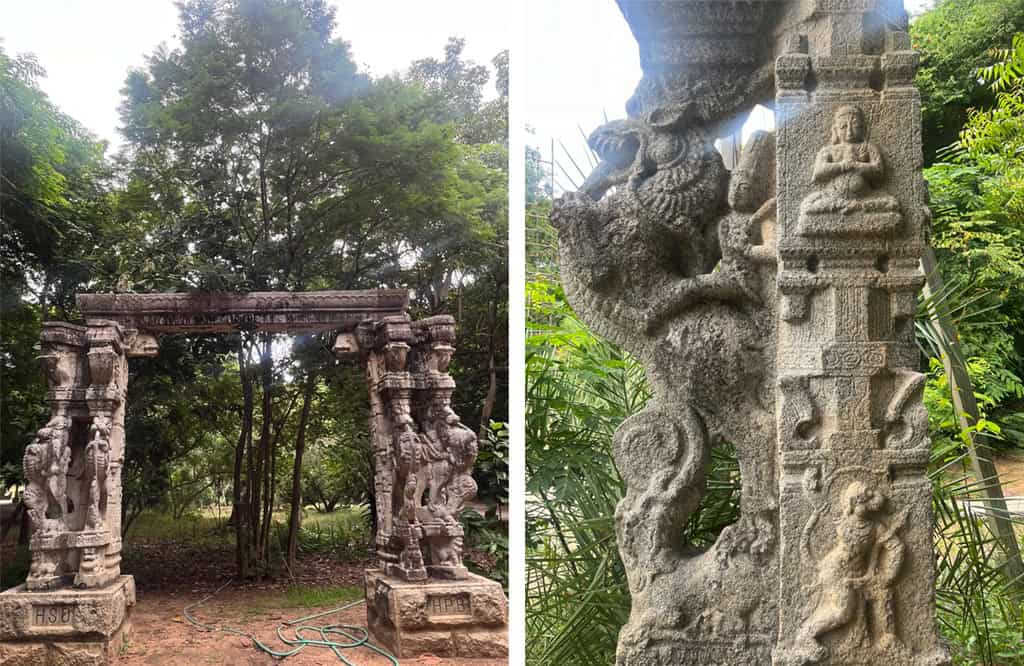
Vijaynagar era trilithons with religious deities.
After the Annie Besant talk, I had an opportunity to meet Tim Boyd, President TS Adyar, and we spoke about how Indic religious thoughts and ancient spirituality were the magnets that pulled the founding members to India and then to Madras, which is now Chennai. TS celebrated its 150th Foundation Day a few months back with an international convention which highlighted the continued importance of TS Adyar as a ‘Flaming Centre’, as Besant said, radiating power of wisdom and compassion across the world.