This commentary pertains to a two-page article, Memorandum relative to an ancient cemetery situated about 11 miles of NW of Madras published in the Madras Journal of Literature & Science, 1858. This article is unsigned and hence the author is not known, only an end note, ‘Madras, 14 August 1858’ occurs; presumably it was John Clark, a medical doctor attached to 13th Light Dragoons as a Commissioned Officer and stationed in Madras, who became the Deputy Inspector-General of Hospitals in Madras in 1860. This is based on the fact that Clark, while in service in Madras, explored the geology of the then Madras city and nearby districts, and particularly the laterite of the Red Hills, Chennai.
Two remarks made in this article appear worthwhile:
(1) That a slab covering one of the graves was of granite — ‘exotic’ to Red Hills — and not of laterite, the native geological material to this locality. Black granites (dolerite) occur as dykes in Kanchipuram, Vellore, Tiruvannamalai, Villupuram districts of modern Tamil Nadu.
(2) Finding of human remains and broken pottery in the ‘tombs’ and in all probability, the writer comments they belong to the period before the introduction of Hinduism, which can be translated as ‘megalithic’ (2500 BCE-200 CE), ‘of iron age’ (1200-600 BCE).
The neighbourhood of the erstwhile Madras district, for example, Chengalputtu, Kanchipuram, Tiruporur, Maduranthakam, Thiruvallur include many megalithic cists and cairns either with or without stone circles, burial urns, and other pre-historic items.
In 2010, Ashvin Rajagopalan, a megalithic-site enthusiast has spoken about his trip to Tiruporur and the discovery of a stone circle and megalith cists. In the same article, Ashvin Rajagopalan also speaks of revelations of burial urns and some rare sarcophagi in Chetpet, Perambur, Pallavaram and Saidapet (all within Chennai-city limits) made in the 1800s. Another newspaper report on a megalithic dolmen, estimated 2500 BP, found by K.T. Gandhirajan (art historian) and Krishna Ramkumar (writer) in Viraraghavapuram, 4-5 kms from Kuvathur towards Maduranthakam, found in 2017 is also available. Smiriti Haricharan (an alumnus of Stella Maris College, Chennai, presently an academic at the National Institute of Advanced Studies, Bangalore) has made trailblazing findings on the megalithic relics of Sirudavur.
The writer of the ‘memorandum relative to an ancient cemetery …’ describes the stone relics he/she found. The writer uses the terms such as ‘tombs’ and ‘apparently of great antiquity’ (p. 346), but they have not been convincingly validated. However, the writer supplies two landmarks for the location of the site where he/she spotted these relics: (1) ‘About two miles (≈3.2 km) west of the Red Hills lake’ (presently, the Puzhal lake). (2) Three miles (≈4.8 km) NNW of Major-General Farran’s bungalow.
Major-General Farran referred here was Charles Farran, born in Dublin, Ireland in 1768 and died in Madras in 1842. He joined the 14th regiment of Native Infantry of the Madras Army in 1790 as a cadet. He became a Colonel of the 30th Native Infantry in 1824 and a Major-General in 1837. Madras historian Sriram Venkatakrishnan determines the New Faren’s Road in the present-day Perambur-Barracks area as the locality where Charles Farran lived. However, highly likely, Charles Farran occupied owned or rented another property in the Red Hills, about which the author of the memorandum speaks.
The writer of this memorandum refers to previous observations of the same artifacts by Arthur Thomas Cotton of the Madras Engineers. Cotton designed and ran the Red Hills – Chinthadaripettai goods-rail service for transporting laterite for roadworks in Madras in 1837, 16 years before the Bori-Bunder-Thané (Maharashtra) passenger rail service started. The writer of this memorandum indicates:
‘They (sic. the stone relics) are situated on a barren plain, a little elevated above the adjoining country, composed of laterite, and partly covered with stunted thorny bushes, few of which are more than two feet (0. 61 m) high.’
The following paragraph, reproduced as such here, includes measurements of the observed relics:
‘Each tomb consists, rather did consist, of a parallelogram, within a circle. The squares and circles are of various dimensions; the square generally six feet (1.8 m) in length, the breadth of different tombs varying from 2½ (0.8 m) to 4 feet (1.2 m), the diameter generally 18 feet (5.5 m).’
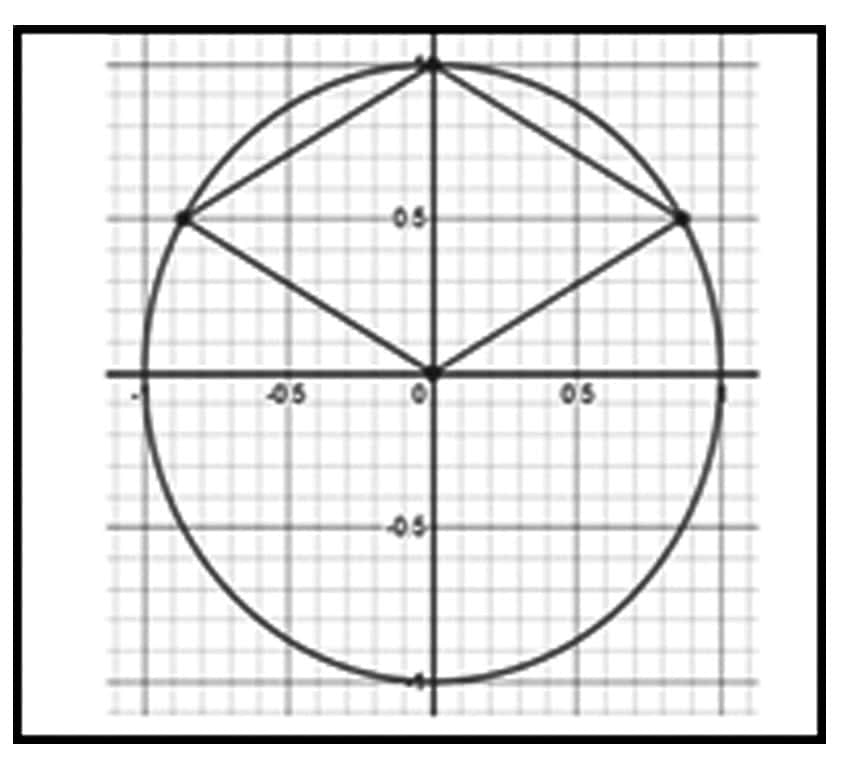
Fig. 1. A parallelogram within a circle (Source: Gary Ward, https://www.quora.com/Can-a-parallelogram-be-inscribed-in-a-circle, accessed 5 February 2024).
The above text is hard to interpret; for example, the word ‘circle’ that included a ‘parallelogram’ occurs in the first sentence, leaving us confused what could a parallelogram within a circle mean (Fig. 1) and the second-time use of ‘circles’ refers to what? Absence of an explanatory illustration of what the author saw, which many of the recent-time authors of similar articles include e.g., 6 is distinct in this memorandum.
However, what makes sense is the following two paragraphs:
‘The writer of this memorandum saw one of the squares, or graves, partly opened. At about two feet (0.61 m) from the surface appeared a slab, not of laterite, but of granitic stone (an exotic at the Red Hills) corresponding in length and breadth with the size of the square; this slab was not removed, but it has been ascertained from unquestionable authority (a gentleman who witnessed the removal of several of the slabs) that under each slab is found an earthern (earthen) vessel filled with human bones – pieces of the broken pottery lie about the tombs that have been fully opened.’
‘There is no appearance of inscriptions on any of the stones; the inhabitants of the neighbouring villages have no tradition regarding the tombs, in all probability, they existed previous to the introduction of Hindooism.’
— by Dr. A. Raman (anant@raman.id.au)