In Chennai, the street housing the Government Press – located near the Vallalar Nagar bus terminus – is named Nattu Pillaiyar Koil Street. A specific building situated on this street is known as “Chengam Market”. A neighbouring street is also referred to as “Chengam Bazaar Street”.
Many years ago, several families migrated from Tiruvannamalai, Chengam, or surrounding areas, settling in the major cities of that era – namely Madras, Bangalore, and Bombay. Those who arrived in Madras in this manner chose to reside near Broadway, in what was, and is, a bustling and densely populated locality. It is highly probable that the building now known as “Chengam Market” was originally established to cater to the daily necessities of these settlers.
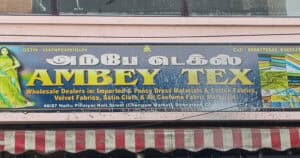
In those days, this building housed distinct shops dedicated to various commodities: flowers, fruits, vegetables, greens, groceries, fish, eggs, mutton, and chicken. For the non-vegetarian food enthusiasts of that era – particularly those residing in areas like Seven Wells, Chintadripet, and Saidapet – this market stood out as an indispensable and unique destination.
Much like how the name “Senganmal” evolved into Sengamma and subsequently Chengam, this Chengam Market has also undergone several linguistic transformations over time. It was variously referred to as Chengam Kadai Market, Chengathan Kadai Market, and eventually Chennakadai Market. Today, locals point out this specific building only if one explicitly asks for the location of Chennangadai Market! Furthermore, it was once a common practice among the people of Madras – specifically the older generation residing in Saidapet – to remark to anyone speaking in a loud or boisterous manner: “Why are you speaking like a woman from Chennangadai Market?”
Currently, as this locality has become predominantly inhabited by communities with a preference for vegetarianism, one can observe that the meat shops that once defined the area have gradually transformed into vegetable stalls. Until a few years ago, this building stood in a dilapidated state, having lost its structural integrity. While a few vegetable stalls, tailoring shops, and frame-making workshops occupied parts of the premises, the remaining area served as a residential space for the local inhabitants. However, it has now been transformed into a four-storey structure, radiating with renewed brilliance.
Located on the very same street, adjacent to the Chengam Market, stands a building that has undergone a series of transformations: originally an Annamalaiyar Mutt, it later became a wedding hall, and today, it serves as a private storage facility. Inside this structure, an inscription dated 1840 can be found, bearing the name “P.V. Narayanasamy Mudaliar Wedding Hall”.
Observing the proximity of this hall to the Arulmigu Arunachaleswarar Temple – dedicated to the deities enshrined in Tiruvannamalai and bearing the names of the Lord and Goddess – one is led to view the “Chengam Market” as a symbolic link connecting Tiruvannamalai, Chengam, and Chennai.
— by Kalaichelvam Namachivayam (chengamsarathy@yahoo.com)