Dental College in Madras in the 1920s
The earliest reference to a dental college occurs in Madras government records referring to the initiative of George Bidie, Surgeon-General, Madras. Bidie submitted a memorandum to Robert Bourke, governor (1886–1890) in July 1888, in which he argued that the profession of dental surgery is one in which an Indian would like to excel when put through a rigorous course of training and tuition method as followed in England. In case dentistry was being regularly taught as a profession, it was necessary for the University of Madras to grant a diploma to those qualified. The government acknowledged on 30 August 1888 that it would approve of the University of Madras being invited to establish a licentiate programme in dentistry. In spite of these transactions, nothing eventuated for the next few years.
The next formal attempt towards establishing a dental college and hospital was made in 1906. Additionally, amended proposals for a dental college and an attached hospital and training young Indians towards diplomas in dental surgery were repeatedly submitted to the government in 1907, 1908, and 1909. In the 1909 proposal made to the government with a copy marked to the Faculty of Medicine, University of Madras, details of two teaching programmes are available:
(1) A full-length programme in dental surgery, similar to the training required to earn a 4-year licentiate issued by the Royal College of Surgeons of England.
(2) A 2-year training programme for those already medically qualified with either an MBCM (MBBS) or an LMP or an LMS culminating with the issuance of a certificate by the University of Madras. This certificate programme was provisionally titled the ‘Licentiate in Oral Surgery’, designed after the ‘Licentiate in Ophthalmology’ then offered at the Madras-Eye Infirmary (later, the ‘Government Ophthalmic Hospital’; and presently, the ‘Regional Institute of Ophthalmology and Government Ophthalmic Hospital’ in Egmore, Madras). Detailed costing of required equipment for the hospital and college and for disbursing salaries to academic and non-academic staff was worked out. This document signed by the principal of MMC and the members of the MMC administrative council, was routed through Alfred Gibbs Bourne, Director of Public Instruction, and submitted to the secretary, medical department, government of Madras (Government of Madras, G.O. # 368, 22 June 1909). However, these efforts also never eventuated. The government rejected the proposal with no explanation. Incidentally, the Bengal and Bombay presidencies were seeking support from their respective governments to establish dental colleges and hospitals in Calcutta (presently Kolkata) and Bombay (presently Mumbai). An America-qualified dentist Rafiuddin Ahmed started a dental college in Calcutta (The Calcutta Dental College) in 1920. This institution, re-named later as the ‘Rafiuddin Ahmed Dental College’ takes the credit of being the first formally established dental college in India, followed by the Nair Hospital Dental College in Bombay – established in 1933.
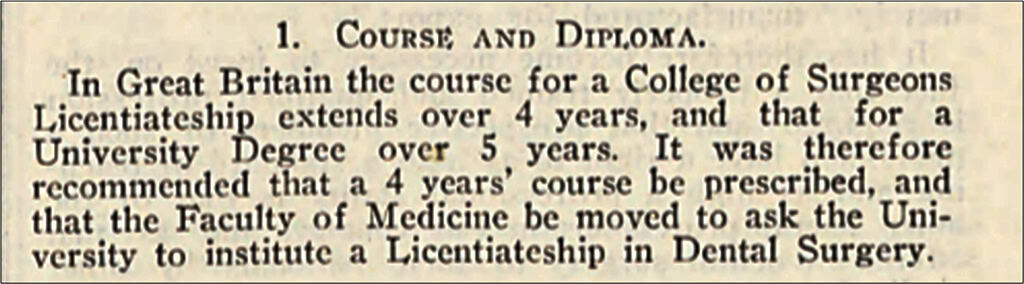
BOX 1. Preamble of the proposal sent by the Miller-Badcock duo. (Source: Badcock).
A renewed effort was determinately made in MMC under the leadership of George Giffard, Surgeon-General, seeking the Government’s attention to offer a formalised dental education at the end of 1918, coinciding with the end of World War I. Alfred Miller of Indian Medical Service and principal of MMC was instructed to draw a scheme in consultation with Christopher Badcock. The Miller-Badcock duo submitted a proposal, routed through Giffard, that emphasized that there were no dental colleges in India at that time (Calcutta Dental College came into existence in 1920) and it would be an advantage to train dentists formally before dental quackery established. Badcock provides an extended outline of the proposed teaching programme in pages 340-341. The preamble of the proposal is reproduced here (Box 1), which comprehensively captures the context of the new proposal.
In this proposal, Miller and Badcock first speak of the details of the four-year long licentiateship in dental surgery, followed by details of contents, pre-required educational qualifications, examinations and their conduct, required academic staff, and the proposed fee structure. They also speak of details of a shorter programme, something similar to the then prevalent Subordinate-Medical Service training programme in the MMC. In 1920, the government sought additional clarifications from Miller. That response instilled some hope that the proposal for a dental college and hospital in Madras would materialise. However, in May 1922, the project was deferred citing financial difficulties. Nevertheless, in December 1922, the scenario brightened slightly since the government again sought freshly prepared costings and anticipated expenditure statements. A progress was imminent (Box 2). Again it proved an illusion in the next couple of years. Badcock clarifies this see-saw experience with relevant evidence and data in the section ‘The public demand for dental training and for a profession of dental surgery’. In the same section, he further clarifies how some of the already practising unqualified, unregistered dentists and dental mechanics came into MMC’s dental department to train in short-term refresher programmes.
Speaking of short-term training programmes offered to unqualified dental practitioners in Madras, Badcock continues speaking about ‘Post-collegiate courses in dental surgery for civil assistant surgeons and sub-assistant surgeons’. This effort strikes as a relevant and useful human-resource development exercise. In May 1920, the chief-medical officers of district hospitals throughout the Madras presidency submitted an urgent request to the government that a six-month long post-collegiate training be offered to assistant surgeons and medical officers of the Subordinate Medical Service (sub-assistant surgeons), who were qualified with either an MBBS or an LMS or an LMP so that they could be comprehensively trained in dentistry, enabling them to handle patients with dental problems in rural hospitals. The government of Madras approved this request. MMC’s dental department organised training programmes (referred as ‘special’ programmes) that comprised 15 lectures on dental surgery, delivered by the professor of dental surgery (Badcock?) and the second dental surgeon (name unavailable), five lectures on dental anaesthesia by the instructor in anaesthetics (name unavailable). The attendees were trained in impression-taking, model-casting, and construction of Hammond splints through practical classes. Two critical remarks are offered at this point: (1) Holding of these courses led to an increase in the number of patients treated in MGGH and to more of conservative work was undertaken. (2) It also brought the dental department of MGGH in line with other dental hospitals (obviously Badcock meant the Guy’s and the London Dental Hospitals, London) in that a considerable proportion of the work was done by students themselves, which of course was out of the question before the special course was started.
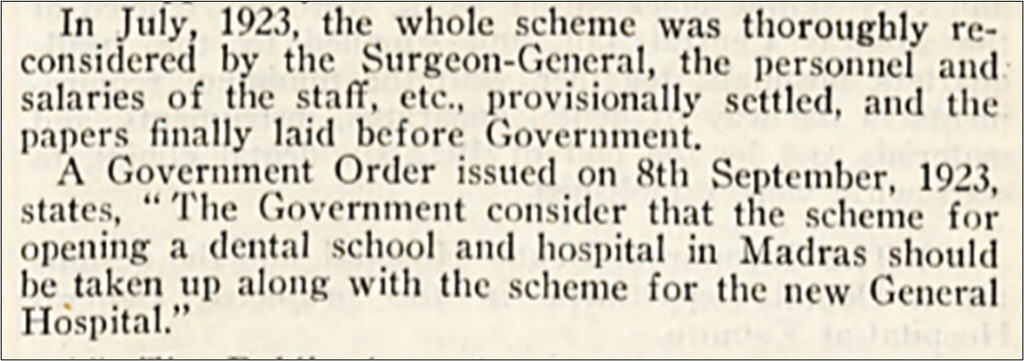
BOX 2. Deceptively bright outcomes for a new dental college and hospital in 1923.
In those special-training programmes, four civil-assistant surgeons and one sub-assistant surgeon in 1920 and three civil-assistant surgeons and one sub-assistant surgeon, in addition to a ‘private pupil’ (details unavailable) in 1921 were trained. Only two such special training programmes appear to have been ever completed. Financial constraints are indicated as the reason for discontinuation. However, the nine government medical officers, who trained in basic, but practical dentistry, on returning to their respective hospitals in districts were enabled with appropriate dental furniture and other relevant materials by the government. Six reasonably equipped exclusive dental rooms in different district headquarters hospitals became available to rural public by the end of 1922.
Badcock speaks of a critical event in this article, which none, thus far, has recorded or reported. That pertains to the movement of the department of dental surgery in MMC-MGGH to the Government Royapuram Hospital (GRH, which transformed into the Stanley Medical College and Hospital in 1934). Space constraint compelled the Madras Medical Department officials including Surgeon-General George Giffard to suggest the department of dental surgery’s move from MMC-MGGH to GRH. The GRH was undergoing refurbishment at this time. Giffard issued an order on 24 March 1924 directing the shift of the department of dental surgery from MMC-MGGH to GRH. At GRH precinct, the department of dental surgery of MMC-MGGH was allotted a well-lit, hygienic operating theatre enabled with necessary modern electrical installations and ample water supply, a second room for patient examination, separate waiting and retiring rooms for men and women. Three state-of-the art oil-pump dental chairs (Fig. 1) were installed, supplemented by a range of dental engines and other relevant instruments and appliances. This facility was a self-contained, smaller-scale dental hospital. The professional staff included a professor of dental surgery (first dental surgeon), a second dental surgeon (assistant dental surgeon), and a dental anaesthetist. Services of nurses and Class IV assistants were provided by the superintendent of GRH. The re-located department of dental surgery in GRH opened for public on 9 April 1924. Badcock comments in the later section of his article that this shift to GRH from MMC–MGGH gained the most-modern precinct, that was earlier intended for development in MGGH. With the shift of the Department to GRH. the plans meant for MMC-MGGH were deferred to a later date, when a greater expansion of this department were to occur. The projected later-date expansion details are clarified by Badcock (Box 3).
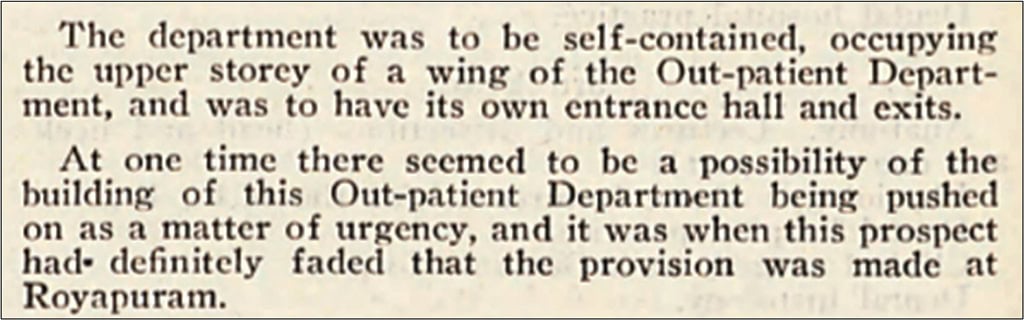
BOX 3. Projected expansion of the department of dental surgery, MMC-MGGH complex.
Badcock concludes with what he describes as the ‘collapse of the whole project: dental hospital, dental college, diploma, and registration’. Almost at the time of reaching final stages of sanction of the development of the ‘new’ dental college and its associated new hospital, with the issuance of a GO dated 8 September 1923, the entire project collapsed colossally.
Conclusion
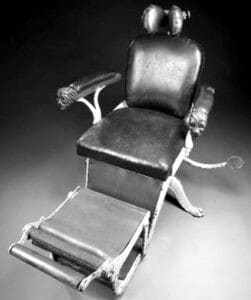
Fig. 1. Oil-pump dental chair with ornate handrests developed by the medical and dental practitioner Basil Wilkerson, Alabama in 1877 (Source: https://coll-ection.science-museum-group.org.uk/people/cp121360/ basil-manly-wilkerson).
This article fills the gaps in the growth and evolution of western-science based dentistry — teaching and clinical — in Madras. Regrettably we could not undo all knots, e.g., those of H Venkata Rao and HM Rao, pioneers of dental education in Madras in the early 20th century. However, we could decode most of the historical details between 1883 and 1927. We have clarified with relevant evidence that two LDSRCS-qualified British dentists Horace John Gould and Christopher Frampton Badcock were officially associated with the department of dental surgery in MMC and conjointly holding the role of the dental (civil) surgeon in MGGH. We have not been able to categorically establish whether Badcock came to Madras as an assistant (i.e., second dental surgeon), when Gould was the first dental surgeon in MMC-MGGH. What is absolutely clear, however, is that Gould taught dental surgery to senior students of the MBCM class in MMC from 1883 until the 1900s. We have gathered relevant evidence that Badcock was living in Madras, when Gould was already employed in MMC-MGGH. Most likely, Badcock was a private practitioner during his early days in Madras. Either in 1905 or 1906, he must have been appointed in the service of the government of Madras as the professor of dental surgery and first dental surgeon in MMC–MGGH, succeeding Gould on return to England. Although our inferences about Badcock are subjective, they are reasonably supplemented by details from his published papers in IMG, Calcutta.
That Gould filled in as an academic teaching basic dentistry in MMC and concurrently served as the surgeon treating dental problems of people who came to MGGH is clear from the details supplied in this article. His successor Christopher Badcock made efforts to establish a dental college in Madras, although unfortunately none of his efforts fructified during his stay in Madras, until the 1920s.
Badcock made concerted efforts to start a state-funded dental college in Madras. From the collected records we can see that Badcock’s efforts pre-date the efforts of Rafiuddin Ahmad in Calcutta, although importantly Badcock was not as successful as Ahmad, more likely because of the conservative thinking of the government of Madras. Badcock made sincere efforts of professionally training assistant (civil) surgeons from various rural government hospitals in Madras presidency in dentistry for defined periods of time from 1900s.
Overall, until the early years of 1950s, nothing eventuated in the context of an exclusive dental college and hospital in Madras. In the late 1949, the government of Madras, when Poosapetti Sanjeevi Kumaraswamy Raja was the Premier of Madras, approved the development of the department BOX 3. Projected expansion of the department of dental surgery, MMC-MGGH complex.of dental surgery as the dental wing, while remaining attached to MMC-MGGH. Only during the chief-ministership of Chakravarti Rajagopalachari of Madras state in 1952-1954, the department of dental surgery grew into an exclusive and independent dental wing. The government of Madras at this point of time, approved the construction of an additional floor in the extant outpatient block of MGGH. The Dental Wing of the MMC was formally launched in 1953-1954, training students towards the Bachelor-of-Dental-Surgery degree programme approved by the University of Madras. Another undeciphered element here is under what circumstances and when the dental department of MMC-MGGH, later shifted to GRH, returned to MMC-MGGH precinct!
The Department of Dental Surgery in Madras was developed as a department of MMC-MGGH in the 1880s to teach basic dentistry to senior students of general medicine and surgery via theory taught in MMC and practical classes held in the apportioned dental ward in MGGH, coinciding with the appointment of Horace Gould. No formal, exclusive training in dentistry leading to either a diploma or a bachelor’s degree occurred during the work times of either Gould or Badcock. This practice and limiting decisions of the government of Madras can be explained by the nature of developments in teaching and practice of dentistry in Britain. In the late 19th century, dentistry in Britain was seen as a sub-specialty of ‘surgery’ that came under the ambit of administration and regulation by the Royal College of Surgeons. Those desirous of practicing dentistry were required to hold a basic degree in general medicine and surgery (MBBS or equivalent) training in a British University (e.g., University of Edinburgh, Scotland). This was the reason why the LDSRCS diploma was awarded by the English, Scottish, Irish Royal Colleges of Surgeons. By 1956, the British Dentists Act 1921 had undergone multiple amendments. Consequently, a new, General Dental Council (GDC) of Britain came above the then extant Dental Board (DB) in the context of administration. One key stimulus for the GDC to acquire greater powers than the DB was that the Teviot Committee Report led by Charles Kerr (the First Baron Teviot) made in 1946, which argued that dentistry has matured into an independent medical profession, and therefore, it could govern itself.