The first serious attempt at town planning as a specialized matter of study undertaken by the Government of Madras was thanks to Lord Pentland, who in 1914 invited the multifaceted Sir Patrick Geddes to the city along with his popular exhibition on the evolution of cities. Remarkably, most of the exhibits were lost enroute to India, the vessel carrying them having been sunk by the Emden. Aided by friends at home, replacements were hurriedly sent and the exhibition opened at the Senate Hall in January 1915. Geddes would also tour 13 towns in the Madras Presidency and prepare a report on them. His visit was followed by that of HV Lanchester, who in 1916 would come on a tour of six months and prepare a seminal work titled Town Planning in Madras. It was in the backdrop of these that the Madras Town Planning Act was passed in 1920, following which the Madras City and Suburban Town Planning Trust was constituted. The Act also created a specialised post of the Director of Town Planning. Prior to this, the Sanitary Engineer and the Director of Public Health were the expert advisers of the Government in matters of town planning. One of the earliest Directors of Town Planning was Reginald Dann.
Born in Surrey in 1883, Dann was educated at Pontefract in West Yorkshire. Details about his early life and education are scarce, though it is stated that he won several competitions in England for the design of towns. Married to Freda Southall, whom he met while serving with the Friends’ Ambulance Unit and the Friends’ War Victims Relief Committee in France during World War I, the couple came to Madras soon after. In 1921, Dann was appointed as Director of Town Planning to the Government of Madras at a salary of Rs 1750 per month. His duties were to advise the Government in all matters connected with town-planning and to assist local bodies in carrying out the duties imposed on them by the Madras Town Planning Act, 1920. He was assisted by R.D. Narasimham, an alumnus of the Government College of Engineering, who had previously worked as the Assistant Engineer, Chengalpattu District and had also served as the Public Works Engineer, Sivaganga. Narasimham was elected a Fellow of the American Society of Engineers in 1924.
The appointment of Dann came at a time when our city was seeing a lot of activity in the creation of newer localities. Housing cooperative societies were starting to be formed, of which the Madras Government Servants Cooperative Building Society, formed in 1923 was the pioneer. This society’s layouts included localities in South Madras such as Gopalapuram, Lakshmipuram and Sriram Nagar. Dann’s inputs were informally sought in the creation of the Gopalapuram layout, as also in Gokulam Colony, a pioneering attempt at Harijan welfare in Triplicane in the late 1920s. The Madras City and Suburban Town Planning Trust too would draw up several schemes, in localities such as Ambattur, Nungambakkam, Kodambakkam and Mylapore. That most of these would not be sanctioned by the government on the grounds that the Trust did not have funds for the execution is another story. Over the course of his tenure, Dann also toured South India extensively, visiting places such as Madurai, Trichy, Srirangamand, and wrote articles on his findings for publications such as the Indian Geographical Journal.
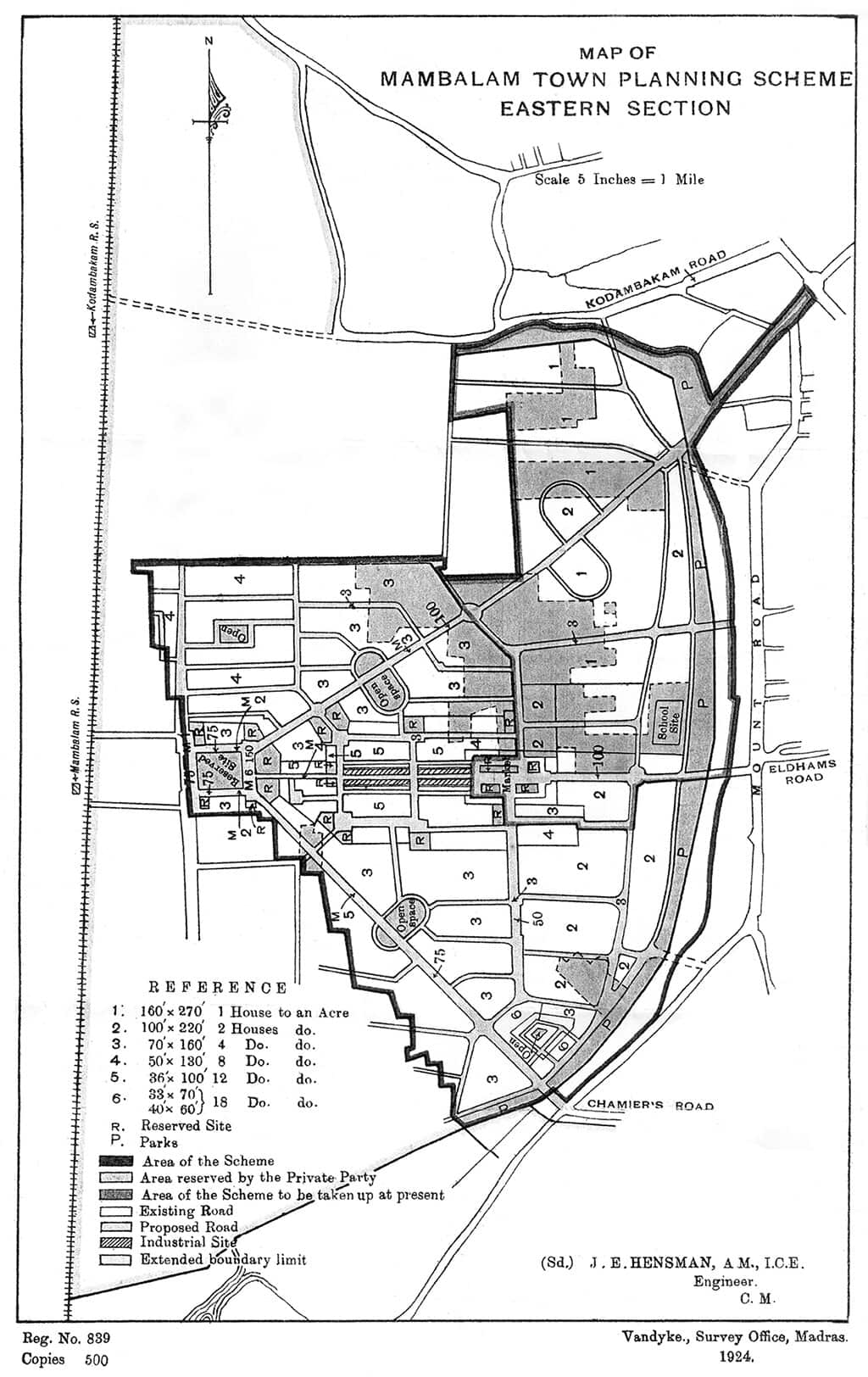
Of the schemes proposed by the Madras City and Suburban Town Planning Trust, the one that attracted most debate, chiefly owing to its ambitious nature, was the Mambalam Scheme, in 1923. When the nuances of the scheme, including its design were widely debated upon, Dann mounted a spirited defence. Writing in an article in the Garden Cities and Town Planning Journal, he stated that it was essential to implement the scheme as it would relieve the pressure of housing accommodation on the whole city to some extent, as it provided for 3000 house sites, translating to around 15,000 to 20,000 people. He also stated that criticisms of its design, particularly of the plot sizes was on account of an insufficient understanding of the concept of a garden city, which favoured an open type development rather than intensive development, as a larger percentage of land and money would be wasted on roads and other works in the latter.
The progress in town planning in Madras as a concept does not seem to have been as significant even after a decade of the introduction of legislation mandating the same. Writing in the Administration Report of the department in 1929-30, Dann remarked that the “situation called for a far more intensive and effective application of the powers of control, of guidance and of initiative, that are vested in local authorities for the development and improvement of their towns, than has yet been seen,” and noted that financial reasons were most frequently advanced as an excuse for failure to adopt a progressive town-planning policy, whereas it had to be emphasised that its neglect was a “luxury that poor local authorities could not afford”.
Dann was an ardent member of the Quaker brotherhood, officially known as the Religious Society of Friends, a Protestant Christian movement founded in the 17th century. This also led him to pursue several private projects within a short span of time since his appointment as Director of Town Planning, notable amongst them being the design of the church inside the Women’s Christian College, the Weslyan Mission in Tiruvallur, and the London Mission in Erode. In Vellore, he would provide the design for the Union Medical Mission hospital and medical school for women. These projects, while in government service obviously created a controversy, with the Madras Chamber of Commerce and the noted architect firm of Jackson and Barker lodging formal complaints with the Government of Madras. Nothing much seems to have come out of this, for Dann is noted to have designed more than twenty hospitals. He was in fact appointed Consulting Architect to the government in 1932. He also served as a member of the Town Planning committee of the Corporation of Madras and was also a special member to the Council.
Dann returned to England in 1937, where he was appointed by the Ministry of Health in connection with the hearing of appeals under the Town Planning Act. It was however a short-lived assignment, for he passed away in 1939 at the age of 56.
It remains a matter of intrigue that a man so central to the Mambalam Scheme is not commemorated in T Nagar and is largely a forgotten figure in the annals of 20th century Madras.