Sarabendra Bhupala Bhupati Bhosle (aka Serfoji the Second, Saraboji the Second; r. 1787-1793; 1798-1832), the titular ruler of Tanjavur Mahratta principality (presently in Tamil Nadu), was interested in human anatomy. Sarabendra’s interest in and knowledge of medicine is documented by Taravath Madhavan Nair (1868-1919), a medical practitioner in Madras city. Nair speaks of a human-eye model kept in his Kunstkammer (Cabinet of Curiosities) in the 1800s. Important it will be to recognise that Sarabendra performed cataract eye surgeries, although we have no record of the success rate. Sarabendra’s medical depository included two complete and accurately made life-size human skeletons: one of ivory and the other of sandalwood (below figure).
In an earlier article on the papier-maché anatomical model (Vol. XXXI No. 14, November 1-15, 2021), used in the hospital located in Fort St. George, decades before it formally transformed into the General Hospital in Madras in the 1800s that trained personnel for the Subordinate Medical Service, we had made an inconclusive reference to two life-size human skeletal models made by Sarabendra Bhupati Bhosle of Tanjavur. But we could not shed any light on the present whereabouts of the skeleton models made and maintained by Sarabendra. However, in the recent past, in 2025, we found an article by a medical doctor R.K. Rau, entitled Some interesting anatomical exhibits published in the June-December 1944 issue of the Bulletin of the Indian Institute of the History of Medicine (presently, the Journal of Indian Medical Heritage, Hyderabad).
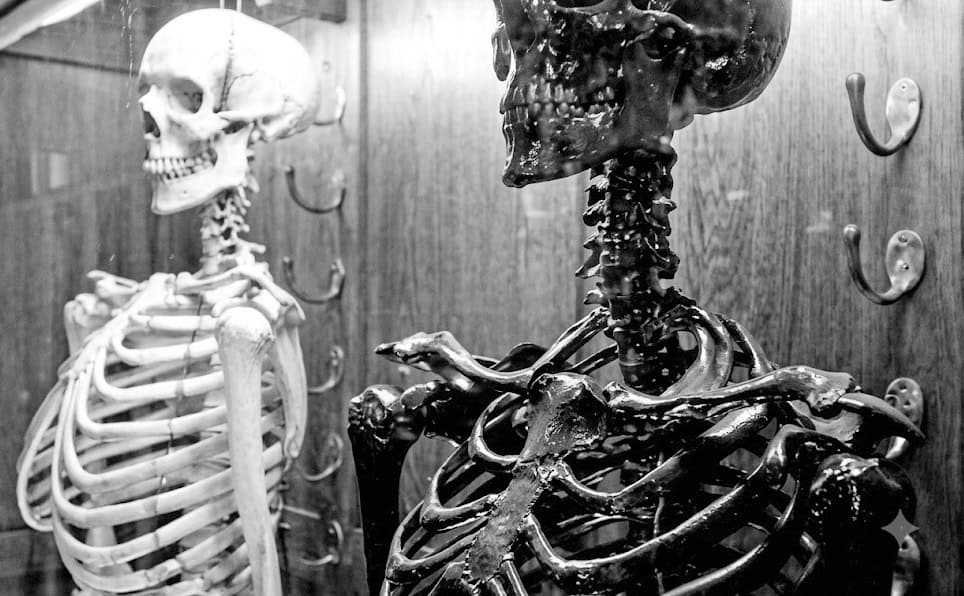
A recent-time photograph of the sandalwood (left) and ivory (right) skeletons stored in the Anatomical Museum of the Andhra Medical College, Visakapatnam.
Before we go into details of the skeletons spoken by Rau, providing some details of R.K. Rau, the author of the 1944 paper, will be in order. He was ‘Runganath Krishna Rau’, Professor of Human Anatomy, Andhra Medical College, Visakhapatnam, in 1929-1946. He had qualified for the Fellowship of the Royal College of Surgeons of Edinburgh. The Archives and Library website of the Royal College of Surgeons, Edinburgh shows his roll number (3295), date of admission into the Royal College of Surgeons of Edinburgh (19 October, 1927), and his professional status (Fellow). In early 1920s, Rau was lecturing in human anatomy at the Tanjore Medical School, Tanjavur. Rau originally published the anatomical-exhibits article in the Antiseptic (a monthly Journal of Medicine and Surgery) Volume 29, 1932. The same article was later republished as such, by Venkata Subba Reddy in the Bulletin of the Indian Institute of the History of Medicine in 1944.
Rau thinks that these near-life-size skeletal models (5’7”, c.175 cm tall) may have been displayed in the foyer next to the Saraswathi Mahal Library developed by Saraboji the Second in 1805-1810. These models were made at the behest of Saraboji for instructional purposes. Rau even tracks details of how he managed to get hold of these skeletons. Anyhow, a 2018 issue of The Hindu (6 April 2018, Visakhapatnam edition) refers to the same ivory and sandalwood skeletons safely stored in the Anatomical Museum of the Andhra Medical College, Visakhapatnam. That is gratifying because these pieces are treasures of scientific art and are still within India.
I could not track down details of how Saraboji II may have thought of creating ivory and sandalwood skeletal replicas. R.K. Rau does not clarify this point either. Presumably, Rev. Schwartz, his mentor, was the trigger. The Henry Wellcome Museum Collection, London, includes an ivory anatomical figurine of a pregnant human (far smaller than the Tanjavur skeletons; c. 20 cm in overall length) with some removable organs, crafted by an unidentified French person in the 17th-18th centuries. The Henry Wellcome Museum also includes a wooden sculpture of a human male showing muscles and arteries, carved in the mid-18th century Switzerland with no sculptor identified. Many new knots have been identified in the present article and hopefully time will untie them.
Notes
1. The Bulletin of the Indian Institute of the History of Medicine has a distinguished history and was founded by Danda Venkata Subba Reddy (1899-1987), who graduated from the Madras Medical College in 1925. Reddy set up the Department of History of Medicine in Andhra Medical College, Visakhapatnam in 1956. He pioneered exploring the medical history of India. Subba Reddy was a medical-science professor and he pioneered medical history of South Asia. Subba Reddy started the Department of Medical History in Andhra Medical College, Visakhapatnam in September 1956, but shifted to Hyderabad in December 1956. He was majorly inspired by Henry Ernest Sigerist of the University of Zurich, a medical historian, and a loud proponent of universal health care in the 1940s. Today the Department of Medical History, Hyderabad, has grown into the National Institute of Indian Medical Heritage, Hyderabad, managed by the Ministry of Ayush, Government of India.
2. The Tanjore Medical School grew out of the Prince of Wales Medical School, named to coincide with the visit of Albert Edward (the Prince of Wales) to Madras Presidency and established in Tanjore in the late 1870s. In the 1910s, this facility metamorphosed as the Tanjore Medical School utilising the Raja-Mirasdar Hospital (R.M.H.) as the hospital facility that was founded in 1876 through the initiative of Henry Sullivan Thomas, Collector of Tanjore. The generosity of the Mahratta royals (particularly, Kamatchi-Amba Devi) both as cash (Rs. 30,000) and as kind (40 acres of land) made the R.M.H. possible. A few wealthy local mirasdars (hereditary landowners in pre-colonial and colonial India who held rights to manage land – miras; they paid either rent or revenue to the rulers of pre-colonial days or to the administrators of colonial state) contributed further towards this effort, meeting the total expense of Rs. 96,000. The Madras Presidency Administration Report for 1907-1908, Ch.6, p. 83 speaks of the Tanjore Medical School that offered ‘hospital training’ in 1907-1908. The ‘hospital training’, most likely, implies the four-year long training towards an L.M.P. (Licenced Medical Practitioner) title. The L.M.P. qualified personnel were eligible for employment in the Subordinate Medical Service of the Presidency of Madras.
One notable alumnus of the L.M.P. programme of the Tanjore Medical School was ‘Vengu Iyer Kuppuswami’ – later Swami Sivananda (1887-1963) – who established the Divine Life Society, and who was born in Pattamadai, Tirunelveli, Tamil Nadu.
3. The Antiseptic was first established in Madras in 1904. It was edited and published by Udupi Rama Rau (1874-1952) and Taravath Madhavan Nair (1868-1919), who were medical practitioners in Madras city in early and mid-years of the 20th century.
4. Christian Friedrich Schwarz (1726-1798) was an Evangelical-Lutheran Missionary belonging to the Halle Mission and was stationed in Tranquebar (Tarangampadi). In 1766, Schwarz moved to the Madras Army Garrison, Trichnapoly (Tiruchirapalli), as the Garrison Chaplain. Schwarz was a friend of Thulaja Bhonsle, ruler of Tanjavur between 1763 and 1773; 1776 and 1787. Saraboji was the adopted son of Thulaja and the legal heir to the throne. When Thulaja died in 1787, Saraboji became the ruler of Tanjavur, at 10 years of age. Comprehensive education of Saraboji occurred in Madras under the direction of another Evangelical-Lutheran Missionary Christian Wilhem Gericke. Throughout his life, Saraboji maintained high regard and respect for both Schwarz and Gericke.
* * *
Footnote: How did Dr Rau take away the skeletons from Tanjore to Andhra remains an unanswered question. It also throws light on the porosity of historic collections in India. That these skeletons still remain within India is something we need to be thankful about.
–The Editor