A thousand-year journey from a Tamil temple to a Swiss physics laboratory, through colonial drawing rooms, smuggling rings, and the question of who owns a dancing god.
In the lobby of CERN, the European Organisation for Nuclear Research in Geneva, stands a two-metre bronze statue of Nataraja — Shiva as the Lord of Dance. It was gifted by the Government of India in 2004, and a plaque beside it quotes the physicist Fritjof Capra: “Modern physics has shown that the rhythm of creation and destruction is not only manifest in the turn of the seasons and in the birth and death of all living creatures, but is also the very essence of inorganic matter.”
It is a striking image: the cosmic dancer beside the particle accelerator, Hindu metaphysics meeting quantum physics. But the neat symbolism obscures a far more turbulent story — one that stretches back to the foundries of the Chola empire and passes through some of the most uncomfortable chapters of India’s cultural history.
Cast in the Chola fire
The Chola dynasty, which ruled much of South India from the ninth to the thirteenth century, did many things extraordinarily well: naval warfare, irrigation engineering, temple construction. But their most enduring legacy might be their bronzes.
Chola bronze-casting followed the lost-wax method — madhu uchchishta vidhana — a technique so refined that metallurgists today still study it. A wax model was sculpted in exquisite detail, encased in clay, and heated until the wax melted away, leaving a hollow mould. Molten bronze — an alloy of copper, tin, lead, and sometimes gold — was poured in. When the clay was broken open, a deity emerged, unique and unreproducible. Every Chola bronze is, by definition, an original.
The Nataraja form crystallised during this period. Earlier depictions of Shiva dancing exist — in Badami cave sculptures, in Pallava reliefs at Mahabalipuram — but it was the Chola artisans who gave the image its definitive form: the right foot crushing Apasmara, the demon of ignorance; the ring of fire representing the cosmos; the drum in one hand beating the rhythm of creation; the flame in another signifying destruction. It is, as the art historian Ananda Coomaraswamy wrote in 1918, “the clearest image of the activity of God which any art or religion can boast of.”
These bronzes were not museum pieces. They were — and in many temples still are — processional deities, carried through streets during festivals, bathed, dressed, and worshipped as living presences. The Western distinction between “art object” and “religious artefact” simply does not apply.
The Colonial Drain
The British were enchanted by the bronzes almost from the moment they encountered them. Colonial officers, amateur archaeologists, and professional dealers began acquiring them in the nineteenth century — sometimes purchased from temples in financial distress, sometimes simply taken.
The scale of removal was staggering. The British Museum holds over sixty Chola bronzes. The Victoria and Albert Museum, the Metropolitan Museum of Art in New York, the Cleveland Museum, the Norton Simon Museum in Los Angeles — the finest specimens of Tamil devotional art are scattered across institutions that most Tamil people will never visit.
This was not ancient history tidying itself up. As recently as 2020, the Norton Simon Museum was in negotiation over a Nataraja that had been stolen from a temple in Tamil Nadu in the 1950s. The statue — known as the “Sivapuram Nataraja” — had been sold through a chain of dealers, laundered through auction houses, and displayed in Pasadena for decades before Indian authorities traced its origin.
The idol wing and the modern smuggling trail
India’s efforts to recover its stolen heritage have been uneven but increasingly assertive. The Tamil Nadu Idol Wing, a specialised police unit, has been at the centre of several high-profile recoveries. In 2016, the Australian government returned a Nataraja valued at five million dollars to India after it was linked to Subhash Kapoor, an art dealer who ran a smuggling operation spanning three decades and four continents.
Kapoor’s network — now the subject of books and documentaries — reveals how the trade works. A bronze is stolen from a temple or illegally excavated from a site. False provenance documents are created, often citing fictitious “private collections” dating to the colonial period. The piece enters the international art market through galleries in Hong Kong, London, or New York. By the time it reaches a museum, its origin has been buried under layers of paperwork.
The Kapoor case led to the return of over two hundred artefacts to India. But thousands remain abroad, their provenance disputed or deliberately obscured.
What belongs where
The Nataraja at CERN is not stolen. It is a modern cast, a diplomatic gift, and its presence in Geneva is entirely legitimate. But it exists in a context shaped by the illegitimate removal of its ancestors. When an Indian visitor sees Shiva dancing in a Swiss lobby, the reaction is rarely simple. There is pride — our metaphysics on the world stage. There is discomfort — why is it always our heritage that needs to travel to gain validation? And there is the unavoidable question: what about the ones that did not travel voluntarily?
This is the tension at the heart of India’s heritage conversation. Preservation and repatriation, national pride and universal access, the temple and the museum — these are not problems with clean solutions. The Chola artisan who cast the original Nataraja was making a god, not a commodity. A thousand years later, the world is still trying to figure out the difference. The dancing god, as always, is unmoved.
God and Works of Art
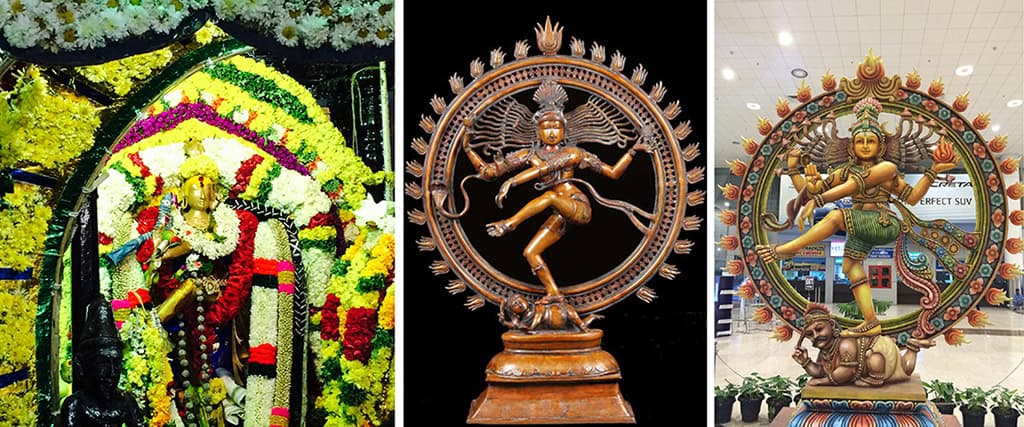
Nataraja in worship, in a museum and at an airport.
– Barath is a B.Tech CSE Student at VIT Vellore