My cousin Raman was my first cricket hero among people I knew personally. He was my first cousin, my elder brother by Tamil tradition, almost three years my senior, and already playing competitive cricket at the junior level when I was slowly making my way into the school team (largely owing to my being his cousin). My joy knew no bounds when I opened the sports page of The Hindu one morning and was greeted by Raman’s photograph. He had taken eight wickets in an innings for City Schools vs. Districts Schools in the annual selection match for the State Schools team. He was then an orthodox leg spinner with a nice loop and a smart googly, and there was no stopping him after such a splendid start.
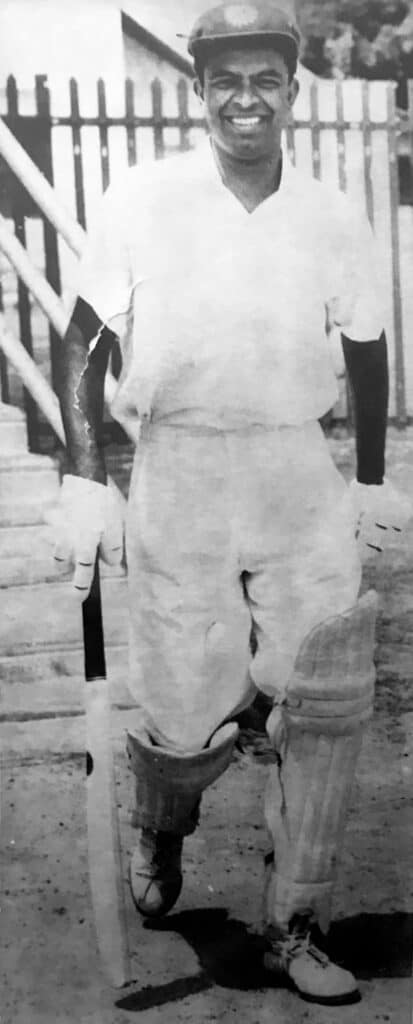
Young Raman.
It was while Raman – P.S. Ramachandran, to give his full name, was pursuing his engineering degree at the PSG College of Technology, Coimbatore, that his cricket career fairly exploded and he became the darling of the crowds in that part of the world. He had evolved into an attacking opening batsman and an unusual spinner who sent down thunderbolts of leg breaks and googlies, in fact, more googlies than leg breaks – the result of his growing into a tall, solidly built young man, I believe. One of the things he did successfully as an opening batsman was to send the new ball over mid wicket or square leg with an imperious flick of the wrists, something today’s spectator would find unsurprising, but was sensational back then. I was lucky enough to watch some of his more brilliant knocks. And, believe you me, he was as successful as a bowler in junior and university cricket as one of his rivals from Bangalore, the one and only B.S. Chandrasekhar, who soon afterwards went on to become one of the world’s great wrist spinners.
By the time I started playing in the senior Madras league, Raman had unfortunately struck a rather long bad patch, perhaps more distressing to me than him, for not only was he my hero, but also my greatest supporter who wished the very best for me. He and I played together for a strong Alwarpet CC in the league, and, while I performed with reasonable consistency, Raman rarely troubled the scorer, and his bowling had completely deserted him. At the end of the season, I left Madras for good. I came to know that Raman left the ground half way through a match in protest against an attempt by his team to tank a match to help the opponents to stave off relegation from the first division. I was proud of him, but also saddened by his loneliness.
Raman soon moved to New Zealand, helped by the sports writer R.T. Brittenden, a friend of Raman’s father P.N. Sundaresan, the sports editor of The Hindu. Raman was living in that country during my first tour of Australia in 1977-78, with the Deccan Blues, but neither of us could cross the Tasman to meet the other during those cash-starved times. I had to wait till the summer of 1986 to meet Raman again. He had now moved to Australia and made Sydney his home, and I was a member of a team called Madras Occasionals led by the late Ram Ramesh, another talented cricketer and colourful character of Madras cricket. My wife Gowri and I basked in the warmth and hospitality of the Ramachandrans – Raman, his wife Raji, and his young son Arjun – for about a week. Raman was enjoying his cricket again, and his leg spin was apparently a big hit in Sydney’s club cricket. One of his teammates going by the name of Steve Waugh later went on to lead Australia. Waugh in fact praised Raman’s bowling during a newspaper interview, a clipping of which I saw during my visit. When I met Steve Waugh many years later, however, he had no recollection of Raman or the interview.
During the Sydney phase of Madras Occasionals’ tour of Australia, we invited Raman to open the innings for us in one of our matches. No one could have been more excited than I at the prospect of watching a vintage Raman knock, but alas, my cousin was run out in the very first over of the match!
Tragedy of a much greater magnitude dogged Raman. Not long after I returned to India, we received news that he had been diagnosed with cancer. The prognosis was pretty bad, and the doctors did not give him much time. He and his family then came to Madras to try homeopathy (banned in Australia), I believe – as a last resort. He eventually underwent allopathic treatment at Apollo Hospitals as advised by my doctor sister Sarojini, and his condition showed some improvement before he returned to Sydney, though we all knew it was perhaps only a temporary reprieve.
Raman was the most devoted cheerleader of the Tamil Nadu team’s Ranji Trophy campaign that season, his enthusiasm quickened by the presence of my brother V. Sivaramakrishnan in the team. Siva had a string of good scores leading up to the final against Railways, in which he made 94 as TN piled up over 700 on its way to a trophy triumph. Raman actually rode a scooter to the stadium every morning defying medical advice and common sense, somehow clambered up steep stairs to the pavilion terrace, and sat in a corner of the topmost row surrounded by his paraphernalia.
There were many outstanding performances – by skipper S. Vasudevan, M. Venkataramana, Robin Singh, V. Sivaramakrishnan, L. Sivaramakrishnan, V.B. Chandrasekhar and others – but you could not take away from Raman’s sterling contribution as he willed TN to that memorable victory 32 years after its first Ranji title.
Raman passed away in Sydney a few months later, all our prayers going unheard.