The Government College of Fine Arts (formerly, the Government College of Arts and Crafts), Egmore, is the oldest institution of its kind in the country. Last year marked 175 years since its initial founding as the Madras School of Art by Dr Alexander Hunter in 1850. Surprisingly, there was no major public commemoration of this milestone. Over the course of the next few issues, we present a profile of this historic institution, which was originally written in 2020 for the book Nurturing music and fine arts – A historical perspective, brought out by the Tamil Nadu Dr J Jayalalithaa Music and Fine Arts University, to which the institution has been affiliated since 2013.
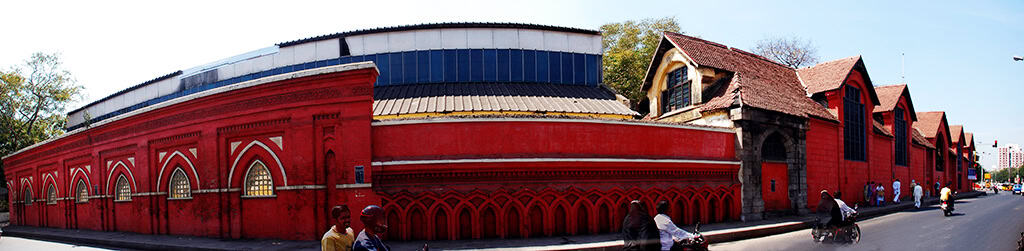
Panoramic view of Government Fine Arts, Chennai. Picture courtesy: Wikipedia.
The Government College of Arts and Crafts, Egmore, is the oldest institution of its kind in India. Over the course of its existence, it has played an important role in the development of our traditional arts and crafts as a formal branch of study and documentation of its various forms. Several distinguished names in the world of arts, architecture and sculpture such as EB Havell, RF Chisholm, KCS Paniker and DP Roy Choudhury have served as its Superintendents and Principals. It has also produced several notable alumni such as KM Gopal, KM Adimoolam and S Dhanapal. This hallowed institution had its genesis in the Madras School of Arts, founded in 1850 by Dr Alexander Hunter, a surgeon of the East India Company.
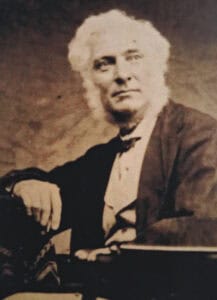
Dr Alexander Hunter.
Born in 1816, Dr Alexander Hunter arrived in India in the 1840s after having had his medical education in Edinburgh. He was a man of varied interests, as he had studied natural history and botany too while pursuing his medical education. He had also passed through a formal course of study in the School of Design under the Royal Scottish Academy. His artistic education was completed at the School of Design in Paris.
Arriving in India, Dr Hunter was posted as a medical officer in Chenglepet near Madras, where the light nature of work meant that he occupied himself with collecting minerals and objects of natural history. He found the area to be rich in clays, feldspars and siliceous rocks, which were useful for making pottery and porcelain. Engaging the services of a local potter, he learnt the technique of making pottery and soon, native potters were being enabled to work accurately from drawings under his directions. The manufacture of bricks and tiles was yet another area where he spent considerable attention. Acquiring the services of two soldiers who had worked in the Staffordshire and Welsh potteries, he engaged the prisoners of the Chenglepet jail in making tiles and good bricks. In a short span of time, forty to fifty different qualities of pottery of various shades were being made in Chenglepet. Several porcelains and glazes of English, French and Italian varieties were also being produced. Hunter sourced the minerals for making the moulds and other raw material such as pastes for the wares from across various places in South India. In 1850, the machinery, apparatus and moulds were shifted to the Orphan Asylums in Black Town in Madras with the permission of the Government.
Dr Hunter was transferred to Madras a short while later and was appointed the surgeon of Black Town. Struck by the poverty of the native inhabitants and with a view to providing them with gainful employment, Dr Hunter promoted several new occupations. These included pencil-drawing, casting of bronzes and cutting of marbles, making of ropes, cleaning of fibres of aloe, plantain, palmyra and coconut leaves, etc. With a view to promote industrial activity, rewards were offered for discovery of clays suitable for pottery, for native sulphate of lime and for a substitute for linen-thread from the fibres of the plantain. The natural consequence of all these activities was the establishment at his own cost, of a School of Arts in Madras.
The account of the initial years of the School as reported in The Arts Journal make for interesting reading. The announcement of the establishment of an institution for the promotion of art education seems to have been welcomed with cheer, going by the great number of applications from Madras and afar. A branch school at Vepery and subsequently another branch at the Military Male Orphan Asylum were opened, under the superintendence of masters trained under Dr Hunter. A fee of one rupee per month was charged from the students. This was augmented by Dr Hunter, who apart from contributing personal funds, also gave up the lower part of his house and library for the running of the school.
The subjects taught included geometrical and free-hand drawing, lithography, wood engraving, etching and pottery. Students whose works were advanced were also helped to market their produce. An industrial school was added a couple of years later, where glazed, painted and encaustic tiles, and bricks of all kinds were produced. Paper made from plantain and aloe fibre for drawing and writing purposes was also produced. Attempts were also made at modelling and casting of native figures, toys and table ornaments. Dr Hunter also started a journal called the Indian Journal of Arts, Sciences and Manufactures, a richly illustrated work with lithographs and etchings which had a lot of material on the various subjects taught. However, its publication ceased after just nine issues.
Over the first three years of its existence, the total number of students in the artistic department was 472, while the industrial department had 45 students. Dr Hunter applied to the Government to be relieved from his duties in order to devote his time to the schools. Unwilling to part with his services, the Government made him a medical store-keeper, which gave him more time at his disposal. Around this time, a committee had been formed to look into the management of the industrial school. Considering the progress of the students, it was recommended that the Government be approached for support. A sum of Rs 500 per month for five years was sanctioned as allowance for the services of a glaze-fireman and a good artist, besides a one-time grant of Rs 6000 for the purchase of machinery, models, casts and studies from England. In March 1855, the school was taken over by the Government.
In 1856, Dr Hunter received the services of an able assistant in the form of Archibald Cole, an artist from the Kensington School of Design, who was made in-charge of the Industrial Section. Hunter for a brief while returned to England in 1858 on sick leave and returned a year later. He took the advantage of his visit to study copper plate engraving and also receive some lessons in wood engraving. The School was put under the superintendence of Dr CM Duff during his absence. Dr Duff introduced the manufacture of bricks, paving and roofing tiles, water pipes and construction of cooking ranges in the Industrial Section during his tenure. In September 1859, Hunter resumed charge of the institution.
In 1860, the School found itself being the subject of a Special Enquiry instituted by the Government of Madras into its working and as to whether it would be viable to continue running it. This was necessitated by the fact that there seemed to be a prevailing opinion that the institution was not making much progress by way of producing tangible results. The Committee undertook a thorough investigation into its working and unanimously recommended that the School, by virtue of its uniqueness, had an important role to play in the development of the arts and should continue to function. It drew attention to the pottery workshops established by Arunachalam Mudali at Chintradripet and to the brick and tile manufactory undertaken by Mr Midford in Poonamallee High Road, both with the help of machinery and people supplied by the School. It also adverted to the opinion of the civil architect and of Mr Wright, locomotive Superintendent of the Madras Railway, both of whom attributed good results to the School of Arts. The fact that the students of the Engineering College regularly underwent training at the School in areas such as brick and tile making, was also instrumental in the Committee pronouncing its verdict. In order to improve its usefulness, the Committee made a set of recommendations, which included employing of additional manpower to assist as teachers, instituting of prize scholarships to induce art students to prolong their stay in the school, etc.
Even after being finally relieved from medical service, Dr Hunter’s services were retained by the Government as he was appointed on several committees such as the Sanitary Committee, the Drugs Committee, a Farm Committee and also the Committee of the Agri-Horticultural Society. The School of Arts was of great assistance to these committees in drawing, etching, engraving and painting illustrations for their proceedings, besides making useful and ornamental terra-cotta works, draining tiles and flower vases. Yet another institution that greatly benefited from Dr Hunter’s services was the Photographic Society, of which he was one of the founders in 1857. The Photographic Society in fact functioned from the premises of the School of Arts during its initial years. Photography as a subject was introduced by Dr Hunter in the School as early as 1855-56, just over a decade since its invention in 1839. Today, several photographs of Madras city and the Presidency taken around the 1870s and 1880s have been digitised and preserved online.
With the question of its existence being resolved, the School of Arts began to establish itself as a mentor for other institutions of its kind being setup across the country. It was approached for assistance and advice in the establishment of similar institutions in various places such as Bombay, Calcutta and Jaffna, besides in States such as Travancore, Vizianagaram and Jeypore. In all, assistance was offered to 33 schools. By the time Hunter retired in 1873, the School had taught more than 4200 students, of which a large percentage had found remunerative employment in Government and other establishments.
Following Hunter’s retirement, Major WS Hunt was appointed Acting Superintendent of the School. Despite the special instructors as recommended by the Committee and approved by the Government more than a decade earlier not being appointed, the Administration Report of the Madras Municipality for the year 1876 noted that the quality and quantity of work done at the School was remarkable. As evidence of the same, the School had been awarded a gold medal by Her Majesty’s Commissioners for contribution to the International Exhibition of 1873 and two other medals for casts and metal works sent to the Vienna Exhibition the same year. Dowley, the Foreman of the Industrial Section had also been awarded a silver medal for the specimens of the ceramic ware, casts, etc. at the Madras Fine Arts Exhibition that had been just held.
In 1873, the School yet again found itself the subject of an enquiry instituted by the Government about its functioning. Reviewing the areas where it had made progress and areas that needed attention, the Committee formed for this purpose suggested various remedial measures such as appointment of a Superintendent for the entire institution (as opposed to different ones for the Industrial and Art sections), employment of an artistic instructor with a British reputation and the gradual expansion of the school into an industrial college. The Committee also specified the subjects it would like to be taught in the Industrial and Art departments.
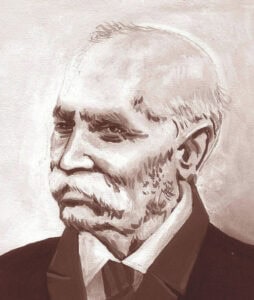
Robert Fellowes Chisholm. Picture courtesy: The Hindu.
The call for appointment of a Superintendent (albeit not a full-time one) was answered in the form of a man who was altering the landscape of Madras around this time, RF Chisholm. Employed as Executive Engineer of the Puri Division under the Government of Bengal in the early 1860s, Chisholm arrived in Madras in 1866, having won the prize instituted by its Government for the best design for the Presidency College on the Marina. A new designation Consulting Architect to the Government of Madras was created especially for him by the Governor, Lord Napier. Amongst Chisholm’s earliest contracts was the construction of the PWD Buildings on the eastern face of the Chepauk Palace. Chisholm would then go on to work on several other projects such as the old Madras Club buildings (on the grounds of the Express Estate), the B&C Mills in Pulianthope, conversion of the old courts in Royapettah into the Amir Mahal and the renovation of the Tirumalai Naik Mahal in Madurai.
Chisholm’s growing stature meant that he was the natural choice to relieve Major WS Hunt of his charge. It was around this time that he was also involved in his most famous work in Madras, the Senate House of the Madras University which was inaugurated in 1879. The campus of the Madras School of Art became his home, as he employed the students of the School extensively in designing the interiors of the Senate House. The variety of stained glass, mosaic and painted canvases produced by them under the watchful eyes of Chisholm are a sight to behold even today. In an article titled ‘Indian Industrial Development’ published in 1909 in the Journal of the East Indian Association, Chisholm would recount how the School worked in conjunction with the Consulting Architect’s office during his tenure. The School became the architect’s workshop and the materials and articles indented for and supplied by it was paid out of sanctioned estimates for public buildings. He also recounted its working, which was divided into the morning and afternoon halves. While the mornings were spent in ‘educational activities’, the students worked on the industrial projects as apprentices at the various handicrafts in the afternoons.
Chisholm’s tenure as Superintendent was also marked by changes in the courses of instruction. A branch for girls was opened in the Arts department. It was however short-lived, for by 1879-80, it had become defunct. Two new branches of Industry were added, viz., enamelling glass and decorating in oil colour, and two others, metal work and wood carving were revived. The Artistic and Industrial Departments were also amalgamated.
Chisholm’s stint in Madras ran into troubled waters in the 1880s, when charges of irregularities in maintenance of accounts surfaced. He had been angling for the post of the Superintending Engineer of the Madras Presidency, an appointment that the Government was not keen on conferring him with. This must have also been instrumental in the search for a successor to replace him as Superintendent of the School of Arts. The search ended with the appointment of EB Havell, an artist from England.
Nothing much is known about Havell’s early life, except that he was an alumnus of the School of Design, South Kensington, which later became the Royal College of Art. He was appointed as the Superintendent of the Madras School of Arts in 1884, which marked the beginning of a two-decade teaching career in India. He was the first full-time Superintendent of the institution, a post that had been recommended by the Committee a decade earlier. His tenure was initially for a period of five years and he was appointed on a salary of Rs 500 per month, with an additional allowance of Rs 50 per month towards house rent.
Havell was instrumental in modifying the curriculum and introducing the study of Indian designs and decorative patterns into the courses. Going against the popular opinion prevailing at the time amongst the authorities that Indian architecture was truly a matter of the past, he set about actively trying to dispel the myth. Soon after taking charge of the School, he hired three master craftsmen, a woodcarver from Ramnad (Meenakshi Achari, later succeeded by his son Kalimuthu Achari), a sthapathi from Kumbakonam (Ramaswamy Sthapathi) and a goldsmith from the Vizianagaram district to teach the crafts that he wished to develop as courses of study. Wood-carving as a course had been started as early as 1877 but had not been popular until a regular class was established. The increasing demand for carved furniture amongst the Europeans led to a corresponding increase in the demand for the course. While the framework or structure of the wood work was that of a modern cabinet maker, the ornamentation drew greatly from the Dravidian models.
(To be continued next fortnight)