Madras Dyslexia Association is a not-for-profit organisation which has been empowering children with specific learning disabilities since 1991. Founded by D. Chandrasekhar, along with specialists and a group of parents of children with dyslexia, MDA has transformed the lives of thousands of children with this condition.
The organisation was set up at a time when there was no awareness about this condition, no empathy for individuals afflicted with it, and no remedial support to help them cope with these difficulties. Tireless and proactive efforts across the past 34 years have enabled a structured dyslexia-sensitive learning-environment empowering children with dyslexia.
Understanding specific learning disability
Specific learning disability (SLD) includes a number of learning disabilities such as dyslexia, dyscalculia and dysgraphia. It is a neurological condition that affects one or more processes related to learning, impacting basic learning skills i.e. reading, spelling, writing and/or maths. These difficulties could impact the individual’s emotional wellness. SLD can also interfere with higher level skills such as organisation, time planning, abstract reasoning, long term memory, active working memory, short-term memory and attention.
Generally speaking, people with specific learning disabilities are of average or above average intelligence. There often appears to be a gap between the individual’s potential and actual achievement. This is why specific learning disabilities are referred to as “hidden disabilities”: there are no physical manifestations, and the individual may be unable to demonstrate the skill level expected from someone of a similar age. Hence, children (nearly 10-15 per cent of school-going children) with SLD are often misunderstood and accused of not listening, being lazy or clumsy, resulting in low self-esteem, confidence and motivation.
Since difficulties with reading, writing and/or maths are recognizable problems during the school years, the signs and symptoms of learning disabilities are most often diagnosed during that time. However, some individuals do not receive an evaluation until they are in post-secondary education or when adults in the workforce. Other individuals with specific learning disabilities may never receive an evaluation and go through life, never knowing why they had difficulties with academics and why they may be having problems in their jobs or in relationships with family and friends.
SLD cannot be cured or fixed; it is a lifelong challenge. However, with appropriate support and intervention, people with SLD can achieve success in school, at work, in relationships, and in the community.
The MDA’s mission is to
- Identify and support children with dyslexia through assessment and remediation.
- Empower teachers and parents through training.
- Create awareness across schools and communities.
- MDA is equipped to handhold an individual with dyslexia through different stages of life – from pre-primary to adulthood. It provides a gamut of services from spreading awareness to assessment to remedial support to enabling teaching fraternity through training and development of teaching aids.
MDA identifies at-risk children, builds up skills and empowers them with coping strategies, through their educational phase. In addition to these full-time and after-school remedial centres, it works closely with the schools to sensitize and train the teachers, and set up and help run resource rooms within the school in order to provide support at the front end within the school environment. Special educators in resource rooms, are developed through MDA’s flagship “Intensive Teacher Training programme”. All the training programmes are based on MDA’s deep understanding stemming from the practical experience of remediating children in its full-time Ananya Learning and Research Centre and after-school remedial centres.
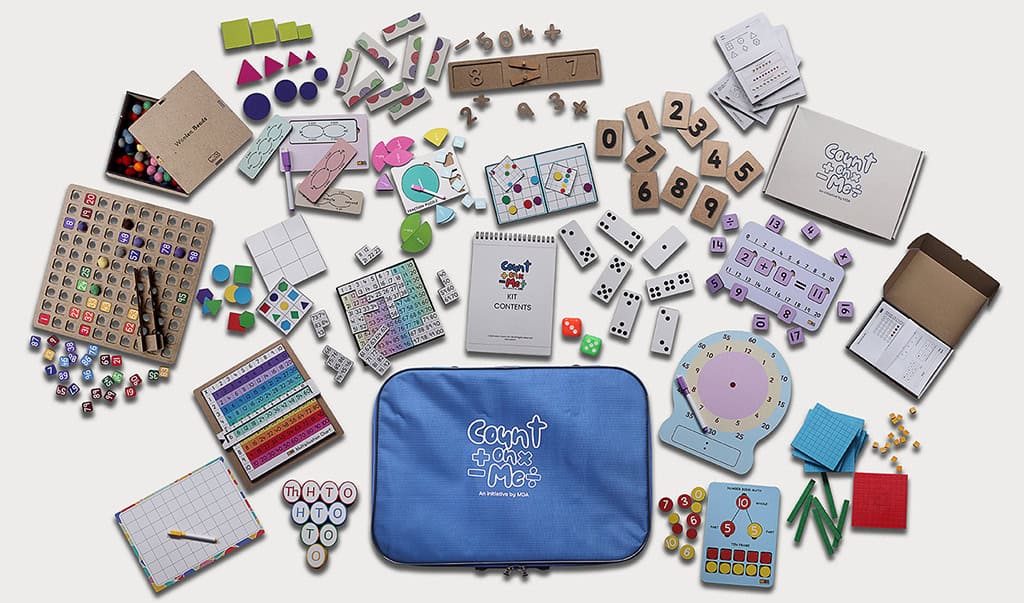
A picture of the recently developed maths kit called Count on Me.
In 33 years, various coping strategies have been successfully taught to children directly and indirectly and their effectiveness has been time-tested and proven. For instance, MDA has put-together a set of exercises (called Wonder Exercises) that complement remedial teaching by preparing the mind and body to receive remedial support. This innovation is cost-effective and easy to deliver.
These activities have enabled MDA to assess over 10,000 children, remediate and mainstream over 5,000 children. Over 25,000 teachers have been trained through face-to-face programmes and another 7,000 through the online portal at NPTEL platform of IIT Madras. MDA has empowered 2,000+ individuals to become special educators/ specialists in dyslexia. It has set up nearly 200 Resource Rooms all over Tamil Nadu, one each in Hyderabad, Nellore, Bangalore, Bhubaneshwar and in Raipur. The next one is coming up at Gangtok.
MDA has also collaborated with the Government of Tamil Nadu to sensitize and train teachers in all the districts of the state to equip them to identify and help children with dyslexia. It has supplied remedial kits to enable these teachers to provide the support.
The services offered by Madras Dyslexia Association are:
- Creating awareness on dyslexia in schools, corporates, parents.
- Conducting training programs for mainstream school teachers. This includes teachers from pre-primary, primary and middle school.
- Intensive Teacher Training programme that trains an individual to become a special educator for children with dyslexia.
- Setting up and monitoring Resource Rooms in mainstream schools.
- Assessing school children for dyslexia.
- Providing full-time and part-time remediation for school children with dyslexia.
- Providing Remedial kits in English and Tamil and workbooks developed by MDA for teaching children with dyslexia.
- Providing math kits and workbooks developed by MDA for teaching children struggling to learn math.
- Providing MDA Avaz Reader app to help children with dyslexia.
- Publishing newsletters to disseminate information on dyslexia.
These initiatives have enabled MDA to reach out to as many children as possible notwithstanding the physical barriers of classroom size and distances.
While some of these activities are paid for by the recipients, a large proportion of them are supported by CSR initiatives of corporates, and by donations from individuals.
Next steps
Leveraging the deep penetration of internet and device accessibility, MDA is closely working with IIT Madras on the development of an app powered by AI to screen children for dyslexia, empower their caregivers to initiate training to them on use of coping strategies and reinforce the learning with activities and games. This project is supported by Cap Gemini. This is the next step to reach out to children who are unable to access the facilities of a resource room, learning center or a special educator; not limited by constraints of distance and time.
MDA hopes to inspire many more individuals to understand this condition and join hands with it. Let’s together Embrace, Empower and Elevate individuals with dyslexia!
Please contact Kalyani Balakrishnan, 98410 47550 for more details on MDA. Email id: ananyamdachennai@gmail.com
Hats off to MDA for their selfless contributions to Society. I bought some of the products of these dyslexia children. They have got some special talents. It’s honing their skills is a real challenge to the caregivers and teachers. The parents should also come forward to put their children in such centres to get them a life.