We were writing on this subject in 1992 and we are still doing it in 2026. The story of Tamil Nadu’s Heritage Commission seems never-ending. The Government, which has of late been doing a commendable job when it comes to preserving heritage buildings under its purview, has however not bothered to bring in larger systems and procedures into place. That is the responsibility of a heritage commission and unless that is in place, a heritage act will remain just on paper. Conservation and preservation will remain subject to the whims and fancies of the party in power.
The High Court of Madras on January 29 questioned the Tamil Nadu Government as to why it had not yet constituted a heritage commission that could look into the conservation and preservation of ancient structures not covered under the Ancient Monuments and Archaeological Sites and Remains Act of 1958 (GOI) and its State equivalent dating to 1966. This is not the first time that the High Court has questioned the Government over its tardiness in the matter. In February 2024 the High Court was shocked to know such a Commission was not yet constituted. Then in October 2025 it ordered the State Government to constitute such a panel in four weeks flat. Obviously, the State Government follows a calendar that is different from ours. Or as Florence Nightingale famously observed, “at once in Madras is measured in periods of Indian cosmogony”.
A Screenshot of the State Archaeology Department Website.
The State Government in response offered what can only be described as dilatory tactics. It said it had advertised for applications from eminent persons to fill in the post of Chairman and had thus far not received any suitable responses. When pressed it came to light that the said advertisement was released on the State Archaeology Department’s website. The Court had difficulty in accessing the site and then directed the State to release advertisements to the same effect in dailies, which presumably has been done.
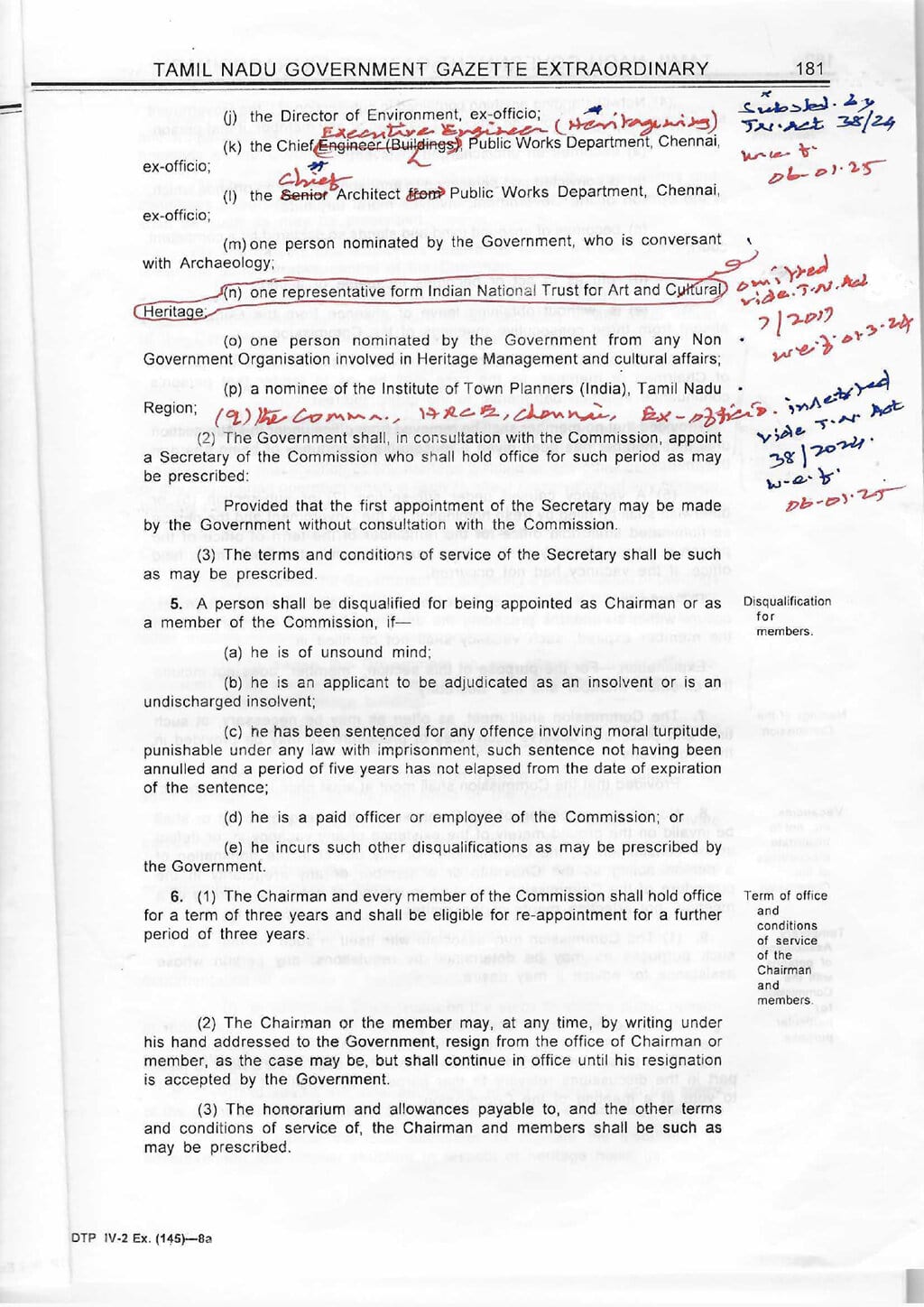
Incidentally, Madras Musings did access the site and found the announcement asking for applications. What was interesting was that the supporting document, which is the gazette notification of the Heritage Act and the constitution of the panel, has numerous handwritten corrections on it, which we reproduce alongside. This is hardly the way an advertisement on a Government website ought to be released.
Be that as it may, it is worth noting here that between 1992 and 2010, S Muthiah was more or less a lone voice writing repeatedly about the necessity for passing a Heritage Act and a Heritage Commission to be set up in the State. The first judgement in this matter came in 2010 when Justice Prabha Sridevan recommended the adopting of the Justice Padmanabhan Committee report on heritage buildings. A lame duck commission was constituted and then when it did not cover itself with glory came the Heritage Act of 2012. It put the cart before the horse for the commission predated the act and so could do nothing. That meant a fresh commission had to be in place which it has taken the State Government all of 13 years to constitute.
Rather miraculously, the fate of public buildings improved dramatically in the interim. These were of course the big and news-worthy ones. Several others, big and small have vanished and as for private buildings, they have all gone – most owners preferred to demolish and sell before a Heritage Commission prevented them from doing so. What was left in a limbo was the repairs and restoration of temples. And that is where the present attention of the Court has come in. It remains to be seen what happens next. The latest advertisement calls for applications before 5.00 pm on February 18th, 2026 and further action will result only after due scrutiny of the applications received.
A well researched article on on the Heritage buildings in Chennai. It’s high time some action is taken to protect the Heritage buildings in and around Chennai otherwise the avaricious Real Estate brokers with the connivance of the political bigwigs will sell them at cheaper rates . And the present Tamilnadu government facing anti-incumbency factors in the ensuing elections will simply keep quiet. So we have to keep fingers crossed till a newly elected government is formed.