The origins and the subsequent journey of our national song Vande Mataram have been well-documented. Appearing in noted Bengali novelist Bankim Chandra Chatterjee’s Anandamath (1875), it became a clarion call during the nationalist movement, as a prayer to the motherland. The man who undertook the Tamil translation of the novel was M. Kuppuswamy Iyer, or Mahesa Kumara Sharma by which name he was more popularly known. This article is a brief profile of this pioneering Tamil translator of the early 20th century.
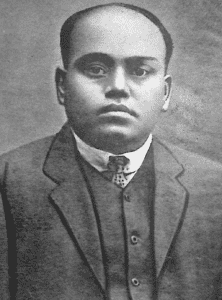
Mahesa Kumara Sarma.
Kuppuswamy Iyer was born into a poor family in Mambakkam, a village in North Arcot district. His year of birth is not known. Orphaned at a young age, he was brought up by his father’s younger brother, Hanumantha Iyer, who was an expert in Sanskrit. After completing his schooling in Vellore, Kuppuswamy Iyer came to Madras and completed his graduation (though where he studied and what his degree was is not known) and joined work at the Sub-Registrar’s Office in Ponneri at a salary of Rs 15 a month. Kuppuswamy Iyer had a flair for languages, and besides learning Sanskrit from his uncle, also managed to become proficient in Telugu. This came in handy when he later joined the Madras Government Translator’s Office as a Telugu and Tamil translator. It was around this time that he also came into contact with the Ramakrishna movement (which had just begun finding its feet in South India) and also the Theosophical Society. He became an ardent disciple of Swami Ramakrishnananda, who had established the Ramakrishna Math in Madras in 1897. Though it is not clear as to how he picked up knowledge of Bengali, it can be reasonably surmised that his association with the Ramakrishna Math and interactions that he may have had with various personalities of the order who visited Madras during the period could have had an influence on him.
In 1904, Kuppuswamy Iyer (who by this time had taken on the nom-de-plume of Mahesa Kumara Sharma) compiled a two-part work titled Sri Ramakrishna Paramahamsa Vijayam, containing the life and teachings of the saint. The English foreword was written by Swami Ramakrishnananda while the Tamil one was written by noted scholar S.M. Natesa Sastri. In 1907, Kuppuswamy Iyer followed it up with a mammoth work titled Vivekananda Vijayam, compiled from various sources including A Short Account of the Life and Teachings of Swami Vivekananda (that had been published from Dhaka), the book Lectures from Colombo to Almora and his own interactions with Swami Ramakrishnananda. Along with these, his translations of the works of Bankim Chandra Chatterjee and also other famous Bengali literary figures would make him one of the pioneers in the world of Tamil translation.
In his introduction to the translation of Anandamath, Kuppuswamy Iyer states that his tryst with Bankim Chandra Chatterjee’s works started with translations of his short stories Radharani and Hiranmayee into Tamil at the instance of T.A. Swaminatha Iyer (and possibly published in The Arya magazine that was being run by him). Around 1905, when the clarion call of “Vande Mataram” had started to resound across the nation with its official adoption by the Indian National Congress as the nationalist salutation to Mother India, Kuppuswamy Iyer, who was then working on a translation of Bankim Chandra’s Chandra Sekhar, decided to take up the translation of Anandamath. Encouraging him to take up the project was G. Subramania Iyer of the Swadesamitran.
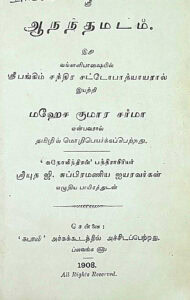
It is interesting to note from the introduction to the Tamil translation, Anandamath had already been translated into Kannada, Gujarati, Hindi, Marathi, English, Telugu besides German and French before Tamil. Kuppuswamy Iyer also mentions that a Sanskrit translation of Anandamath was being undertaken around the same time, by Sri Saila Thathachariar of Kanchipuram, who had also translated a few other works of Bankim Chandra such as Durgesanandini and Jugalanguriya. Kuppuswamy Iyer counted Subramania Bharati amongst his close friends and it is now well documented that the nationalist poet provided the Tamil translation of Vande Mataram that appeared in Anandamath. But a less-known fact that Kuppuswamy Iyer states is that Bharati also translated into Tamil a few verses from Jayadeva’s Gita Govinda that appeared in the original version. Bharati held Kuppuswamy Iyer in great respect and also acknowledges their friendship in the introduction of his work Gnanaratham. G. Subramania Iyer wrote a foreword to the translation of Anandamath, which was printed at the Kapali Press in Madras and came out in 1908.
In 1910, Kuppuswamy Iyer suffered a personal setback, with the demise of his wife Lakshmiammal. Their union had produced three children, a girl and two boys. The elder of the boys was named Nalinaksha Kumara Sharma, while the younger one was Rajeevaksha Kumara Sharma. Records available online seem to state that Nalinaksha had his early education at the Muthialpet Boys School, which meant presumably the family were residents of George Town. Kuppuswamy Iyer married Balasundari Devi a short while later. With young children and a wife to take care of, Kuppuswamy Iyer shifted to Singapore along with his family in 1914 and took up a job as Dubash at the Magistrate’s Court and later the Supreme Court. His literary journey continued, as he kept sending articles to various magazines that he had been associated with during his Madras days, such as Chintamani, Viveka Bodhini, Bala Bharati and Lokopakari. In 1916, his work Valmiki Vijayam, a translation of Hara Prasad Shastri’s Balmikir Joy was brought out by V.V.S. Aiyar’s Kamba Nilayam. Around 1921-22, he translated Swami Vivekananda’s famous essay in Bengali, Barthaman Bharat as Varthamana Bharatam, which was also brought out by Kamba Nilayam. Between September 1924 and December 1926, he translated noted educationist Aswini Kumara Dutta’s philosophical work Bhaktiyoga which was published in Lokopakari.
Kuppuswamy passed away on September 23, 1929 at his residence in Singapore. For a man of such literary accomplishments, he remains an enigma. In an obituary note published in the Viveka Bodhini, writer Guhapriyai expresses hope that someone who knew him would write about his life. The state of affairs may have well continued, but for the publication of the serialised articles of Bhaktiyoga in the form of a book in 1949, wherein a brief profile of Kuppuswamy Iyer appears (and based on which this piece has been compiled). The book was published as a tribute by Nalinaksha Kumara Sharma, who was a successful doctor, working at the Government Hospital in Johor Bahru in Malaysia. It was edited by V.K. Ramanathan, an advocate and was brought out by the Sakthi Press.