(Continued from last fortnight)
The School also did a great amount of work in teakwood, blackwood and rosewood. Havell also introduced novel teaching methods in areas such as metal work which were aimed at saving time and effort and aided simple industrial purposes.
Havell believed that the Indian students had a great natural aptitude for ornamental design, that could be easily developed. Handloom weaving and block printing were two other areas that received his special attention. He believed that the ‘soundest basis for the industrial regeneration of India is to be found in the revival of the great handloom industry’. He also believed that ‘with proper looms and proper instruction, the Indian weaver could take a leading position in the world of hand-woven fabrics’.
Havell was appointed by the Government to undertake a survey and report on state of the arts and industries of the Madras Presidency. He undertook three journeys into various parts of South India and his observations were published under the title ‘Reports submitted by Mr EB Havell during the years 1885-1888 on the Arts and Industries of Certain Districts of the Madras Presidency’.
In 1889, Havell proposed a scheme for the reorganisation of the School based on the experience gained over five years of his stint. Drawing the attention of the Government to the fact that the School covered a very wide field, ‘far wider than the organisation of any Indian School of Art’, he stated that a large expenditure was necessary in order to consolidate the scheme of work being carried out. He also suggested several changes in the appointments of instructors and teachers. By this time, he had made himself invaluable to the Government, which had no hesitation in recommending his reinstatement as Superintendent on the expiry of his term of five years in 1889.
Writing to the Home Department, Government of India, on the subject of his reappointment, the Chief Secretary of the Government of Madras wrote that Havell’s services were ‘unquestionably more valuable to the Government than they were when he was first engaged’. However, the increment mentioned in the terms of reappointment that he would be eligible to draw was to be subject to his clearing a vernacular examination. This condition had near disastrous consequences for the School, for Havell failed the test. He requested that the test be made simpler, which did not find much favour and hence he resigned his appointment. He was however persuaded to stay on until the end of 1891, by which time a successor could be found. Thankfully for the School, a suitable successor could not be found and Havell too, having taken up the test again in 1891 and clearing the same, expressed his desire to continue as Superintendent. A relieved Government accepted the withdrawal of his resignation and Havell was back in the saddle. His tenure continued till 1896, when he was finally transferred to Calcutta as the Superintendent of the School of Arts in that city. Edwin Holder was appointed the Acting Superintendent of the School until a successor could be found. The Government did not have to search far, for there was a ready replacement in the form of Sir Alfred Chatterton, a man who would go on to become one of the most prominent personalities with regard to industrialisation and industrial education in the Madras Presidency.
Born in 1866, Chatterton joined the Indian Educational Service as a Professor in the Engineering College of Madras in 1888. He was made in-charge of the PWD Workshops in 1892 and was also in charge of the Sub Division the same year. He was no stranger to the Madras School of Arts, having been associated with it earlier in 1889. In 1897, he was appointed the Superintendent of the School. This was not an exclusive appointment, for he continued to work in the Engineering College.
Chatterton’s earliest initiative on taking charge as Superintendent was with respect to the introduction of aluminium as a technical industry. He brought out some aluminium from England and after experimenting with it at the School, ordered at his own risk a ton of the metal to be sent out to Madras. This formed the base for the starting of the aluminium industry. With the Government sanctioning a sum of Rs 1500 towards manufacture of aluminium vessels in the School as an experimental measure, Chatterton set about developing the same in a big manner. Thanks to his personal exertions, extensive orders for aluminium ware were received from all parts of India and by end of 1899, a net profit of around Rs 11,750 was earned by the Government. Consequent to the School’s success, the aluminium industry was begun in a small way at the Madura Technical Institute and also at the Victoria Jubilee Technical Institute in Bombay. Chatterton’s efforts would ultimately lead to the establishment of the Madras Aluminium Factory, much to the chagrin of the British-owned business houses of Madras. Handloom was yet another area which received Chatterton’s special attention. He undertook experiments in weaving at the School, with the introduction of fly-shuttle looms as an improvement over the native handlooms. This was not however a great success.
The School led the list of delegates from the Madras Presidency participating in Delhi Durbar Exhibition of 1903 held in connection with the festivities to commemorate the coronation of King Edward VII as the Emperor of India. The Madras Room was created entirely by Chatterton and students of the School, and incorporated several elements of the Dravidian style of architecture such as the temple pillars and the figurines. The door to the room with its intricate wood carving drew special attention. The fittings and furniture of the room were purchased by the Nizam of Hyderabad. The School also won several medals for the various exhibits made by it.
In 1899, Chatterton was relieved from his duties at the Engineering College and was appointed on special duty by the Government of Madras in connection with the development of technical trades and industries in the Presidency. He was instrumental in persuading the Government to open a Department of Industries in 1908. Madras was the first province to do so in the entire country. He was a great supporter of the Swadeshi Movement, declaring it a good sign for India to develop her industrial life. The chrome process of making leather was yet another technique that Chatterton advocated in a great way. The School started tanning hides by this process for the purpose of utilising them in the manufacture of buckets to raise water, in the apparatus known as the kavalai lifts. He later started the Chrome Leather Factory in the area that would one day come to be known as Chromepet. Chatterton also founded the Pencil Factory at Korukkupet that would be later sold to V Perumal Chetty and Co, the business house that ran it under the name of Madras Pencil Factory. Chatterton’s stint at the School came to an end in 1907. He was succeeded by WS Hadaway, an American who was then making a name in Britain for his silver work.
Born in Malden, Massachusetts, Hadaway studied at an art school in New York, where he met his wife Jean Louise Carre. They both left the USA in 1897 and migrated to London, where Hadaway soon began forging a highly successful artistic career as a silversmith, designer and teacher. His early work in silver was illustrated in several journals such as The Art Journal and The Studio. There is no information on how Hadaway came to be appointed as the Superintendent on the retirement of Chatterton, of the Madras School of Arts and Crafts, as it had been renamed in 1905. It is however interesting to note that the Government of Madras was at this point in time looking for a person who had been trained in India and was acquainted with Indian trades or Indian art and preferably, would be a native of the country to take over as the Superintendent of the School. It even wrote to the Government of India for its recommendation, which replied stating that they had no knowledge of any such person qualified to be appointed. This search would however be suspended until a good two decades later, for Hadaway had a long stint as the Superintendent from 1907 to 1927.
Nothing much is known about Hadaway’s tenure. He was however involved in producing several monographs titled Cotton Painting and Printing in the Madras Presidency, Tinsel and Wire in the Madras Presidency and Illustrations of Metal work in Brass and Copper, mostly South Indian, etc. It was during his tenure that a significant change occurred in the structure of the institution. A Committee was appointed by the Government of Madras in 1921 to go into its working and to submit proposals for its reorganisation. Its main brief was to decide on a question that had been debated upon almost since the early years of the School, that is whether to teach Fine Arts or Industrial Art or both. In 1923, the Committee submitted its report recommending that the two aims were incapable of attainment in a single school and that the object of the School of Arts should be to teach the application of arts to industries. This was accepted by the Government, which approved the dropping of the Fine Arts section while however stating that it would consider opening in due course a separate institution to teach the same. This does not seem to have happened even four years later, for in 1927-28, the Government sanctioned the reintroduction of the fine arts classes. It was also decided to appoint a Board of Visitors to the School, who would make periodical visits and offer suggestions as to its working. Hadaway retired in November 1927 and the School got its first Indian Superintendent, Rao Bahadur NR Balakrishna Mudaliar.
Born in 1870, Balakrishna Mudaliar was an alumnus of the School. He was appointed as a teacher in 1889 and promoted as the Assistant Superintendent in 1920. There is no information as to what he studied or what he taught at the institution. He endowed Rs 1000 for awarding gold medals in the School by rotation for each department to the first two pupils for their best works. Outside of his vocation, Balakrishna Mudaliar was an ardent sportsman, one of the original members of the Madras United Club and its Vice President for some time. He was a good tennis player and had the distinction of being the first to win the Club’s singles and doubles championships consecutively for three years. He was also a good cricketer and played against Lord Hawke’s touring team in 1894. In all, he is credited with having won more than 100 prizes in sports, a remarkable achievement. His long association with the School came to an end with his retirement in 1930. Commemorating his tenure and in appreciation of his services, the School erected a bust of his in 1933, sculpted by the master sculptor MS Nagappa. Balakrishna Mudaliar’s successor was the man whose works across the country would make him one of its foremost figures in the world of art and sculpture, Debi Prasad Roy Choudhury.
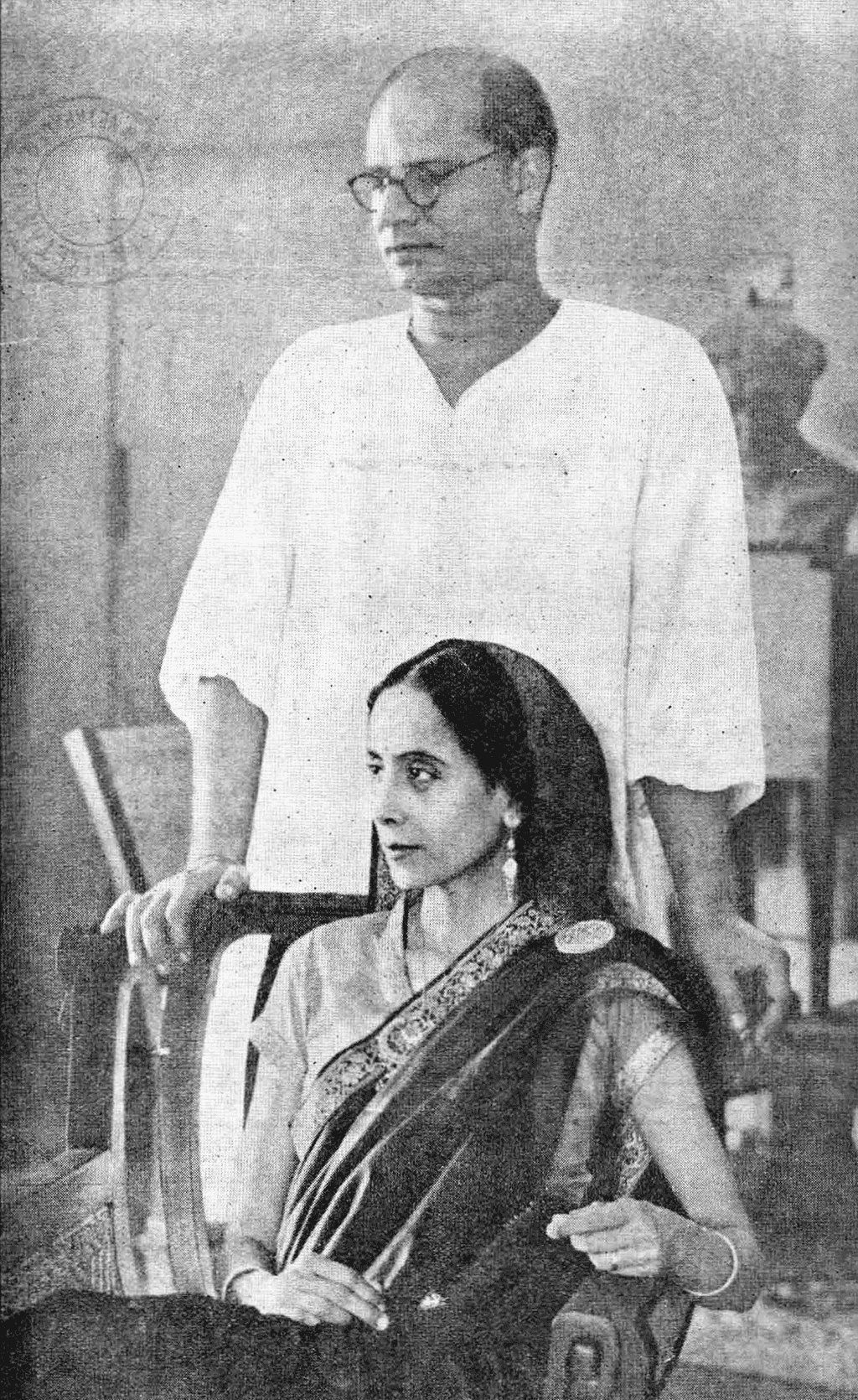
Mrs and Mr DP Roy Choudhury.
Born in 1899 at Tejhat, the part of undivided Bengal and now part of Bangladesh, Choudhury learnt painting from the renowned artist Abanindranath Tagore, a nephew of Rabindranath Tagore, at the Indian School of Oriental Arts. He then learnt sculpting, initially from Hiromony Choudhury and later at Italy. Initially coming under the influence of the Bengal school in terms of style and technique, Choudhury developed a style of his own and became one of the first Indian artists to sculpt in bronze.
Choudhury applied for the post of the Principal in the School and was appointed in January 1929. Writing in the Swatantra magazine in 1952 in a series titled Life with an Artist, his wife Charulatha states that there were several prominent personalities such as AMGC Tampoe ICS, Dr P Subbarayan, SV Ramaswamy Mudaliar and Kamaladevi Chattopadhyaya who were instrumental in Choudhury landing this job. It was the start of a nearly three-decade long association with the institution, one that would see several students such as Paritosh Sen, KCS Paniker, KM Gopal and S Dhanapal learn their craft under his influence and go on to become legendary figures in the world of contemporary Indian art.
Choudhury was quite maverick in his approach. Legend has it that when he once accidentally dropped coffee on his canvas, he asked for more cups of coffee and poured them all over and created a unique painting, instead of discarding it! On yet another occasion, when rain had splashed water on an almost completed painting on a woman in a captivating pose, he changed the entire image into that of a wet crow perched on a branch, inspired by the vision in a flash. Needless to say, such brilliance inspired several students, and in the words of Khasa Subba Rao, the editor of the Swatantra magazine, “the influence of the School as a centre of inspiration for things artistic had outgrown provincial status and it had acquired the stature of a national institution.”
Choudhury retired from the institution in 1957. Post his retirement, he was contracted by the Government of Madras to sculpt one of his most famous works in the city, the Triumph of Labour statue on the Marina. Modelled on the photograph of raising of the flag on Iwo Jima by American Marines in World War II, it was to commemorate the country’s first ever May Day rally that happened in Madras in 1923. Choudhury interestingly chose two people from the college to model for the statue, Ramu a student and AP Srinivasan, a watchman.
Following the retirement of Choudhury, the institution would go on to be served in succession by several alumni. The first in the list was a man who in 1966 would go on to establish the famous Cholamandalam Artists Village, KCS Paniker. Born in 1911 in Coimbatore, Paniker graduated from the School in the 1940s and chose to work as a teacher in his alma mater, teaching painting. He was one of the founders of the Progressive Painters Association in 1944. It was during his tenure as the Principal that the School became the backdrop for what today is known as the Madras Art Movement, a collective term denoting the body of work and style of several artists apart from him such as SG Vasudev, KV Haridasan, AP Santhanaraj and KM Gopal.
Paniker’s tenure lasted for a decade and he was succeeded by R Krishna Rao. Joining the School in 1942, Krishna Rao’s academic brilliance earned him the distinction of finishing the five-year Diploma in Fine Arts course in three years. After a stint with the War Publicity Department and as a textile designer in Gudiyatham, Rao was appointed the Head of the Department of the Applied Arts in the School. His defining contribution came the following year, that of designing of the emblem of the Government of Madras. A native of Madurai, he chose the Western Gopuram of the temple as the inspiration for his creation. In 1965, he was promoted as the Vice Principal and transferred to the Government College of Arts and Crafts in Kumbakonam, before coming back to Madras to head the College on the retirement of Paniker.
S Dhanapal initially trained in painting, before going on to specialise as a sculptor. He was appointed as an instructor in the sculpting department and in 1957 rose to become the Head of the Department. He sculpted using varied sculptural media such as terracotta, metal, wood and cement and worked closely with Choudhury on several of his commissions. KM Adimoolam, the famous abstract artist was greatly influenced by Dhanapal and graduated with a Diploma in Advanced Painting from the School in 1966.
Over the past decades following Dhanapal’s retirement in 1977, the institution has been helmed by several dedicated personalities such as L Munuswamy, AP Santhanaraj, S Murugesan, CJ Anthony Doss (all alumni) who have kept the flag of the institution flying high.
In 1973, the institution, which had been upgraded to the status of a college in 1961, came under the aegis of the Department of Technical Education. Following this, the courses of study were upgraded up to the level of a Degree, and Industrial Design courses in Ceramic, Textile and Visual Communication were offered in affiliation with the University of Madras. In 1991, the College was brought under the purview of the newly created Department of Art and Culture. Masters Level Degree programmes in Painting, Visual Communication Design, Ceramic Design, Textile Design and Sculpture were added over a period of time. Since academic year 2014-15, the institution has been under the aegis of the Tamil Nadu Music and Fine Arts University.
The institution currently offers four-year full time undergraduate courses (BFA) in Painting, Sculpture, Printmaking, Visual Communication Design, Industrial Design in Textile and Industrial Design in Ceramic. It also offers two-year postgraduate programmes (MFA) in these courses, except for Sculpture.
Today, the institution stands as a proud torchbearer in the field of arts education in the country. It has been the fulcrum around which the Industrial and Fine Art movement in South India has developed over the period. Its dedicated band of teaching staff carry on the proud legacy of the institution and ensure that the vision of its founder Dr Alexander Hunter and his illustrious successors lives on.
(Concluded)