It is not about the Adyar river, not about Cooum, nor is it about cleaning up the Buckingham Canal or about making these three waterways navigable. But the novel project taken up by the well known Delhi based NGO, George Institute of Global Health India, is about a crucial safety aspect of fishing communities in Chennai – along the Marina, Besant Nagar and Thiruvanmiyur areas.
It entails making the fishing communities understand the importance of focusing on their personal safety whenever they put out to sea. Apart from Chennai, the project has also been launched in Nagapattinam district as well as in the neighbouring coastal state of Kerala.
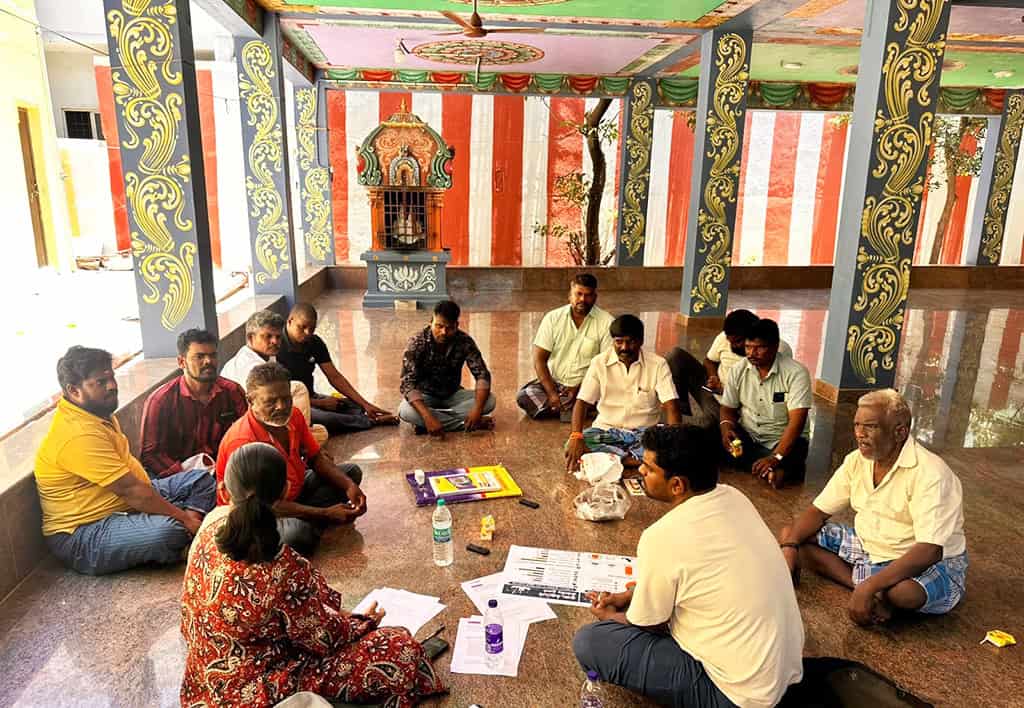
Chennai based project manager Sharmila Shanmugasundaram interacting with fishermen at Odaikuppam – Besant Nagar ( Chennai).
In a conversation with Madras Musings, Chennai based Project Manager Sharmila Shanmugasundaram explains the details of the project titled “Improving lifejacket wear among boaters”.
In India there are more than 60,000 deaths every year attributed to drowning, thus making the tragedy a large public health issue. This has not been scientifically addressed. Fishermen on the coast are exposed to the dangerous conditions of the sea while working for their livelihood. “As they have a high risk of drowning, the study focuses on understanding the barriers to lifejacket use and co-design interventions to improve the same,” she explains. As the number of fishermen in Tamil Nadu is very high, the objective of the project is to improve lifejacket wear by these fishermen on the Chennai coast as well as across the coast of Tamil Nadu.
Talking about the steps being undertaken to implement the project, Sharmila Shanmugasundaram says, “We have been having meetings with Tamil Nadu Fisheries Department and informing them about our study findings, and discussing the possible interventions to make fishermen use lifejackets and lifebuoys, after taking in their inputs.”
The fishermen, however, feel that a lifejacket is not necessary as they believe that their swimming ability is sufficient to save themselves in an emergency situation at sea. They are rather reluctant to spend out of their pockets to acquire a lifejacket, but would use one if it is provided to them for free. They are also happy about the concern being shown for their safety. Sharmila informs us, “There are over 10 lakh fishermen in Tamil Nadu apart from inland fishers”.
She further explains that in the first phase, a cross-sectional study of the prevalence of lifejacket wear was undertaken among 1,356 fishermen in 12 fishing sites in Tamil Nadu and an equal number of them in Kerala.
The study also focused on the determinants, especially the barriers in wearing a lifejacket. The project is presently in its second phase: “We are co-designing interventions in consultation with the fishing communities and stakeholders at the authoritative level aimed at improving lifejacket ownership and use. Interventions are being developed that include ‘behaviour change initiatives’ to improve fishermen’s safety against drowning. In the third phase, the effectiveness of the interventions would be evaluated. The study’s principal investigator is Jagnoor Jagnoor, Program Lead of Injury, The George Institute of Global Health, Sydney. The study is being funded by the Indian Council of Medical Research (ICMR).