As mentioned in the Heritage Watch column, Fran Forsyth has published an account of her life, and this includes memories as a child living in Madras in the 1960s. We reproduce below excerpts, with permission.
– The Editor
It was the early 1960s and we were living in India. British companies, like my dad’s, had handed over to their new Indian owners and the process of transition was complete. My Dad never fully left India. He returned for stints with his Indian colleagues right up to the year he died, and he would have been happy to die there.
Khader Nawaz Khan Road
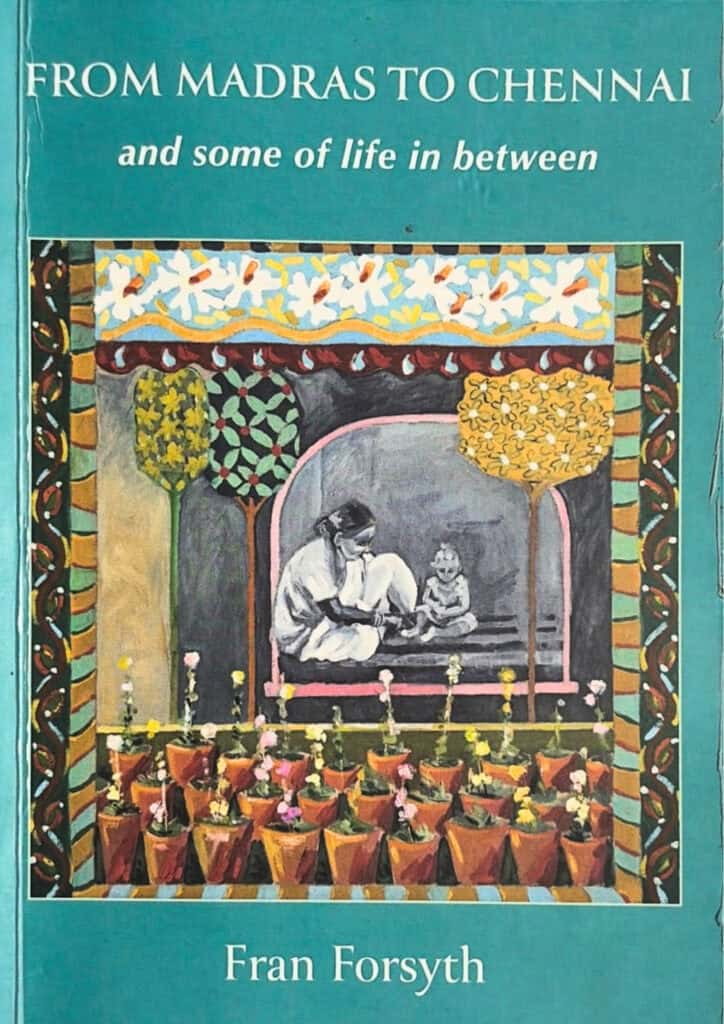 We lived on Khader Nawaz Khan Road in Nungambakkam. Once you got the hang of it, those words were nice to say. They sound to me like the beginning of a children’s poem. Khader Nawaz Khan Road Nungambakkam. That part of Chennai is now packed tight with buildings, mainly offices and upmarket shops. The roads appear to have changed direction, and the house seems to face the wrong way. It was still there when I visited in January 2024. It was mucky and dilapidated with boards and wire fencing, wedged between buildings and traffic, thick pollution and noise. Despite the change, it was also still the same – the familiar symmetrical shape in Art Deco style with geometric lines along the outside and a sensible, easy layout. I knew all the rooms so well, where we had talked and slept and sat to eat together. Where we had lived our everyday lives.
That house, where we went when I was two, was provided by the company, Tube Investments. It was spacious and comfortable, as were the other distanced houses on the road. Next to us was an empty plot with patchy dried-up grass and pink earth. When it rained, the earth became muddy and a dip in the middle filled with water where the buffalo loved to wallow. I watched them up to their necks in thick pink water, happily sitting still. And then they tried to get up, heavily swaying and heaving and pulling to rise and walk away. The pink water sloshed and the suction of mud held them down. The process seemed to take hours, and their struggle went on and on. I thought I could see the beginnings of panic in their flat grey faces and wide-spaced staring eyes and that hint of panic began to become my own. Eventually they succeeded and I watched them walk away. Sometimes they wandered into our garden and ate Mum’s precious cannas. “Quick quick. Shut the gate shut the gate.” Our mali (gardener) had left it open.
Khader Nawaz Khan Road was a quiet road. There wasn’t much traffic, but in those days there weren’t many cars. There were bullock carts pulled by buffalo or cows, and long-handled carts with large, thin wheels which were pulled from the front and pushed from the back by men.
The house was only slightly set back from the road. It had a small front lawn with unpromising, usually half-eaten red cannas planted in a curve around it. There were two gates so you could drive in one and out the other, and a portico in the middle with the upstairs veranda on top. The kitchen area was three rooms; the first, nearest the dining room, for the fridge and storage, the next for cooking and then an area for washing up. They were warm and humid and had a distinctive odour, different from the rest of the house, of lingering food and drains. All drains had a strong, metallic rust smell. Sometimes I recognise it in the bathrooms of other hot countries and although not at all pleasant, its familiarity makes me smile. In the mornings my Mum would stand by the fridge to discuss food and stocks with the cook and the bearer. Sometimes she did abracadabra and produced some sweets for me. Everything was screwed down tight and put away so that ants and other creatures couldn’t eat it.
The Club
The library Mum went to was at the Adyar Club. We went there at least once a week – sometimes as a family, and sometimes just Mum, Ayah and me. When we first went to Madras there was another club, more prestigious, called the Madras Club. Its members were mainly higher echelons of the British Raj or Army, and it was very formal and starchy. No women or non-British men were allowed. Numbers dwindled through the fifties, and in 1963 it closed as a separate institution but blended itself into the Adyar Club, which was financially helpful to both. The Adyar Club had opened in the late 1800s specifically as a less formal option. It admitted women as guests, although not as members until many decades later. So the club I knew as the Adyar Club became the Madras Club, as it is now, and its address, rather oddly, is the Madras Club, Adyar Club Gate Road.
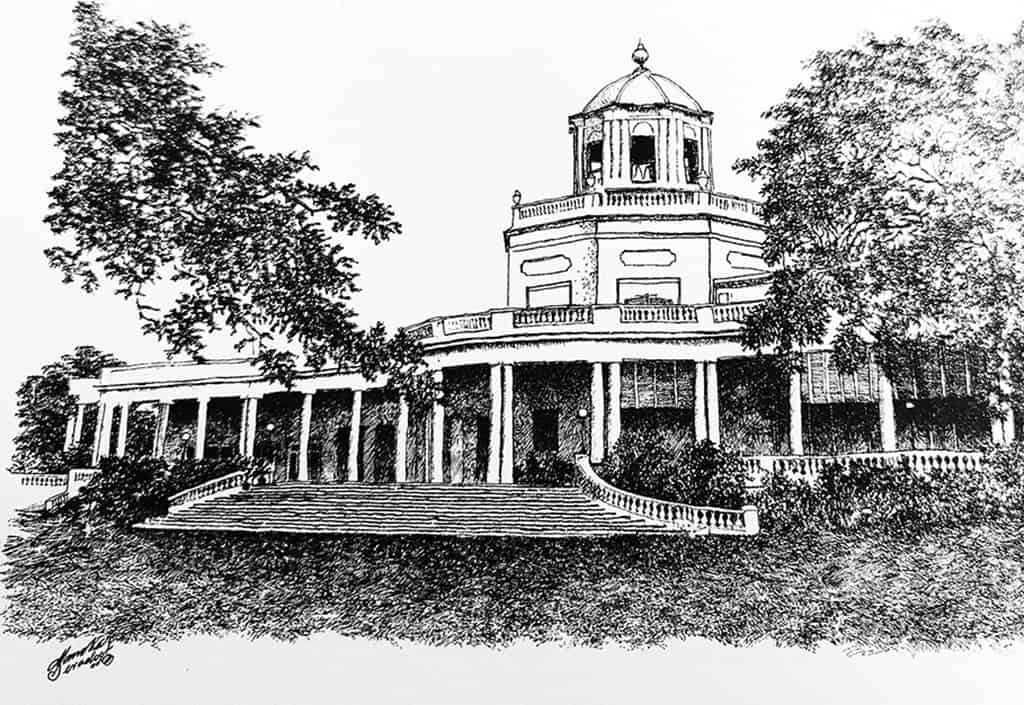
The Moubray’s Coupla in the Madras Club. From our Archives.
There were no or very few non-British members of the Club until the mid-fifties when other Europeans, such as diplomats and consultants, and Americans began to join. Indians were ‘invited to join’ during the time of transition when the British were leaving and all companies and institutions were being handed on. Now membership is almost exclusively Indian. Out of about 1000 members, only around 40 are foreign – may be American, Japanese or British. The foreign faces you occasionally see are usually in Chennai for work. They live in the city and visit the club to use the pool, which wasn’t there when I was a child, or the walking track, or just to socialise and enjoy the oasis of green and birds and beauty.
The sight of the club buildings has an extraordinary impact on me. The whiteness, the pillars, the cupola and the sweeping steps to the long veranda at the front, and the black and white marble flooring on the portico side, are all so beautiful to behold. But even more breathtaking than the sight are the feelings. A surreal familiarity. A time-travel experience. The strongest sense of myself at that early age, in that place, among the people who were in my world at that time.
I went with my Mum in the afternoons. We drove past the portico to a small building where the office and the library still are today. Mum stocked up on books and I meandered between the shelves, enjoying the smell and the extraordinary neatness of all the lined-up spines. When I returned to that library in 2002, I found two books which my Mum had signed for – William Hickey’s Memoirs and John Masters’s Bugles and a Tiger. Perhaps I had been there when she had chosen them and carried them back to the car. I looked at her familiar writing on the sign-out card and ran my finger along the ‘M V Forsyth’ written by her hand.
After the library, we had tea on the veranda, or bearers arranged cane chairs and tables on the lawn. I had a tall glass of juice which they called an orange cobla. I liked to drink it noisily through a straw.
Sometimes we walked near the edge of the river. An occasional rowing boat would glide by from the Boat Club further along, and small groups of buffalo swam or just wallowed on the opposite bank. I wore a hat and I felt the sun on my skin.
The back of the Club, the portico side, felt different. Pots of plants formed walkways into dense shade. It felt secluded and secret with jungly trees and leafy shrubs which smelt of hot earth and freshly watered warm plants. There was an aviary with whole trees in it and a myna bird that could speak in English, Tamil and Hindi. I loved that part of the Club. Sometimes I went there with Ayah and we sat on a bench near the aviary. We sat in the damp heat without talking. The birds were quiet at that time of day, just sitting it out in the trees, and the air was still, too hot to stir, and if anything moved it was slowly.
There were children’s parties, and parties I didn’t go to when my parents dressed up and I stayed at home with Ayah. There were lunch get-togethers when families met, and there were decorations at Christmas. My Dad was Father Christmas one year and ho-ho-hoed from a cart pulled by bullocks through the grounds.
Sadras
The best place for picnics was an old Dutch fort at Sadras. In the 1600s, that Coromandel Coast was fraught with foreign powers. They built forts, set up trading posts and fought battles to gain control. The British East India Company was in Madras, based at Fort St. George; the Dutch were at Sadras; the French at Pondicherry and the Danish in Tranquebar. The ruins of the forts are all still there, except in Pondicherry, as the British destroyed it in 1761. But the French legacy remains strong there. It is an extraordinary enclave in Tamil Nadu where almost everyone speaks French. They have gendarmes, not police, and you can eat perfect croissants for breakfast.
At Sadras we parked outside what remained of the entrance, and with the help of people from the local village, we each carried something to where we would set up our camp. There was a quiet, ghostly feel in the fort – a vast abandoned area of broken buildings, dark dungeons and small red bricks scattered on the dusty, pale earth. Our voices and presence seemed to make little impact; they were superimposed, as we were, on that strange, ear-pulsing silence which heat and emptiness give off. It seemed a place that had been completely forgotten. I walked with my Mum around the small Dutch cemetery; she felt it important to acknowledge the people there and we tried to decipher the writing on the beautifully engraved flat stones. Sadras is now a heritage site, maintained by the Archaeological Survey of India, but in all the times I have been there over the last nearly 25 years, I have never seen another visitor. It remains a deserted, abandoned Dutch fort, full of its own history and a vivid part of mine.
Leaving
In Madras the wooden boxes with metal edges seemed to have multiplied. Their heavy square shapes and wood smell filled the downstairs room. I understood that our leaving was definitely going to happen, but I could not understand why Ayah couldn’t come too. Mum tried to explain. Ayah couldn’t leave her family and friends and uproot from all her connections, and she wouldn’t like the way of life in England. This is a difficult concept at any age — that the strength of your will and love cannot keep someone safe or happy or fulfil their every need.
The airport was small. It was a room with glass windows for people to see out to the planes, and a flat roof where they could stand and wave. Ayah came to the airport. We hugged and said goodbye and her face was all wet with tears. “My sweet lime, my sugar lump, my beauty face.” Then Mum and Dad and [my sister] Jan and I walked across the tarmac to the plane, Mum had my hand. I was crying.
Inside the plane, I sat beside the small round window. People had sorted their luggage and were settling down. I could see a lot of people on the flat roof, Ayah at the front of the crowd. I called out to her. I was sobbing, shouting so she could hear me through the window, across the space between us to the building where she stood. “Ayah, Ayah! I love you!”
“She can’t hear you, darling,” my Mum said, and I turned to look at her and saw other people looking at me and smiling. What were they smiling for? How would I live without Ayah? How would she live without me?
India, 2002
I decided to return to India, to go back to what was now Chennai, for the first time since I was thirteen. It was blatant nostalgia, a wish to touch my past and feel connected to the people who had been in it. I would be away for three weeks. The coincidences and luck associated with the trip were seriously uncanny, and I truly felt they were the work of Jan and Mum and Dad, who were now my precious ghosts. Every day in Chennai I was astounded by the depth of familiarity around me, all the more astonishing given the amount of change that had taken place. Strangers wanted to help me. They pored over my old photos and discussed possibilities with other strangers on the street. From my 1950s photo, a passerby recognised the house on Khader Nawaz Khan Road, now hidden behind and between other buildings, and he guided me to the back of an office from where I saw our house! It was luck that the owner was there on that particular day. He was overseeing the process of turning the downstairs into a Punjabi restaurant. I knew immediately that he understood my quest and even seemed to share the wash of emotions. He let me walk around every inch of the house and let me video as I wanted. He said I could go back any time to just sit quietly and think.
And I sat in the unchanged church I used to go to with Ayah. I had letters written by her with her address on the back. They were written nearly forty years earlier, but I went to the Thousand Lights area clutching photos of Ayah and her address at that time. People tried to help – they wanted me to find her or perhaps her daughter – but unfortunately to no avail. I walked around the dusty grounds of Church Park School with its perilously shiny red floor. I had tea and cake with Sister Basil who used to be up in Kodai. We called her ‘Sister Daddy’ because she had Dad’s name.
On the same day as the house and church and school, I passed a hoarding on a roundabout which said “TI Cycles, Murugappa Group” – the company Dad had worked for, with the factories he had set up. He and Mum had been friends with the Murugappa family, so that name was very familiar, and it seemed so strange to see it there, as if it were waving to me.
I went to the Gymkhana Club with its blue-tinged water and what looked like the same diving board and slide as when I was thirteen years old. And then to the Madras Club. Through the gates and into a time warp of bright white buildings and beautiful leafy green. The grounds, the buildings, the trees, the verandas and the play area at the side were all as I remembered. The sound of the air was the same, it had a softness to it, muffled despite the crows.
Excerpts from the book From Madras to Chennai, and some of life in between by Fran Forsyth.