The Glossary Named Hobson–Jobson, 1886
This article relates to an 1886-published glossary titled Hobson-Jobson, being a glossary of Anglo-Indian colloquial words and phrases and of kindred terms; etymological, historical, geographical, and discursive, compiled by Henry Yule and Arthur Burnell, two Britons working in India. This is an intellectually intrepid effort of lexicalizing Indian words used by the British in India in the mid and later decades of the 19th century. On closer reading, this volume impresses more as a lexicon that extensively catalogues words assimilated into spoken and written English by the British residents in 19th century India, from various Indian languages. Joseph Rudyard Kipling, while serving as the sub-editor of the Civil and Military Gazette (C.M.G.) in Lahore, commented on this glossary in C.M.G.–1886. Kipling’s commentary is exhaustive. It is delightful and hilarious. Hence, parts of it are reproduced here. The present article aims to highlight that a comprehensive knowledge of historical lexicons, dictionaries, and glossaries of the English language is essential for present-day English teachers in India, mainly because such volumes provide conceptual clarity on the evolution of the English language, in addition to value-added meanings and origins of words. I am convinced that such an understanding will go a long way toward improving the classroom teaching of English in India, particularly in teaching English as a second language.
In the title of this article, I have borrowed words from Also sprach Zarathustra: Ein Buch für Alle und Keinen (Thus spoke Zarathustra: a book for all and none, 1883–1885) by the 19th century German thinker Friedrich Nietzsche, to refer to a 19th-century book, Hobson-Jobson, being a glossary of Anglo-Indian colloquial words and phrases and of kindred terms; etymological, historical, geographical, and discursive. For convenience, this book will hereafter be referred to in this article as Hobson-Jobson, a strange and curious name! To Nietzsche, Zarathustra personified liberation and forthrightness. To Nietzsche, Zarathustra was a brash refuter of social categories radiating self-determination and authenticity; represented a distinct style of thinking, trouncing conventions and traditions; sought a new wave of candour. The subject of the present article, Hobson-Jobson, is a catalogue of widely used colloquial words in India in the mid-19th to mid-20th centuries that portrays an avant-garde thinking as appropriate in modern social linguistics. Hobson-Jobson documents those Indian words first assimilated into spoken English by the British living in India and later in written English using English spellings. Hobson-Jobson impresses more as a lexicon that lists Indian words used by the British in India in the referred time. This effort of Yule and Burnell strikes as a brave effort when considered against the language-use puritanism of the British. This becomes all the more significant when the best English was the Queen’s English, particularly in the later decades of the 19th century. Hobson-Jobson illustrates the defiance of puritanism and fits snugly into the Zarathustra metaphor.
Colloquialism is the informal, more usually spoken than written, communication between equals. Colloquialism implies words and phrases understood by people in particular geographical regions, expressions appreciated by people speaking specific-language dialects, commonly used words that lack focal meaning, and a rapidly changing vocabulary. One unique example of regional colloquialism is the widely used phrase ‘gun time’ in the present-day Tamil Nadu (earlier, the Presidency of Madras). This phrase means either a punctual person or the punctual start of an event. The ‘gun time’ phrase has been in vogue in Tamil Nadu from the early decades of the 19th century, which arose from the firing of empty shots from a cannon in Fort St. George, sharp at 12 noon and 8.00 p.m. every day, when time devices were unknown. Other examples of regional colloquialism used India-wide are ‘forenoon’, ‘prepone’, and ‘thrice’: forenoon and prepone used as opposed to ‘afternoon’ and ‘postpone’, respectively; ‘thrice’ used as a natural extension of frequency-adverbs ‘once’ and ‘twice’. Such a distinct phraseology exclusive to present-day India is strange because standard English dictionaries list ‘forenoon’, ‘prepone’, and ‘thrice’ as archaic and suggest the use of ‘morning’, ‘to advance’, and ‘three times’ instead.
George Bernard Shaw, English dramatist and satirist, explored the power of language in high and low British society of the early 20th-century in Pygmalion, wherein Henry Higgins, a professional linguist and a high-society gentleman, trains Eliza Doolittle, a London-slum dweller, to use King’s English in everyday conversations instead of the cockney to which she was used. Today, colloquial English, as a language genre, is receiving attention from professional linguists for diverse reasons. They argue that colloquialism (not only in English, but also in other languages, enhances authenticity and relatability, reveals personal identity and culture, and enriches literature. Remembering the extensive use of colloquial English by Charles Dickens (19th century) and Stephen King (b. 1947) in creative works is not out of place at this point. In addition, while rationalising the evolution of colloquialism, both as a progressing and progressive-language genre, communication sociologists consider colloquialism a powerful and an effective-language tool in casual communications, since it builds positive connectivity between people. Colloquialisms and slang in different languages, including English, imply the way people communicate in real society. In fact, colloquial communications strongly influence the quality of interactions between people, reflecting sensitivities and experiences. Because social reality is catalysed and energised by human communication and interactions, individuals recognise colloquial communications as real mainly because of repeated use over time. What is critical here is to recognise that ‘new’ meanings for extant words evolve due to changing styles and dimensions of social interactions and are influenced by multimedia. For illustrative examples, see the website of the Oxford University Press. An inevitable social advancement is that meanings for evolved words get altered as we humans experience reflective processes within ourselves and others. Different meanings that words can bear on different people are based on perceptions that gradually get internalized by the ‘circuit of culture’ that includes representation, identity, production, consumption, and regulation.
The line of distinction between colloquialism and slang is thin. ‘Slang’ is ‘an informal nonstandard vocabulary composed typically of coinages, arbitrarily changed words, and extravagant, forced, or facetious figures of speech’, whereas ‘colloquial’ is more specific to a language ‘that is most suited to informal conversation, and it ultimately garners an additional, disparaging implication of a style that seems highly informal for either a specific or a specific situation’. Yet many linguists consider slang a subset of colloquialism.
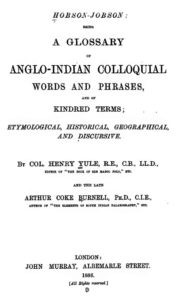
Cover page of Hobson–Jobson (1886, 1st edition).
Against such a context of colloquialism and slang, the present article refers to a late-19th century glossary, compiled by Henry Yule and Arthur Burnell, published in 1886 (Fig.1), that stands apart by its intents and contents from other similar works of 19th-century English. I felt compelled to share details of the Hobson-Jobson in this forum because when I spoke about this glossary to a few professional English teachers in India, many of them responded in surprise. As said before, the Hobson-Jobson, to me, is a valiant attempt that contextualizes and validates colloquialism in the English language by formally cataloguing the then prevalent loan and assimilated words from Indian languages in the 19th century. Standard British dictionaries of English (e.g., Oxford English Dictionary) list words that have been added by migrant communities into Britain in the last few decades, and linguists consider such a development as positive, since they have added value to the English language and its consequent enrichment of vocabulary. Danica Salazar (lexicographer, Oxford Language Unit and World English Editor, Oxford University Press) says in The Guardian, ‘It is only when we share ownership of English, and embrace the language in all its diversity, that it can truly be a gift that everyone can benefit from’.
Henry Yule and Arthur Burnell
Henry Yule (1820–1889) was an engineer, a geographer, and an orientalist from Scotland. After training in the Royal School of Military Engineering in Chatham, Kent, he joined the Bengal Military-Engineering Corps in 1840. He worked in the Khasia-s (presently, North-eastern India) initially and in Calcutta later. Arthur Coke Burnell (1840–1882) was a pre-eminent Sanskrit scholar, with a penchant for southern-Indian languages and literature. During formative years, he was influenced by Michael Viggo Fausbøll, a Danish Orientalist and a Pali-Prakrit and Sanskrit-language specialist. In 1860, Burnell worked in Tanjore in the Presidency of Madras. Further to the Handbook of South Indian Paleography (1874), his other literary works include translations of many Sanskrit texts and chapters. He wrote commentaries on High Tamil and on Tamil poetry.
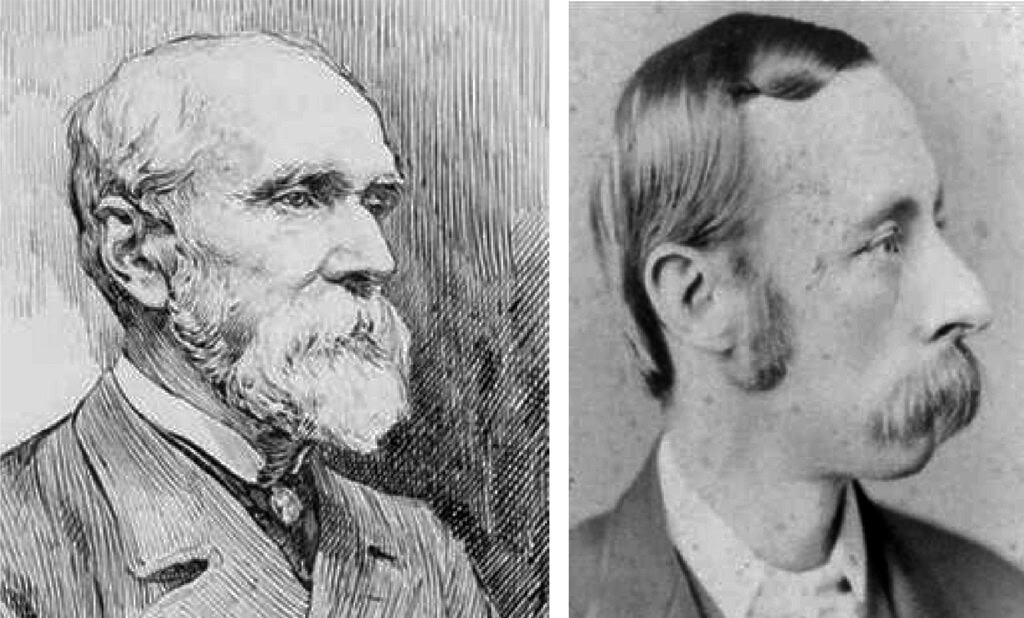
Left: Henry Yule and right: Arthur Burnell.
A second edition of the Hobson-Jobson appeared in the early decades of the 20th century through the efforts of William Crooke (1848–1923), a civil servant in the State of Oudh (presently, North-eastern Uttar Pradesh) and an orientalist. In this edition of the Hobson-Jobson, Crooke added a handful of new entries and quotations, further correcting some etymological explanations. Indian reprints of Crooke’s edition of the Hobson–Jobson, printed by the Oxford University Press India and Munshiram Manoharlal (New Delhi), are presently available.
The terms ‘Anglo-Indian’ and ‘Hobson–Jobson’
Currently, the term ‘Anglo-Indian’ refers to descendants of mixed ancestry in India, British on the one hand and Indian on the other. But until 1911, Anglo-Indian meant only the British living in India. Before 1911, descendants of European-Indian lineage were either ‘Eurasians’ or ‘Indo-Britons’ and not ‘Anglo-Indians’. When the Constitution of India was promulgated in 1950, Article 366 (2) explained an Anglo-Indian as a person of European-Indian descent, a citizen of India, and a habitual resident. This explanation offered a special political status and valid representation to Anglo-Indians (previously European-Indians, Eurasians, Indo-Britons) as citizens of India, which was later modified with the 104th amendment, 2019. Presently, the term ‘Anglo-Indian’ refers to people of mixed, i.e., European-Indian descent with a wider scope than what was implied in 1950. The first edition of the Hobson-Jobson appeared in 1886, with the preparatory work by Yule and Burnell starting in 1872. The 1872–1886 timespan adequately clarifies that ‘Anglo-Indian’ used by Yule and Burnell in the first edition of Hobson-Jobson meant the British residents in India. Consequently, we understand that the Hobson-Jobson records colloquial English words and other assimilated foreign-language words used commonly by the British residing in India.
In the introduction of the Hobson-Jobson, Yule explains that it is a ‘typical’ and ‘delightful’ example of that class of Anglo-Indian argot that was made of highly assimilated Oriental words to English vernacular (Yule and Burnell 1886). Hobson-Jobson is a lengthy and complex text. It is a valuable historical record of details, especially. Nirad Chandra Chaudhuri, a renowned author in English and of Indian roots, remarks in ‘Historical Perspective’ in the Linguasia edition of the Hobson-Jobson (1994):
‘British working bees of the Empire, who worked all over the country, often in small towns where one was the single White man … [who were] forced to create shortcuts by employing Indian words, mostly of north-Indian origin, but anglicised phonetically.’
The Reader’s Digest Great Encyclopaedic Dictionary (1975) speaks of the Hobson-Jobson:
‘the vocabulary, consisting of Anglicised Hindi or other Indian words, developed by British subjects in civil and military service in India: also called Hobson-Jobson’.
Yule and Burnell (p. 319) explain the unusual phrase ‘Hobson-Jobson’ as that derived from the Arabic-wail cry “Ya Hasan, ya Hosain” of the Shia Muslims in British India during the Muharram mourning of the martyrdom of Hasan and Hosain, grandsons of Prophet Mohammed. Yule and Burnell (1886) clarify that the call “Ya Hasan, ya Hosain”, misheard as “Hosseen–Gosseen” by British soldiers in India, over time gradually turned slangy as ‘Hossy-Gossy’ and ‘Hossein-Jossen”, ultimately settling as ‘Hobson-Jobson’. Strangely, many of the late 19th century English authors saw both this book and the title as coarse and uncouth. Technically, Hobson-Jobson falls into the linguistic phenomenon described as ‘ablaut reduplication’.
(To be concluded next fortnight)