Introduction
Over the years Madras has produced many eminent doctors and scientists, but amongst these, the name CS Krishnaswami is unlikely to be familiar to many residents of Chennai today. To hundreds of people around the world with an interest in an esoteric tropical bacterial infection, however, his name is very well known, and it deserves to be better known by the residents of his adopted home. This article aims to set the record straight, drawing on the small amount of information available in the public domain along with evidence gleaned from his family and their friends, to all of whom I offer my sincere thanks for their help.
Background
Few people have the good fortune to be responsible for the discovery of a new disease or the recognition of a previously undescribed pathogen. One such person was CS Krishnaswami, who in 1912 was co-author of a paper in the Indian Medical Gazette about a “hitherto undescribed infective disease occurring among the population of Rangoon”. This disease, now known as melioidosis, is estimated to infect some 165,000 and kill up to 89,000 people each year, with India bearing more than 30 per cent of this burden. The disease, which is now being diagnosed with increasing frequency across India, including Chennai, is caused by a soil-living bacterium. It can infect people through cuts and abrasions sustained during farming, by inhalation during monsoon storms, or by ingestion of contaminated water. In susceptible people, particularly those with diabetes, it can spread rapidly, causing sepsis, pneumonia and abscesses anywhere in the body, frequently leading to death unless the right antibiotics and supportive treatment are given promptly.
The discovery
When Captain Alfred Whitmore of the Indian Medical Service was appointed as Pathologist and Police Surgeon to the newly opened General Hospital in Rangoon, Burma in 1909, he was allocated two assistants. One of these was Assistant Surgeon CS Krishnaswami. The two men were responsible for conducting autopsies on ‘police cases’ brought in dead or dying from the streets of Rangoon. Krishnaswami would have done the initial dissections under the supervision of Whitmore, and so would have been the first to notice the characteristic abscess-like lesions throughout the body. The features were similar to those of glanders, a disease of horses that was then prevalent amongst the gharry ponies of Rangoon, but Whitmore and Krishnaswami realised that the bacterium that caused it was subtly different. The fact that they were able to recognise a new disease working in the relative backwater of the empire that was Rangoon, and within only two years of the establishment of a new laboratory, is impressive. The two men jointly published their findings in July 1912 in a seminal paper which has since been cited many hundreds of times by other authors.
Krishnaswami’s life and career
Combakonam Sivarama Krishnaswami was born sometime around 1888 in Kumbakonam, some 280 km from Chennai. Little is known of his early life, but he subsequently attended Madras Medical College (MMC), where he was reputed to have been a classmate of Arcot Lakshmanaswamy Mudaliar. He qualified as a Licentiate of Medicine and Surgery around 1909 and was almost immediately appointed as an Assistant Surgeon in the Subordinate Medical Service in Rangoon. It is interesting that he decided to travel to work overseas and also sport a moustache, both of which would have been considered taboo for Brahmins in the 1900s. This suggests that he was not constrained by traditions and customs. Whether this was what attracted Whitmore, who was no blind respecter of authority himself and certainly did not suffer fools gladly, to him or vice versa we do not know. Krishnaswami took over sub-charge of the Pathological and Post-Mortem Department of the RGH towards the end of April 1910 and remained as Whitmore’s assistant until 1915, when Whitmore was obliged to return to military service and spent the rest of WW1 in India. Krishnaswami then took overall responsibility for the mortuary until 1917. That year he described his experience with more than 200 cases of the new disease, which had become known as ‘morphia injector’s septicaemia’ because 95 per cent of these cases bore the marks of morphine injection, to the Burma Assistant Surgeons’ Association. Remarkably, he said that one in every twenty autopsies he had performed in Rangoon was on a case of the disease.
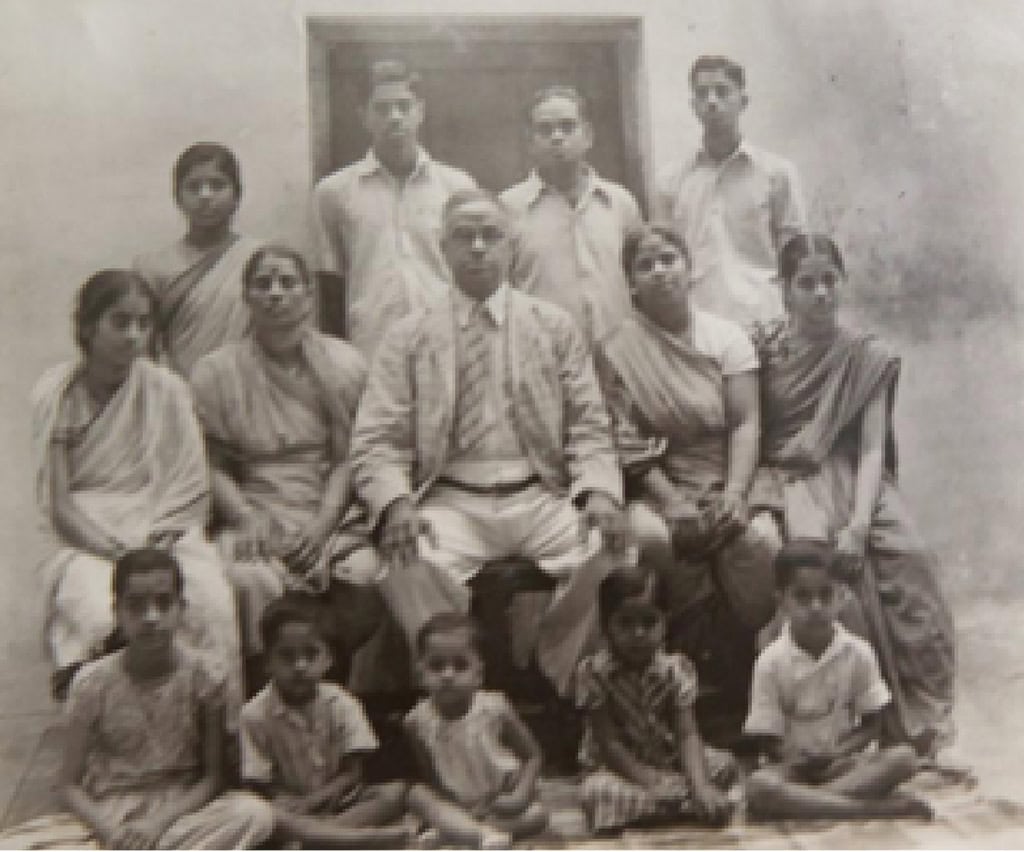
The Krishnaswami family in Madras c. 1951 (photograph courtesy of R Krishnamoorthy). Standing: second from left: Chittaranjan Das (fourth son), fourth from left Motilal Nehru (third son). Seated: first from left RK Seetha (eldest daughter), second from left Kamakshi (wife), centre CS Krishnaswami, extreme right RK Balambal (second daughter). Seated at front: first from left RK Meenakshi (youngest daughter), extreme right R Krishnamoorthy (eldest grandson, son of RK Seetha, aged 11).
Later that year, however, his career had a dramatic change in trajectory, and he spent most of the rest of his time in Burma working in what were then known as Lunatic Asylums. His family also say that they heard that he had to supervise hangings in the jail. He was in charge of the Rangoon Lunatic Asylum from 1917 until 1920. He then moved to the Minbu Lunatic Asylum, where he remained in charge until 1925. He then disappears from the records of staff in the mental hospitals in Burma for a few years. His family say that he spent 3-4 years training in London, and in 1928 his name appears on the list of passengers returning from London to India via Ceylon (Sri Lanka) on the Ormonde. Where he had been and what he was doing whilst in England is not known. His whereabouts over the next few years are also something of a mystery, although he is listed in Thacker’s Indian Directory as a Civil Surgeon in Pegu, a city in Lower Burma, in 1936 and 1937. However, confusingly the Annual Report on Mental Hospitals in Burma for the Year 1936 states that he returned to take over charge of the Mental Hospital in Minbu in August that year. He was still there in 1937, and also in 1938 when he received a special commendation for the way in which he had carried out his duties. In 1939 he was transferred south to Tharrawaddy Mental Hospital but thereafter the trail goes cold, at least in part as a result of the Japanese invasion of Burma in late 1941. As far as I have been able to ascertain, he remained in Burma throughout WW2 and did not take part in the mass exodus in which around half a million Indians fled Burma, mainly on foot, to Assam, with many thousands dying on the way. How he survived under the Japanese and what he was doing is unclear, but unfortunately many records from that period have been lost. His family say that he eventually returned to Madras until 1946.
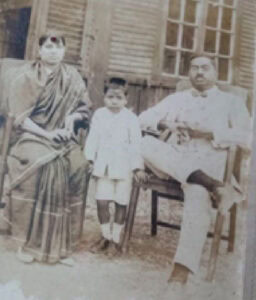
Krishnaswami with his wife Kamakshi and their second son, Gandhi (photograph courtesy of Sushila Sitaraman).
Back in Madras, Krishnaswami reconnected with an old friend and colleague from his time in Rangoon, Prof. R. Venkateswaran. Venkateswaran had taught and researched chemistry at University College, Rangoon, but had trekked back to India during the Indian exodus in WW2. He subsequently worked for the Indian government until 1949 when he retired to Madras. His daughter, Lakshmi Sundaram, remembers how Krishnaswami was an almost daily visitor to their family home, ‘Burma House’. He was a great friend of her father but, although she and her sisters liked him, they did not know him well. Despite the fact that he lived quite a long way from Burma House, his car would arrive every evening around the same time and they would all go to the beach where the two men would sit talking whilst the girls played. On one occasion, Lakshmi’s younger sister remembered going to see Queen Elizabeth II when she visited Madras in 1961, where she saw Krishnaswami, whose car had broken down, being towed away by the police.
Talking to Lakshmi and to Krishnaswami’s grandchildren, what comes over loud and clear is the fact that he was quite an unusual, somewhat idiosyncratic man, perhaps not surprisingly when one considers what he must have seen and experienced during his time in Burma. His wife was called Kamakshi (or ‘Kannamma’) and they had three daughters and four sons, whom he named after famous Indian political leaders (Mohandas K Gandhi, Motilal Nehru, Chittaranjan Das and Gopalkrishna Ghokale). One of his sons, Gokhale, also worked as a doctor in Burma and specialised in malaria. However, Lakshmi described Krishnaswami as “not normal as a husband and a father”. This led to friction with at least two of his sons, who left home as soon as they could and were thereafter not in regular contact with their father. He appears to have been somewhat obsessed with having a balanced, nutritious diet and was considered unusual inasmuch as he used to sprout lentils and beans at his house and make his wife prepare them because they were full of vitamins. Despite this, he delighted in taking his family to the ice cream parlour at Spencer & Company Ltd., and he often distributed chocolates to people he met, with the result that he was nicknamed ‘Chocolate Thatha’ by the younger members of the family.
Sushila Sitaraman, daughter of his eldest daughter Sita, remembered him as an intelligent, hard-working and sincere person. He was highly disciplined but also very strict, wanting perfection in everything. He was extremely knowledgeable and able to hold a well-informed discussion on almost any topic. Every Thursday he used to attend lectures at places such as the British Council or the YMCA. He always carried a small pocket watch with a fob chain. Except for special meetings, he only ever wore a beige coat and a white dhothi. She also fondly remembered trips with him to the cinema and the circus, and said that he used to make good tea every evening for everyone!
Krishnaswami died in Madras in 1964 after a long, interesting, and at times extremely difficult life. As far as melioidosis is concerned he was undoubtedly the right man in the right place at the right time. His training at MMC clearly stood him in good stead for his work in Burma, and Madras held sufficient attractions for him to return there when he eventually retired. Whilst he has not shared the eponymous glory that Whitmore has had in having a bacillus and a disease nicknamed after him, this enigmatic and elusive man deserves to be celebrated as a worthy son of Madras.
— by Prof. David Dance, Honorary Professor, Faculty of Infectious and Tropical Diseases
London School of Hygiene and Tropical Medicine
Dear Dr. Dance,
Thank you very much for your interest and showcasing the life and achievements of my grandfather.
Dr. Raj Rajaraman