(Continued from last fortnight)
The Glossary Named Hobson–Jobson, 1886
A casual, preliminary communication between Yule, living in Palermo (Italy) post-retirement, and Burnell in Madras-Government Service in Tanjore in the early 1870s triggered an exercise, which materialised as the Hobson-Jobson in the following decade. Yule and Burnell had met once in the India-Office Library (Whitehall, London) previously; otherwise, their acquaintance was only through correspondence. Most likely, as much as we get to understand from Yule’s introductory section (Yule and Burnell 1886), Burnell shared some preliminary thoughts on this topic, which grew into Hobson–Jobson (p. vii):
‘About 1872 …he (Burnell) mentioned that he was contemplating a vocabulary of Anglo-Indian words, and had made some collections with that view. … I likewise had long been taking note of such words, and that a notion similar to his own had also been at various times floating in my mind. And I proposed that we should combine our labours.’
Joseph Rudyard Kipling while serving as the sub-editor of the Civil and Military Gazette (C.M.G.), Lahore in 1882-1887, reviewed Hobson-Jobson in G.M.G. in the 15 April 1886 issue. J.R.K.’s review of the Hobson-Jobson is delightful and candid; hilarious, too. Parts of his review are reproduced below to illustrate Kipling’s enchanting prose, its colloquiality, and plush mélange of Indian-speech forms and formal English, laced by a delicate authenticity and inclusiveness.
Colonel Yule’s Hobson-Jobson is not a book to be lightly disposed of in one review. The difficulty in glancing over its eight hundred closely packed pages is where to begin; and having once begun, where to leave off. … The two gentlemen (Yule and Burnell) conceived the notion of compiling an Anglo-Indian glossary; and the result of their labours is a fascinating volume, neither glossary, vocabulary, dictionary or anything else that may be described in one word, but simply, Hobson-Jobson: a glorified olla podrida (a stew of pork and beans) of fact, fancy, note, sub-note, reference, cross-reference, and quotations innumerable, bearing on all things connected directly or indirectly with the East. Justly does Colonel Yule call it a ‘portly, double-columned edifice’. It is a book which, unless we are much mistaken, will take its place among the standard works on the East; and will pass, gathering bulk as it goes, from decade to decade. Words, says Colonel Yule, are the jetsam which the tides of languages cast up on the beach of human thought, to be gathered together and placed in cabinets by the curious.
When the author of Hobson-Jobson takes a word up, he deals with it lovingly, showing how it grew or fell away from its original purity by the corruption of time; also in what varying senses it has been used; concluding finally by three or four notes, or sometimes a page of quotations from all manner of strange and recondite sources, which shall throw a full or a side light on that word. Where his trove has no particular history, he tells, like the sages of old, a tale in a pleasantly discursive manner. Bundobust (arrangement, system, agreement …), for instance, has no pedigree, but its meaning is varied and its use extensive.
Forty-three years ago, an old khansamah (steward) informed the author that there must be a bahut accha bundobust in Belait (‘thank you’ agreement in England), because the young and raw Sahib on his arrival at Calcutta was wont to say ‘Thank you’ to his servants when they brought him tea. Three months of the East, continued the khansamah, changed civility into abuse. This explanation is supplemented with a couple of lines from the ever-dear Ali Baba, and shows in some measure from what mixed sources Colonel Yule builds up his information. Of bus (stop! enough!), Colonel Yule says justly, ‘few Hindustani words stick closer by the returned Anglo-Indian’. Turning to jinrickshaw, which Colonel Yule spells jennyrickshaw, we find that its exact meaning is ‘man-strength cart’, and here those who may be ignorant of two most pleasant books are introduced, by the way of quotation, to Miss Bird’s ‘Japan’, and Gill’s ‘River of Golden Sand’. As a suggestive book, over and above all its other merits, Hobson-Jobson, pity it is that the title is so uncouth, stands alone. One of these days, it may set the Government searching for a substitute for opium revenue when that drug ceases to be imported into China. The Chinese set a far higher value on the ginseng root than on opium, paying from six to four hundred dollars an ounce for it, and attributing to it miraculous virtues. An inferior sort of ginseng comes to China from America, but there exists a very closely allied plant in our own Himalayas. Supposing that the genuine root could be grown in India, or the substitute educated up to its relative’s powers, the possibility of an extensive and remunerative trade would seem to be assured; for ginseng, apart from the mythical attributes with which it has been invested, has many of the good points of opium without its drawbacks. … Everyone in the East, the book ranges from Constantinople to Japan, should possess himself of Hobson-Jobson and once possessed of it should apply himself diligently thereto. It will coerce him pleasantly to consult other books and to explore fresh avenues of thought, and may end in making him something that at a pinch might pass for an oriental scholar. Further, it will interest him intensely throughout.
Hobson–Jobsonism, a new abstract noun
In a 2025-blog captioned The story behind Hobson–Jobson, Ben Zimmer, an American linguist, lexicographer, and language commentator, uses Hobson–Jobsonism, a new morpheme of Hobson–Jobson. The term Hobson–Jobsonism means diverse, current adoptions of other-language words into English that, when spoken, sound similar to assimilated words. Zimmer’s Hobson–Jobsonism, most likely, will be used widely in day-to-day English in the future, because of its linguistic outlandishness. Similar morphemes, not strictly ‘abstract nouns’, but ‘adjectival nouns’, are in ample use currently. One example is Johnsonese, first used by Thomas Babington Macaulay, implying ornate texts embellished with superfluous Latinates, following the inimitable style of the 18th-century English grammarian, lexicographer Samuel Johnson. One other example is journalese that arose from the word journal (Old French, 1880s) referring to a sensational prose with overused cliché-s and jargon generally written by journalists. Two other similar words that have evolved in the 21st-century are ‘computerese’ and ‘legalese’.
The Hobson–Jobsonism, a glossary of Anglo-Indian Colloquial words and phrases
Hobson-Jobson, being a glossary of Anglo-Indian colloquial words and phrases and of kindred terms; etymological, historical, geographical, and discursive opens with Introductory Remarks (pages xiii–xxiv), signed by Yule, that includes a few pages of explanatory notes and instructions to readers is presented in three subsections: (i) supplement, (ii) data of quotations, and (iii) transliterations. Pages from xxix to xlvi include a list of cited books, followed by two pages of corrigendum (pages xlvii and xlviii).
Whereas the other details are nearly similar to any standard lexicon, the explanation provided under ‘transliterations’ in Hobson-Jobson will be of interest to modern readers. A dictionary is a reference book that includes a list of words arranged alphabetically, each word explained with definitions, pronunciation keys, and etymology. Concise editions (e.g., The Concise Oxford English Dictionary) serve as sources of quick reference, clarifying words and vocabulary of a language, whereas extended editions (e.g., The Oxford Encyclopaedic English Dictionary) are broad in scope and clarify definitions, usage, etymologies, pronunciation keys, with illustrated examples, grammatical notes, and variants of discussed words. Modern editions are available in electronic formats.
In a broad-brush context of English lexicons and lexicography, the Hobson–Jobson is unique, since it lexicalises words from languages spoken in India that were assimilated into spoken and written English by the British residents in India in the 19th century. This book also lists words from Persian and Arabic, two relatively less-spoken languages in India that had entered the subcontinent because of the Mughals (16th to 19th centuries). Since the comments of J.R.K. in 1886, partly reproduced in the present text, comprehensively capture the gist of Hobson–Jobson, I analyze only two examples here.
Similar to any standard lexical work, Hobson–Jobson includes scores of words arranged alphabetically using English spellings, set in two columns on each page. For example, page 144 refers to cheroot, a tobacco product, similar to ‘cigar’, well known in Spain and Portugal from the 16th century. In a majority of listed nouns, the letter ‘s’ is shown immediately after, characterising the number status (‘s’ for singular) of the noun. This is followed by a brief explanation of the etymology of the word and also as spoken in the native, original language. The noun cheroot evolved from curuttu (Tamil, spelt shuruttu by Yule and Burnell 1886), a commercial product of dry-tobacco leaf rolls ready for smoking, produced in the Tamil-speaking Tiruchirapalli and Dindigul, and the Telugu-speaking Guntur in the 18th century. This section of the text also mentions cheroot’s alternate names, viz., tritchies (a corruption of Tiruchirapalli, a.k.a. Trichy, the land of cultivation) and lunkas (read as lanka-s implying the cheroots produced in the Jaffna peninsula of then British Ceylon). The Hobson–Jobson includes pertinent annotations of cheroot from previously published documents, shedding greater clarity on diverse usages and the evolution of meanings. Yule and Burnell (1886) cite, for example, John Henry Grose’s A Voyage to the East Indies: containing authentic accounts of the Mogul government in general, the viceroyalties of the Decan and Bengal, with their several subordinate dependencies … with general reflections on the trade of India (1772), Pierre Sonnerat’s Voyage aux Indes orientales et à la Chine, fait par ordre du Roi, depuis 1774 jusqu’en 1781 (1782), and Alexander Lindsay’s Lives of the Lindsays (1840), exemplifying how widely this product was known and used in India at that point of time.
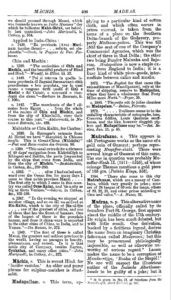
Snapshot of page 406 illustrating the sorts of included details.
A perspective of the included details can be obtained from the two snapshotted pages 406–407. It speaks of ‘Madras’, presently the metropolis of Chennai. Here, readers can gain an understanding of the nomenclatural evolution of the town of Madras, later a city, that includes a reference to Fryer’s classic map of Madras, 1670s. Additionally, Yule and Burnell explain the Madras fabric, widely used to wrap the head in Mauritius, South Africa, and the islands of the Caribbean (French-speaking Antilles) in the 18th and 19th centuries. The Madras head-wrap was exported from the coastal village Pulicat.
Conclusion
Details of past glossaries of English slang and colloquialisms (e.g., Passing English of the Victorian era by Ware 1909; The American slang dictionary by Maitland 1891) can be obtained from historical sections of present-day dictionaries and online resources.
Lexical borrowing, the process by which a language accepts words and phrases from another language and eventually enriches its vocabulary, occurs through cultural and trade interactions, ultimately resulting in either loanwords or colloquialisms. The cultural and trade interactions are key drivers of linguistic change and social evolution (Zenner et al. 2019). Colloquialisms and their subset, slang, are informal features of a language that are more usually used in casual, everyday speech than in formal contexts. Nevertheless, we presently know that the words and expressions considered colloquial and slang at some point in historical time eventually lost their edges and were accepted in formal conversations and written texts. Words such as ‘nice’, ‘grit’, ‘fake’, ‘okay’ considered slang in either the 18th century or earlier are presently acceptable in standard oral and written English communication. Colloquial and slang words evolve via the same mechanisms as standard, formal words develop in a language, following the same mechanisms of metaphorization, clipping, and borrowing from other languages that facilitate their evolution, driven by social influence.
Both colloquialism and slang allude to casual use of words and idiomatic expressions that are usually more figurative, light, sometimes indirect, graphic, and transient than formal language. ‘To catch red-handed’, ‘green with envy’ are examples that illustrate the power of such word formations. In the 18th century English-speaking world, colloquial and slang referred to the language used by less-educated people and those of less social repute. However, by the end of the 19th century, colloquialism and slang came to refer to words and expressions that were not considered dignified speech.
Colloquialisms and slang belong to a linguistic phenomenon that involves constant modification; sometimes rigorously influenced by the assimilation of foreign-language words. Colloquialisms and slang heighten a social and/or contextual meaning, acceptable to a group of like-minded people. When slang is regional, it becomes a colloquialism. In Indian English, some of the English words and idioms are unique, verging on colloquialism. Some examples would be ‘timepass’ meaning wasting time, and phrases such as ‘kindly revert’ meaning please respond, and ‘revert’ is still tautological.
Ethnicity is an organic construct; it is neither involuntary nor automatic. When people recognise themselves as of a specific ethnicity, they develop special linguistic traits and practice them. Words and idioms assimilated in a language different from the parent source most usually show similarities at linguistic levels, such as the pronunciation, and differences at other levels, such as grammar and syntax. Colloquialism was an ethnic marker among the British community of 19th-century India, as evidenced by words listed in Hobson–Jobson.
Assimilated words into British usage include influences from different Indian languages that are mostly contact-induced borrowing. The partial congruence of the assimilated Indian words as British colloquialisms with standard British English can be perceived as unmistakable evidence of linguistic novelty. Additionally, the listed words in Hobson–Jobson fall under a novel, eclectic genre (pronounced zhaan-ruh, and not jan-er – most commonly said in India), since they include loanwords from spoken segments of different Indian languages. By adopting a ‘new’ form of spoken and written language, the British living in India (the Anglo-Indians) distinguished themselves from other speakers of formal English. This matches well with the pattern of evolution of the Chicano English, an American-English dialect spoken by Mexican Americans in the Southwest, characterized by Spanish-influenced pronunciation (e.g., sound of ‘th’ said as the sound of ‘d’), unique vocabulary (e.g., ‘barely’ meaning ‘just now’), and specific grammatical patterns, a fully formed native-English variety reflecting its cultural heritage (Penfield 1985).
Overall, the Hobson–Jobson is a fascinating book that lists several assimilated Indian words in English, sometimes modified slightly for an unyielding English tongue, but spelt using English letters of the alphabet in 19th-century India. The Hobson–Jobson not only provides a compre-hensive list of such assimilated words but also speaks elaborately of their evolution and change over time, drawing evidence from various previously published documents. Additionally, the Hobson–Jobson is a repository of Indian history, approached and documented uniquely via assimilated Indian words.
A comprehensive knowledge of historical lexicons, dictionaries, and glossaries in the English language is critical for present-day English teachers, essentially because such books provide scope for a systematic understanding of the evolution of the English language, meanings, and origins of words that will go a long way in improving teaching practices, particularly in the TESOL context.
Acknowledgement
I thank K.Elango (Chennai), Prakya Sreerama Kumar (Bengaluru), Trichur S. Suryanarayanan (Coimbatore), Rajeswari Shanmugam (Sunnyvale, CA), and Ordetta Mendoza (Chennai) for their critical reading and helpful inputs.
(Concluded)