This January, Copenhagen hosted the International Conference for Hedgehog Professionals – yes, it’s really a thing. This was the third annual edition of the event where hedgehog nerds of various stripes – researchers, caregivers, veterinarians, and others – gather to discuss matters pertaining to the welfare of the tiny creature. The agenda read like a catalogue of the charmingly niche. One speaker elaborated on the finer points of designing hedgehog friendly robotic lawn mowers. Another shared his analysis of eDNA from hedgehog droppings to reconstruct their diets. A third gave a talk, rhetorically titled, “Why Does the Hedgehog Cross the Road?”
From India, Dr. Brawin Kumar of the Hedgehog Conservation Alliance carried the story of a species most of the world has never heard of. Recently, he coauthored the first complete mitochondrial genome analysis of the Madras Hedgehog (Paraechinus nudiventris), traced its evolutionary origins, and placed this elusive, nocturnal creature firmly on the scientific map. “Madras hedgehogs can be the subject of many research papers, but first, we have to save them from extinction,” he says. (This time, his talk focused on the parasites that afflict the creature.)
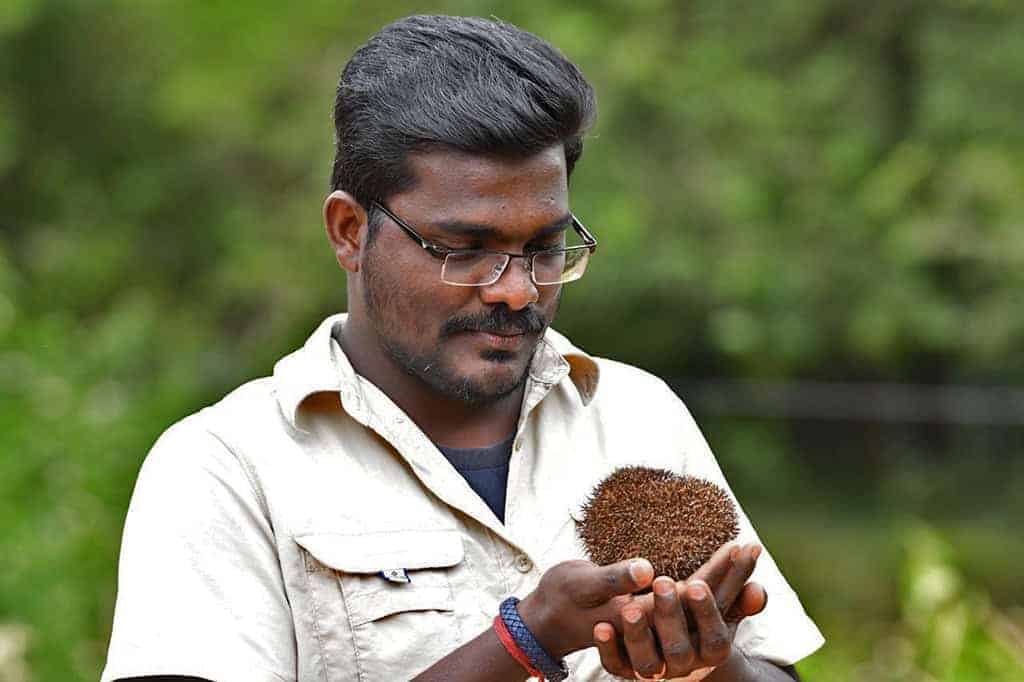
Dr. Brawin Kumar of the Hedgehog Conservation Alliance. Picture courtesy: Jude.
While hedgehogs of the West have captured the popular imagination, their poor cousin endemic to southern India has remained largely unknown. It is one of four hedgehog species found in India and remains so obscure that few know of its existence even in its homeland. Dr. Kumar’s mission – to pull this little known species back from oblivion – feels both improbable and important. What does it take to study – and save – an animal that most people don’t even know exists? I chatted with him to find out.
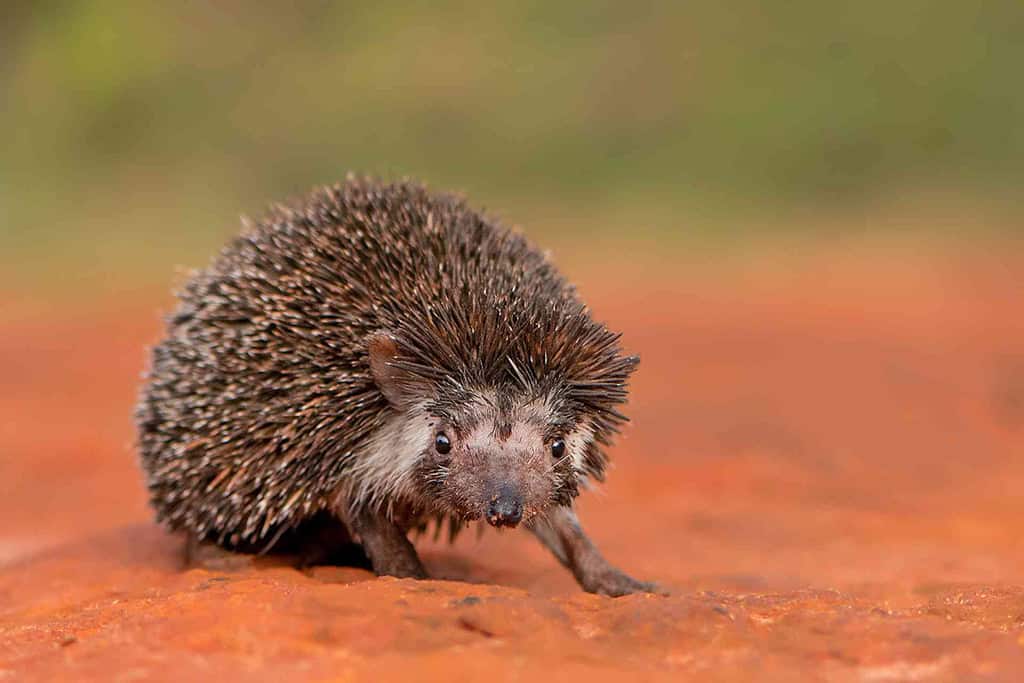
Mull-eli.
What first drew you to this elusive creature?
One year into my job in conservation with the Zoo Outreach Organization (ZOO) in Coimbatore, at an Earth Day celebration in 2011, the audience in Tirunelveli asked me about a spiny little creature that often ends up as roadkill in those parts. One of them had even saved up its spines and brought them along.
Despite my postgraduate degree in biotechnology, I had no clue. The experts at ZOO identified it as the “mull‑eli” (which means spiny rat in Tamil) or the Madras Hedgehog. It took several visits to the region before I finally saw my first live hedgehog – a spiny animal resembling what I described in an essay as a “small bunch of twigs arranged with utmost care, ambling about in the scrub looking for food.”
Meanwhile, I started reading up about them. The British first recorded these mammals in scientific literature in 1851, but very little is known about the behaviour of these solitary, nocturnal and elusive animals. They are hard to spot, but I began doing field surveys.
I got data from other sources: Local newspapers reported sightings – an unexpectedly good resource. We networked with conservation groups like the Nellai Nature Club. People reported sightings from camera traps. I also drew up a questionnaire to document people’s perceptions about hedgehogs in places where they have been historically documented. Older people said that they had seen live hedgehogs, or the pawprints on the sand, growing up, but not so much now.
At the end of the five‑year‑long study, we got a clearer picture of the distribution of these hedgehogs and the threats to their survival. In 2018, we published a detailed paper on this.
And what did those findings reveal about Madras Hedgehogs?
Hedgehogs were not confined only to arid landscapes and thorny scrubland as we expected. Their habitats include pasture lands, edges of agricultural fields, shrub lands, grasslands, sand dunes, foothills of small hillocks, and even urban areas! You can see them in cattle‑grazing fields, behind houses, and under leaves of the palmyra trees. You might even see them near lamp posts where they feast on insects that fall to the ground.
We pooled together confirmed locations and sighting records and used an algorithm to predict the potential distribution range of hedgehogs in southern India. Ninety percent of the hedgehog population lives outside protected areas, where – unlike mega fauna like elephants and tigers – they have no safeguards under the Indian Wildlife Protection Act.
If their range is larger than expected, why are you worried about their survival?
Worldwide, wildlife has had to contend with habitat loss, vehicular traffic, and climate change. Madras Hedgehogs face additional dangers. Dried hedgehog spines are used as medicine for whooping cough and other ailments. The meat is a delicacy. The dead skin is hung in front of homes to ward off the evil eye.
When hedgehogs sense a physical threat, they curl up into a spiny ball – a strategy that worked well against predators, birds of prey or foxes, but fails entirely against a motor vehicle in motion. Hunters simply pick up the spiny balls and sell them in the marketplace – dead or alive – as products and pets.
Hedgehogs that end up as pets die soon because they are fed only greens. Even zoos that get rescues do much the same thing. There is simply not enough scientific awareness about the animal – few seem to realize they are not mini‑porcupines.
You created a Tamil comic book about the Madras Hedgehog?
As an ecologist, it shocked me to see that the children in the hedgehog’s homeland were growing up ignorant of the existence of the tiny mammal and what it was up against. I worked with the cartoonist Venkatesh Babu to create a 20‑page Tamil comic book Mullikkaattu Ithigaasam (Legend of Scrub Forest). The plot: Two school children rescue a little hedgehog from a local quack. Most of the timid creature’s siblings have already died as roadkill. The mother is overjoyed to be reunited with her little one in the end.
If more people know what a hedgehog is and if they can record sightings with location and time-stamps – like birders do for various bird species – we can get a better estimate of the hedgehogs’ baseline population and distribution. Even recording a hedgehog roadkill can help. Hedgehogs are indicator species. When hedgehogs thrive, it means the ecosystem around them is thriving too. It will be helpful to have some baseline estimates about the hedgehog population. This comic is part of outreach to engage people and hopefully turn them into citizen scientists.
What are your next steps for outreach and conservation?
My goal is to conduct a mass outreach programme for the conservation of the Madras Hedgehog and its habitat.
Hedgehogs are not vermin, but their local name in Tamil is mull‑eli (literally thorny rats), so people do not think twice about exterminating them. Being insectivores, hedgehogs are natural allies of farmers and help them cut down on chemical pesticides – a fact we need to emphasise during outreach. In its habitat, underpasses in the roads will help hedgehogs avoid traffic which currently mows them down.
The government could nominate Hedgehog Day because India is the home of other species as well like the Long‑eared Hedgehog and the Indian Hedgehog. The birthday of M. Krishnan (30 June 1912), pioneering Indian naturalist and nature writer, would be an ideal date because he was the first person to document that the Madras Hedgehog can survive snakebites. But how they do it – we still do not know.
Many good research papers about the characteristics and the behaviour of the Madras Hedgehog are waiting to be written, but first we have to ensure the survival of this species.
Last question, especially for Chennaiites: Can you find the Madras Hedgehog in the city?
In colonial times, vast parts of southern India constituted the Madras Presidency. That is how the Madras Hedgehog got its name. It is endemic to southern India – found only in Tamil Nadu, Kerala, Karnataka, Andhra Pradesh and Telangana.
There are, in fact, no hedgehogs even in the Arignar Anna Zoological Park in Vandalur, Chennai. The Madras Museum has a specimen, but its collection date and location are missing, making it impossible to say whether it was collected from the capital city. So, the Hedgehog is not in the uyir college, not in the “seththa college” either – both places where locals traditionally go sightseeing during the Pongal festival.
There are potential hedgehog habitats in and around Chennai, but we have not done field surveys yet, and without field studies, scientists cannot conclusively answer this seemingly simple question.
— by V. Vijaysree, v.vijaysree@gmail.com