In 1980, in Chennai, a young man dies of renal failure and his family hesitates to donate a kidney. For a cinematic timestamp, it was the year Rajinikanth’s Kaali opened in theatres. In his short story Kagitha Sangaligal, Sujatha Rangarajan — modernist writer and pioneer of Tamil science fiction — imagined a tragedy with his usual economy. The plot, written in spare, unsentimental prose, poses a stark question: Are blood ties infallible when a life hangs in the balance? And the answer? The title itself, “Paper Chains”, gives it away.
At her husband’s bedside in the ward of the Government General Hospital, the young wife begins her daily vigil. Walking past the statue of Dr S Rangachari – the “Flying Doctor” who raced across the Madras Presidency in a Puss Moth monoplane to reach far flung patients – she is too preoccupied to notice the bird droppings streaking his bronze likeness. Another morning, she might have allowed herself a small smile at the good doctor’s posthumous indignity. Not today. The shifting rhythms of the general ward, however, do not escape her: the medicinal smells, the low moans of the patients, the steady traffic of nurses, physicians and unauthorized visitors. Almost subconsciously she begins to pen lines with the cadence of a Beatles song.
People come, people go//Selling prayers, selling soap
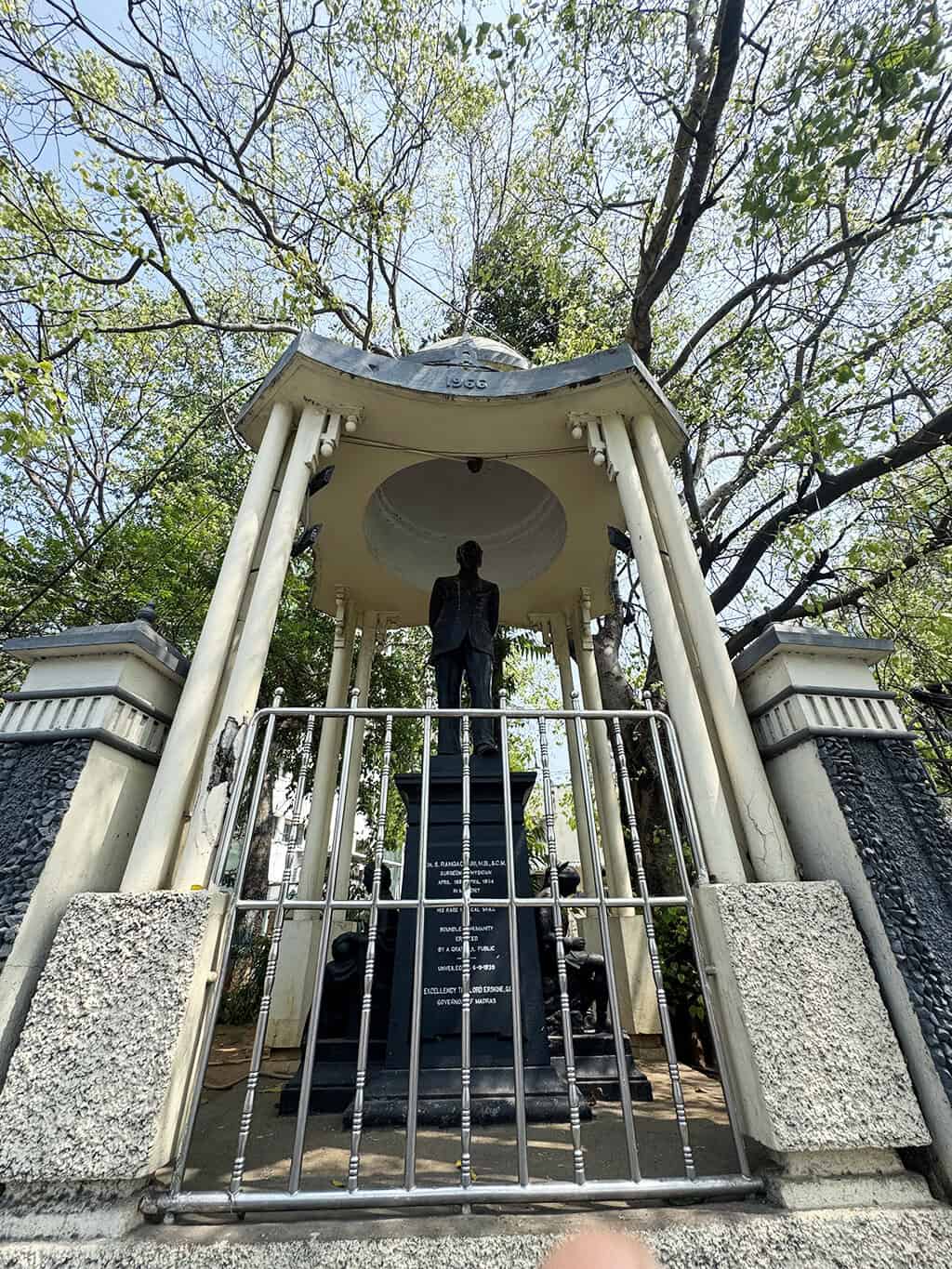
Statue of Dr. S. Rangachari outside the GH, picture courtesy: Surya Kumar.
By afternoon, the diagnosis arrives. On the chief doctor’s advice, she rushes to Spencer’s on Mount Road, for a bottle of human albumin, clutching the prescription as if speed alone might change her husband’s fate. At the iconic departmental store — where the Corporation sometimes set up temporary vaccination booths — she moves blindly past the familiar counters.
On the ride back, as the bus shudders, another line surfaces for her poem about the general ward. It comes to her the way the morning’s line did — unbidden, a rhythm she can hold on to while everything around her shifts in ways she can’t yet name.
People come/ people go //Selling prayers/ selling soap Human albumin — and hope.
Sujatha’s spare telling stayed with me long after I closed the book. Days after I read the story, I mourned for the young widow, an English literature graduate. I asked myself: what if this renal affliction had happened to me, or to a loved one, at age twenty-five?
Blood relatives were once the only lifeline for those who needed a kidney. Sujatha’s bleak ending belonged to a world where medicine offered no alternative — where love, fear, hesitation, or family politics could decide who lived and who died.
In the early 1980s, cyclosporine arrived. Thanks to this powerful immunosuppressant, altruistic strangers — even the newly dead — could donate their kidneys. For the patient, it became a matter of waiting for the right match. But the wait can stretch into years, binding patients to dialysis machines, until life itself slips away.
Even as all this was happening, science was already looking for alternatives through research. In 1964, a young American schoolteacher lived almost nine months with a chimpanzee’s kidney. Later, pigs became the chosen species to replace human organs — heart, liver, and kidneys.
In the 21st century, with genome-editing technology CRISPR, researchers began editing pig DNA with precision, silencing rejection signals and erasing hidden viruses. In 2024, one patient survived six months with a pig kidney carrying ten edits in its genome — a milestone.
In January 2025, Tim Andrews, a 66-year-old, received a pig kidney with 69 edits at Massachusetts General Hospital in Boston. By summer, he was strong enough to throw the first pitch at Fenway Park, Boston’s famous baseball stadium. Andrews named his kidney Wilma – after the pig. By late October, his body had rejected Wilma. Now back on dialysis, he waits again — but his trial gives others a glimpse of what might be possible. “It’s like going to the Moon,” he said in the news story in the journal Science. “I am just one of the people on this journey who suffered pain, health issues, and grief to move the program forward.”
Sujatha’s readers had pleaded with him to reconsider the heart-rending ending of Kagitha Sangaligal. They said they would donate a kidney, but their generosity would have been of no avail. The drug that dramatically improved survival in human transplant surgery and expanded kidney donation beyond blood relatives had not been invented yet.
“The story was set in a time when immunosuppressants like cyclosporin were not in vogue,” the author wrote. “Today, if you contact a broker in Royapuram Tsunami Nagar, fifteen people will come forward to donate their kidneys.” In the rehabilitation slum where fisherfolk had lost everything to the waves in 2004, kidneys were sold, not given. Poverty turns bodies into commodities.
In his 2026 book Every Living Creature, surgeon Joshua D. Mezrich traces how xenotransplantation — the transplanting of organs between species — could save human lives. It offers a glimpse of a near future where survival does not depend on a sibling’s hesitation, a stranger’s desperation, or anyone’s altruism. In this vision, science becomes the more reliable bond — the one that endures when human kindness falters.
The lines she once shaped in the ward echo differently now, in this age of editable genomes. People come, people go// Selling prayers, selling soap// Xenotransplants — and hope.
Someday, when science spares the pig as well, the last line may change again.
People come, people go// Selling prayers, selling soap// Xenotransplants — 3D‑printed organs — and hope.