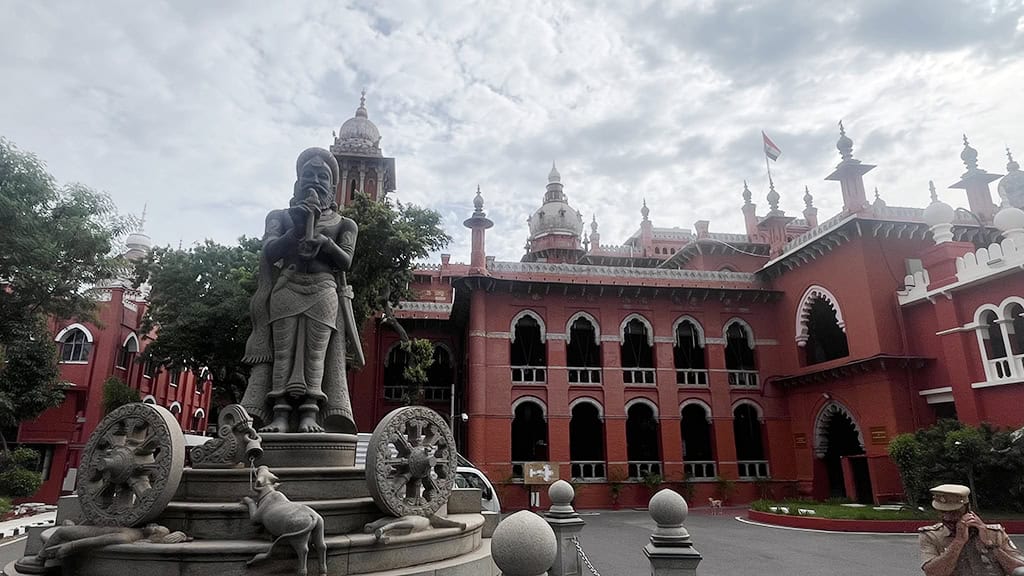
Madras High Court’s sprawling building with Manu Needhi Cholan statue, a symbol of justice.
I had the singular honour of visiting the exquisitely gorgeous heritage edifice of Madras High Court. It was to attend a heritage walk led by Mr. N.L. Rajah, Senior Advocate of the Madras High Court. Normally laypeople are not allowed inside the heavily secured confines of the court but this was an exception. It was a memorable peek into the hallowed corridors and courtrooms of this marvel of Indo Saracenic architecture.
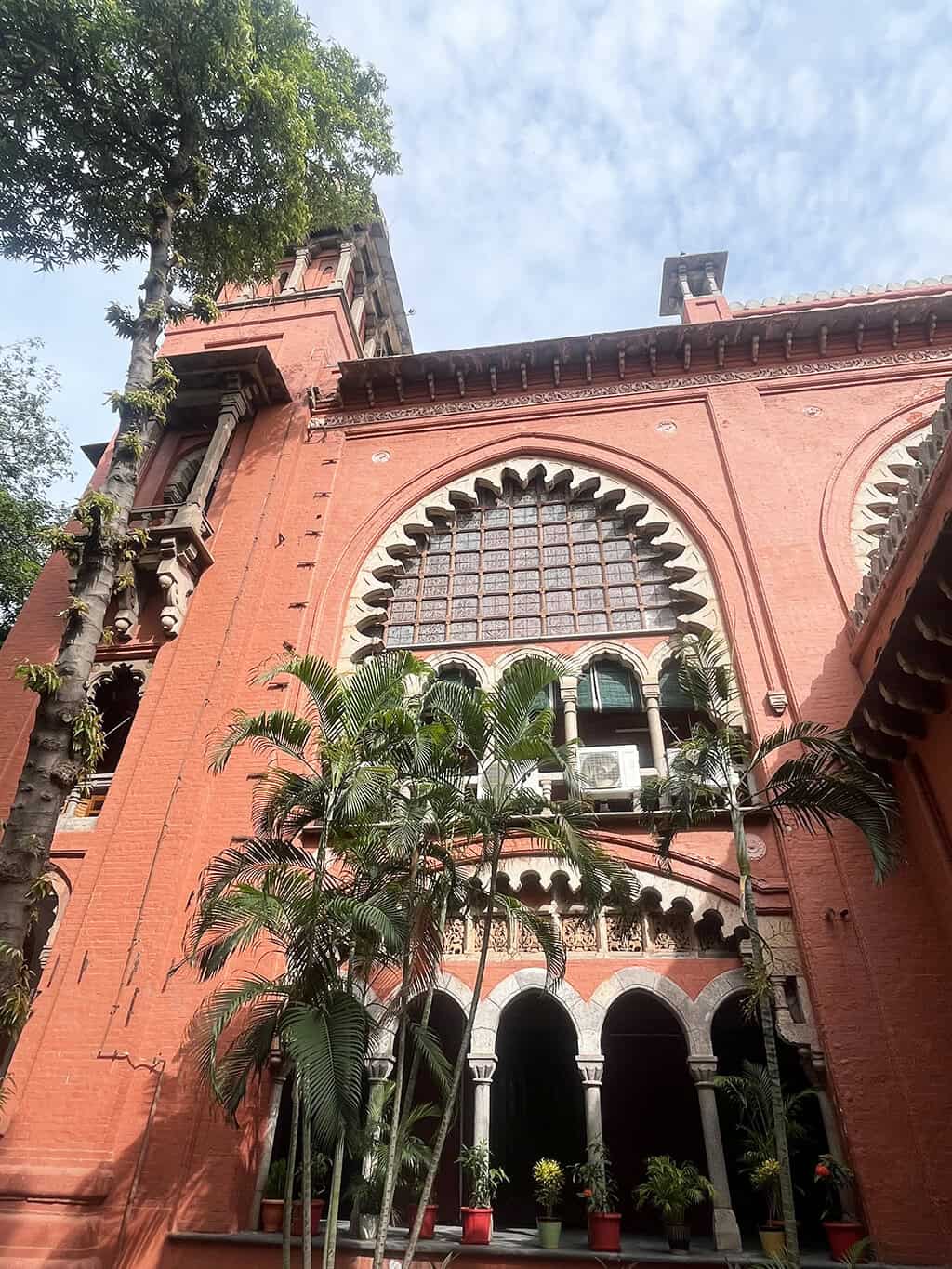
Distinctive arches, pillars, cupolas, jharokhas and red brick exterior.
Let us go back in time and learn about its origin. It was designed by J.W. Brassington and the architects were Henry Irwin and J.H. Stephens. It took the renowned contractor Namberumal Chetty four years to build and it was declared open on July 12, 1892.
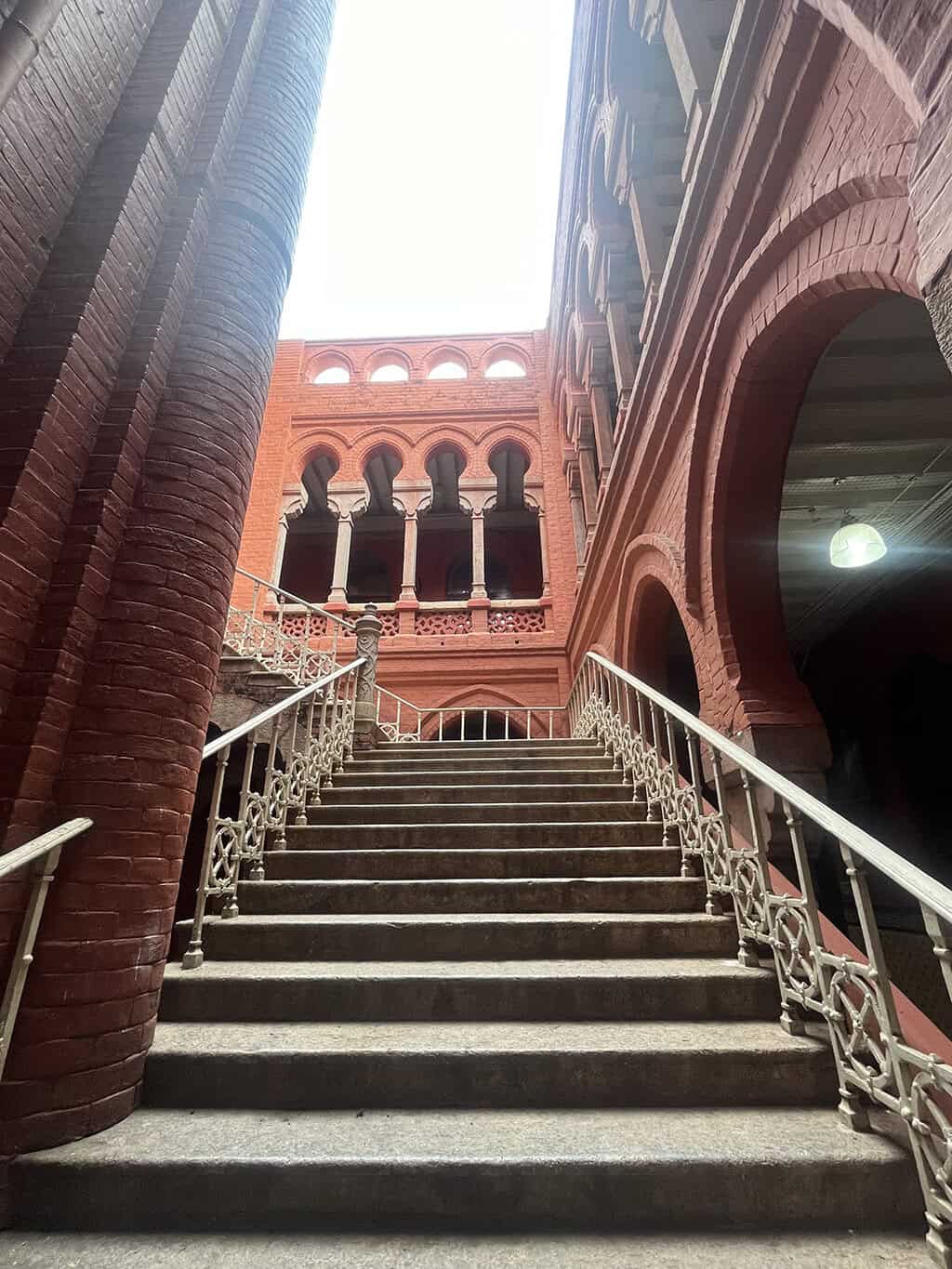
The grand staircase which wraps the main dome tower.
With distinctive red brick exterior, massive granite pillars, gorgeous arches, traditional chajjas with intricate brackets, stunning stone balconies, magnificent bulbous domes of various sizes, glorious minarets, stained glasses, Athangudi tiles flooring, imposing staircases and multi-coloured plasterwork, the sprawling buildings of Madras High Court are mesmerising.
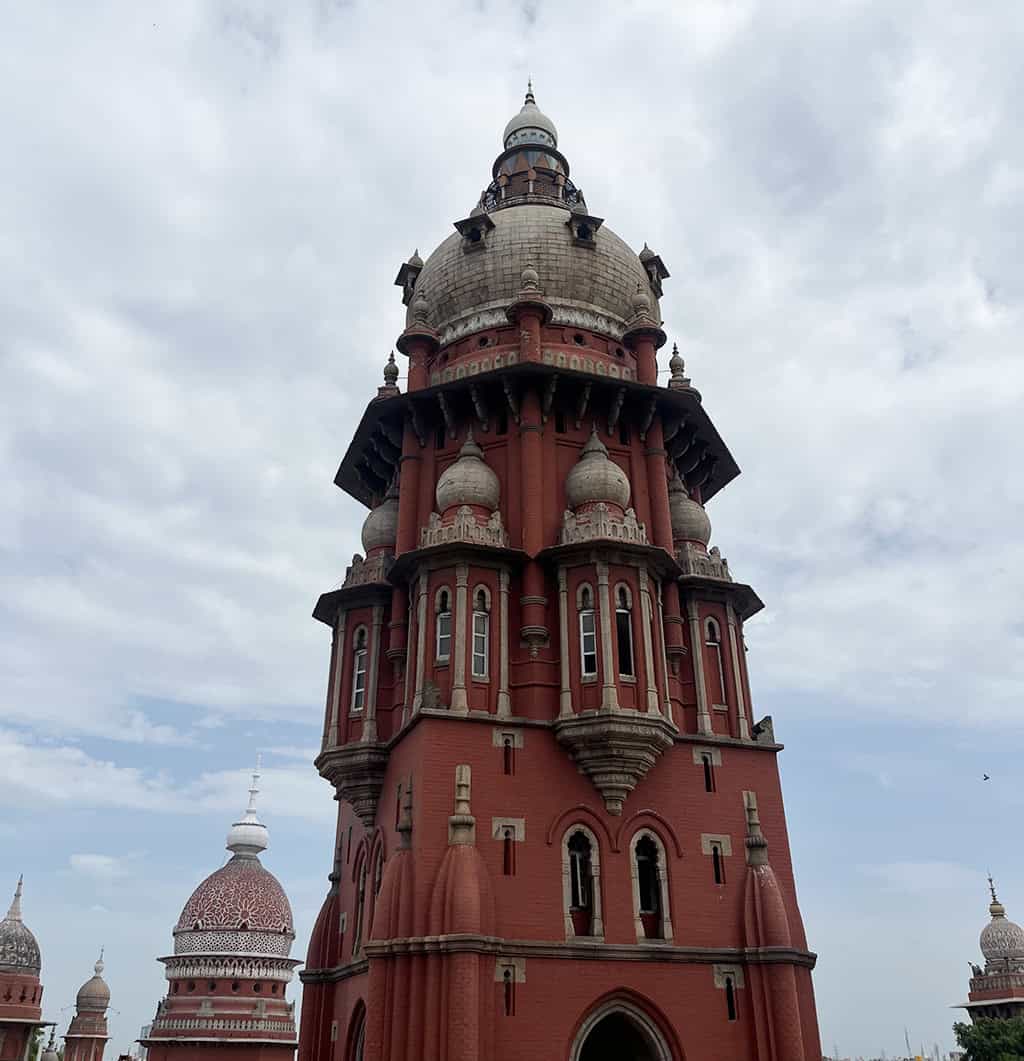
The piece de resistance of Madras High Court is the main ‘lighthouse’ dome.
The judges of the High Court have been true trailblazers. For the first time in the Madras Presidency, an Indian was appointed judge of the Madras High Court as early as 1877. He was Justice Sir T. Muthusamy Iyer. He then rose to the enviable position of Chief Justice of the Madras High Court in 1893. Who could have thought that a Munsif could climb so high. I kept gaping at his marvellous marble statue which is so lifelike?
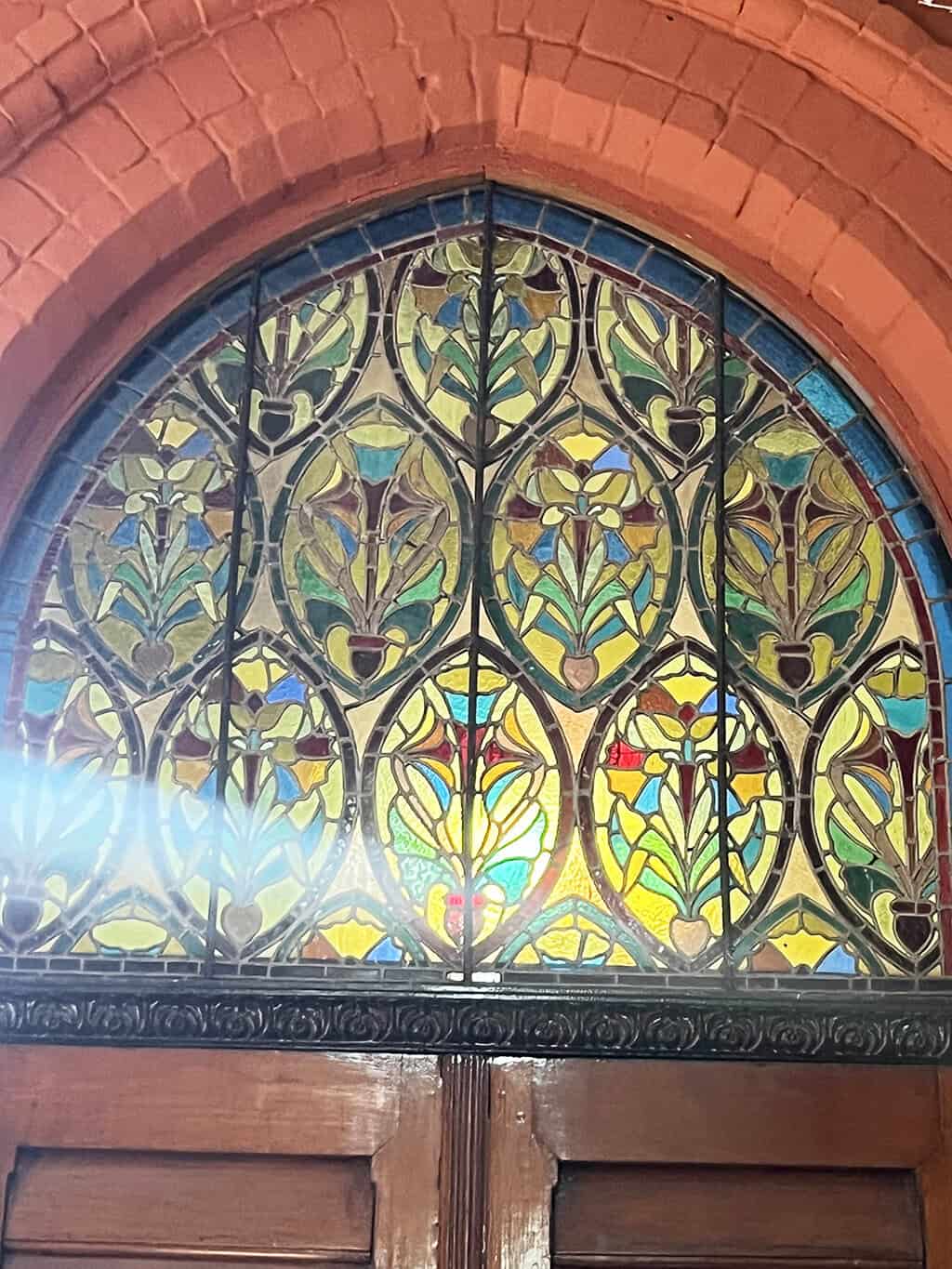
Spectacular stained glass doorways to courtrooms.
During the heritage walk of the High Court, our group came across a defunct lighthouse. This lighthouse called the Doric column (135 feet tall) is made of Charnockite (Pallavaram Gneiss), a locally available stone. Incidentally, it was the second lighthouse in the city’s history and functioned for 50 years from 1844 onwards until the need was felt for a taller option. The first ever lighthouse was in Fort St. George built in 1796. What’s most interesting is that in 1894, the third lighthouse came up on the top of the High Court’s central dome as it dwarfed the nearby Doric column by 55 feet. So, a ‘lantern room’, an engineering marvel of the time, with a kerosene lamp was established right on top of Madras High Court’s tallest dome.
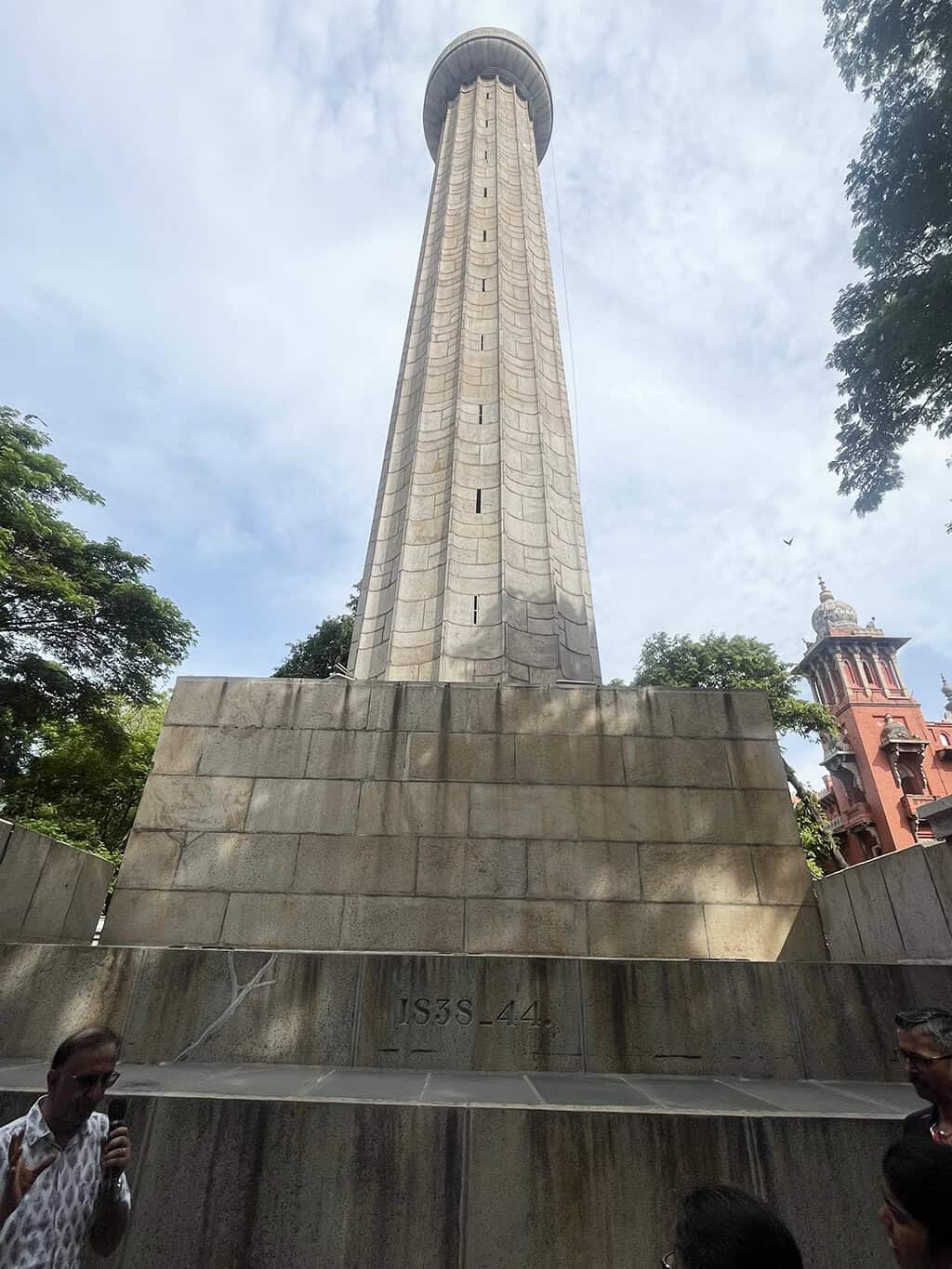
Doric column lighthouse (1844-1894).
It functioned as the city’s flagship lighthouse until the fourth and the last lighthouse was inaugurated on the Marina in 1977. How interesting that when the High Court was instituted in 1892, nobody had a clue that within two years it would have a lighthouse operational from the top of its highest dome. Significantly, our very own Madras High Court holds the distinction for being the only court in the world to have functioned as a lighthouse as well, from 1894 to 1977. It was decommissioned in 1977 when the Marina lighthouse, which was electrical, was instituted.
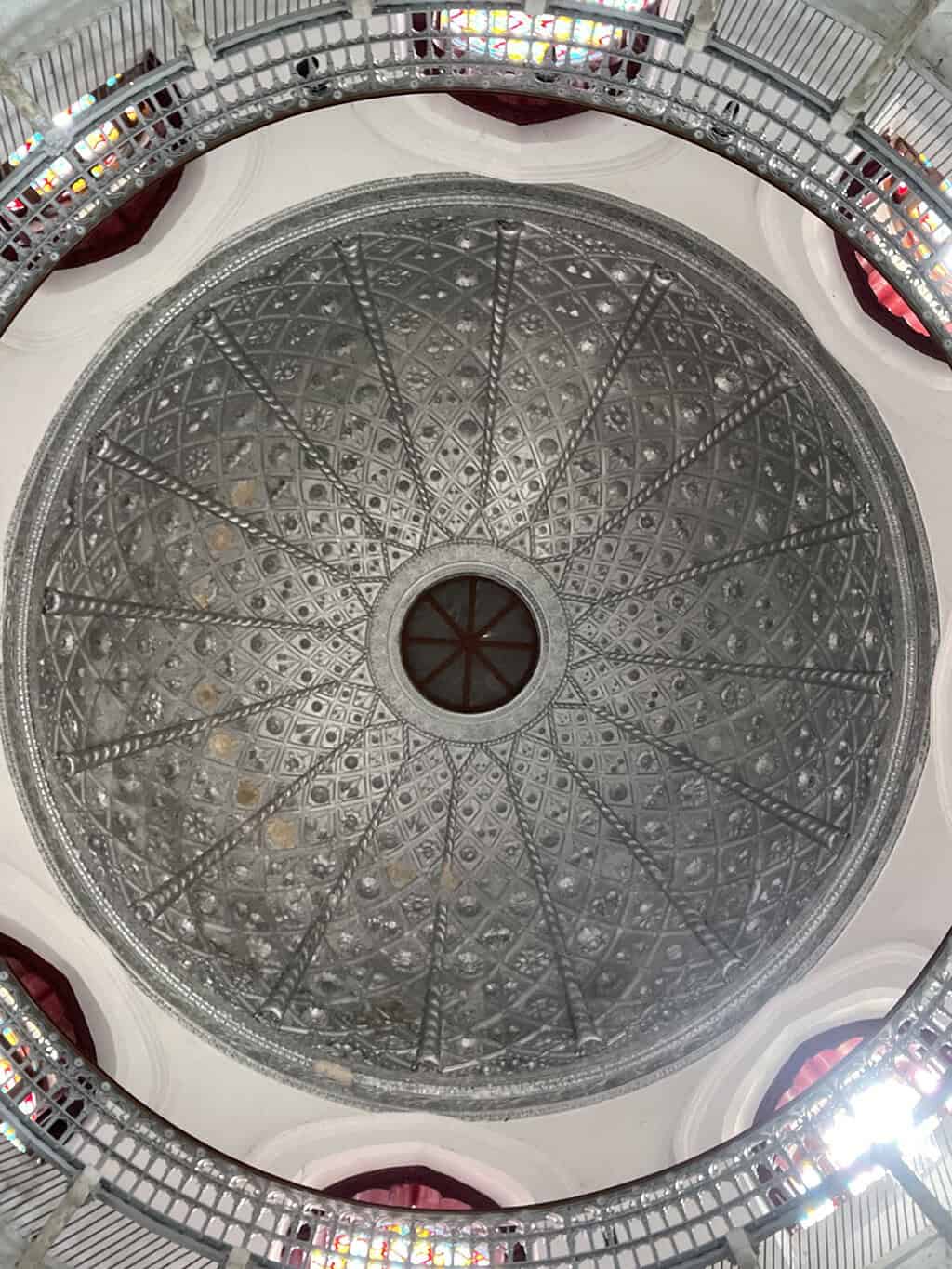
The fine plasterwork of the West Block dome.
What I absolutely loved about this unique and rare heritage tour was the climb to the top of the main dome. The first stage was a winding stairwell which was rather narrow and had steep stairs so that when I reached the next storey I was panting for breath. The next level was a huge octagon. The view from here of the Bay of Bengal, the Chennai harbour and the rest of the city’s landmarks was spectacular.
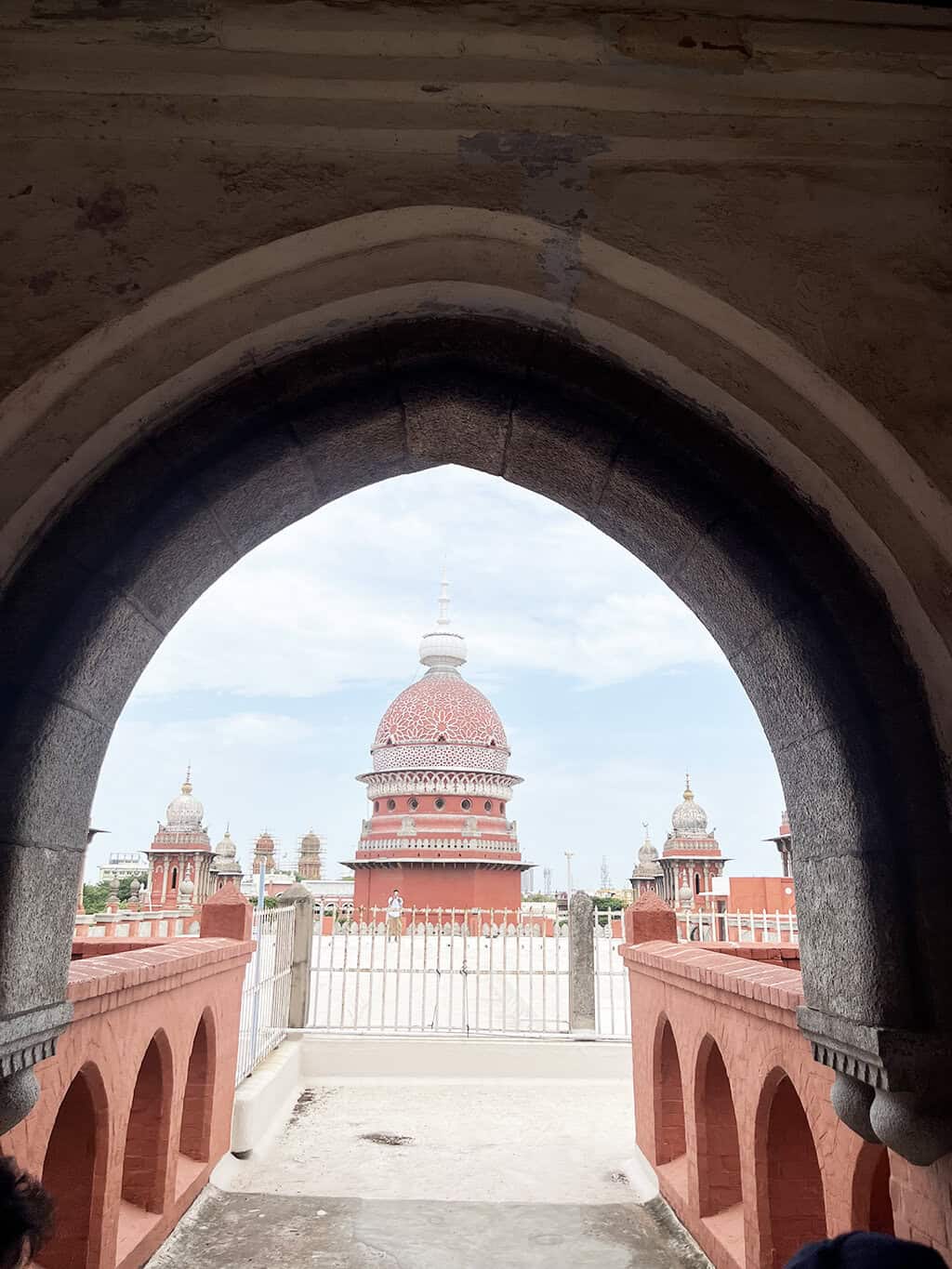
Beautifully framed West Block dome with a uniquely shaped finial.
It also serves as a vantage point to look down at the other domes and numerous minarets of the entire High Court building which has a crucifix plan. Finally, right at the centre is a spiral staircase which takes you to the very top of the main dome where the ‘lantern room’ of the now defunct lighthouse is. Although many of us wanted to go up the spiral stairs, Mr. N.L. Rajah told us that nobody is allowed to go beyond where we had already reached.
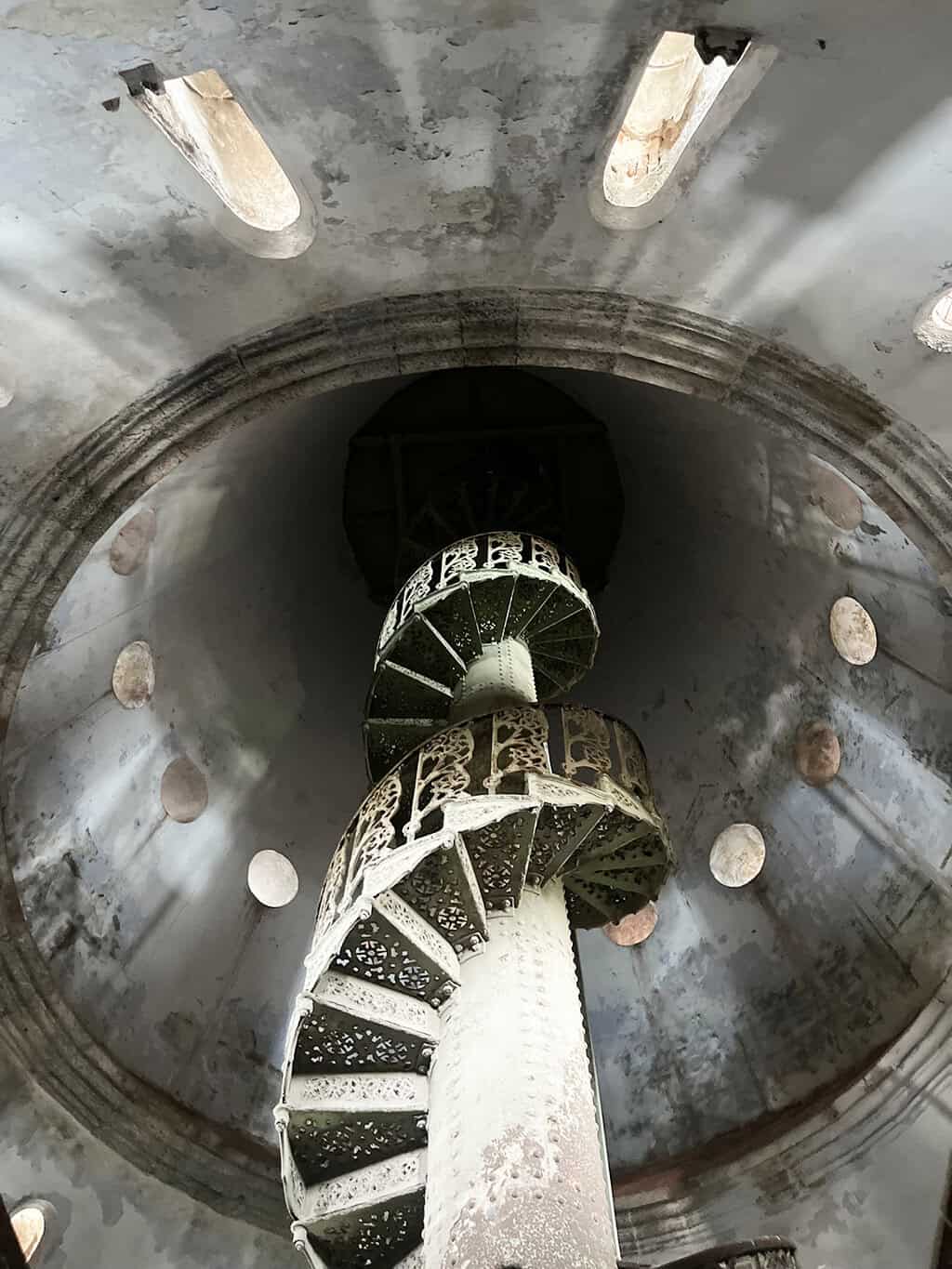
The spiral staircase leading to the lighthouse of Madras High Court.
It was an unbelievable experience to walk into hallowed courtrooms with antique ornate wooden chairs for judges. They had elaborately carved teakwood artwork along with stained glasses on the entire back wall behind the Chief Justice’s chair. The ceiling of the court room had highly ornamental woodwork with mind boggling geometric patterns. We were told that everything is as it was in 1892 when the High Court was established. Well preserved heritage indeed.
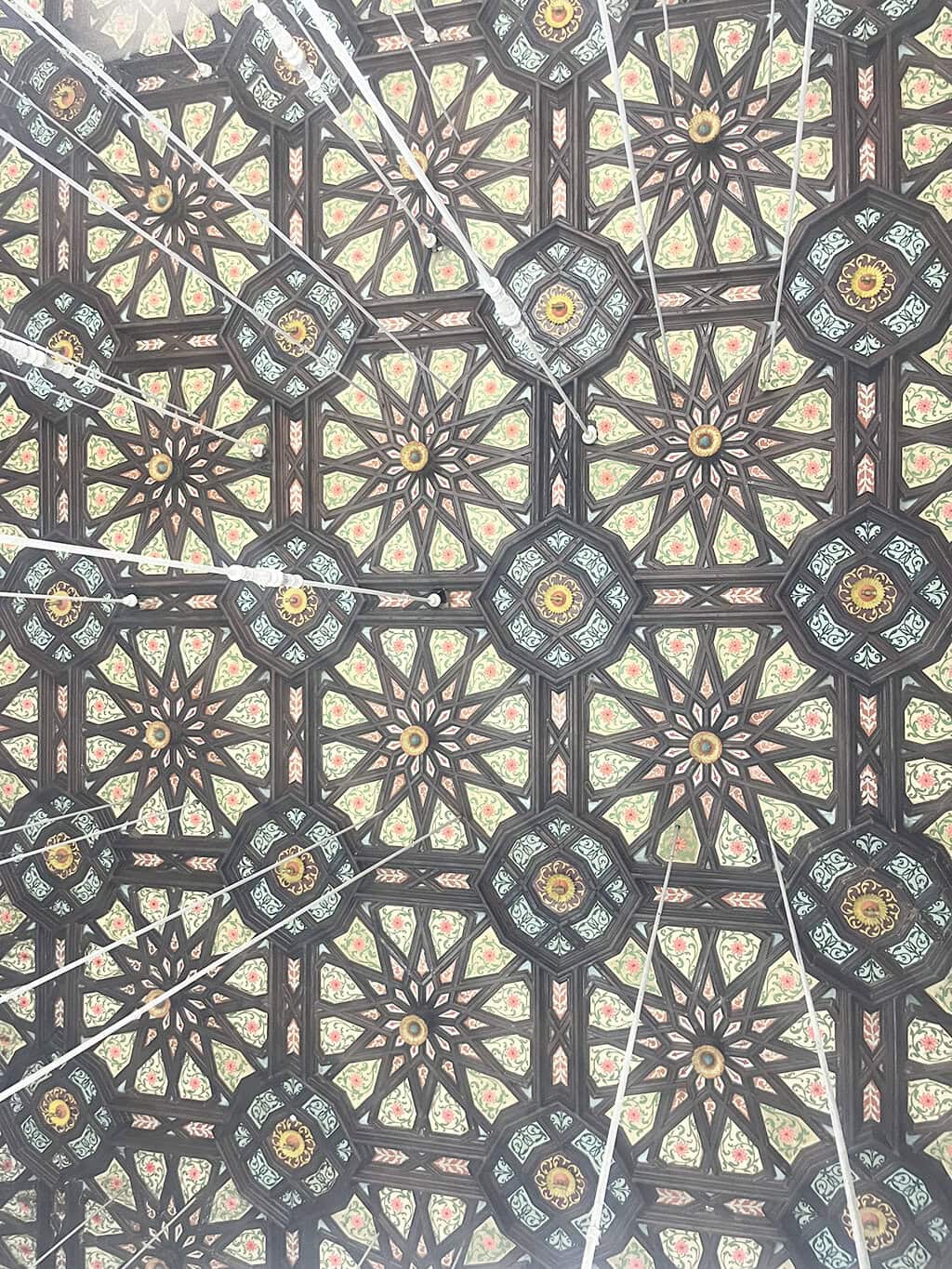
The minute details of geometric woodwork of the roof in courtrooms.
The incredible heritage tour came to an end under the ceiling of the West Block dome is a sight to behold. It has a silver coloured intricate plasterwork and soars high above an octagonal junction of four long corridors. The Athangudi tile patterns right under this dome are absolutely marvelous. After bidding goodbye to the esteemed lawyer, Mr. Rajah, I made an exit with all the information and thrill buzzing in my mind. It took me a long while to have all this grandeur and history sink in. It was indeed an experience that will forever be etched in my mind!