Some cities preserve themselves through monuments. Others through cuisine, commerce or grand festivals.
Madras has always preserved itself through culture.
And among its most enduring inheritances, understated perhaps yet profoundly influential, stands drama and theatre. Not merely as entertainment, but as one of the strongest cultural threads woven into the emotional and intellectual fabric of the city.
For generations, Madras did not simply watch theatre. It lived it.
Long before multiplexes, OTT platforms and social media occupied our evenings, Chennai gathered under stage lights. Sabha halls, temple courtyards, school auditoriums and modest theatre spaces became places where society met itself — laughing at its contradictions, debating morality, questioning authority and celebrating Tamil expression in all its richness.
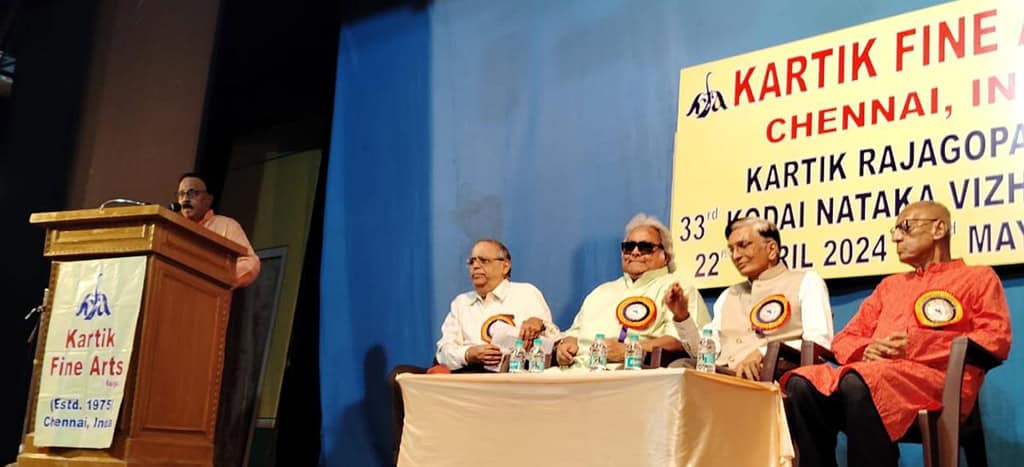
Kodai Nataka Vizha in Chennai. Picture courtesy: The Hindu.
Drama was Madras speaking to itself
Humour met philosophy. Satire met social reform. Ordinary life transformed into compelling storytelling.
To understand old Madras without theatre is perhaps to understand only half the city.
Tamil theatre in Chennai flourished because the city embraced it not as elite culture, but as public culture. Office-goers rushed from work to evening performances. Families debated scripts over dinner. Students volunteered backstage. Amateur troupes rehearsed in neighbourhood halls. Theatre became as natural to Madras life as Carnatic music, temple festivals and cricket on the Marina.
At the heart of this cultural movement stood pioneers like Pammal Sambanda Mudaliar, who transformed Tamil drama into a disciplined art form, moving it beyond mythology towards realism, social commentary and literary depth.
And then, in the 1990s, emerged what should be considered one of Chennai’s finest cultural traditions – the “Kodai Nadaga Vizha”.
If December and January belong to the celebrated music season around the Music Academy, then April and May deserve to belong to theatre.
Kodai Nadaga Vizha is not merely another event in Chennai’s cultural calendar. It is a seasonal reaffirmation of the city’s theatrical soul. For more than three decades, this summer festival has sustained Tamil theatre, nurtured amateur troupes, introduced emerging artists and keeping alive the irreplaceable experience of live storytelling.
Its importance lies not in nostalgia alone. It preserves continuity.
In an increasingly fragmented digital world, theatre still offers something of the rare collective experience. Unlike cinema or streaming platforms, live performance demands presence. Actors perform before you without retakes. Emotions unfold in real time. Laughter becomes communal. Silence carries meaning.
Life slows down. And people reconnect.
Perhaps that explains why theatre has not disappeared, despite changing times.
It has simply adapted.
Look closely at Chennai’s growing stand-up comedy culture and one sees unmistakable traces of theatre. The timing, storytelling, improvisation, satire and commentary on social behaviour all echo the DNA of traditional Tamil drama.
Today’s Gen Z audience may prefer a twenty-minute comedy set to a two-hour social play, but the instinct remains unchanged. A stand-up comic speaking about Chennai traffic, Tamil parents, hostel life, office politics or dating anxieties is ultimately doing what theatre has always done – holding a mirror to society.
The format evolved. The stage survived.
Rather than lamenting the decline of traditional audiences, Chennai must recognise this shift as an opportunity. Kodai Nadaga Vizha can become the bridge between classical theatre and contemporary performance blending satire, spoken word, youth theatre and experimental storytelling while preserving Tamil theatrical traditions.
Madras has always adapted without surrendering its soul
But preserving theatre cannot remain the responsibility of sabhas alone. The next generation must inherit this duty.
First, stronger institutional support is essential. The State Government and corporate Chennai must step in with seriousness. Theatre deserves structured funding, fellowships, grants and sponsorship ecosystems, much like sports and cinema enjoy today. Chennai’s IT, automobile, manufacturing and startup sectors could meaningfully support theatre festivals and amateur productions through CSR initiatives.
Artists cannot survive on passion alone.
Second, amateur theatre must return to schools, colleges and universities with purpose. Drama should not remain confined to annual day performances. Inter-school and inter-collegiate theatre circuits, scriptwriting competitions and campus drama festivals can become breeding grounds for future playwrights, directors and actors. The next great Tamil scriptwriter may today sit unnoticed inside a classroom in Anna Nagar or Tambaram.
Talent needs platforms
Third, Chennai must consciously build a stronger theatre ecosystem. Affordable performance spaces, playwright workshops, mentorship under veteran directors, grants for experimental productions, neighbourhood theatre festivals and theatre appreciation programmes in schools are urgently needed.
Why not theatre cafés?
Why not public performances in parks, metro spaces and cultural precincts?
Why not collaborations between dramatists, stand-up comedians and digital creators?
A culturally confident Chennai can make theatre fashionable again, not in superficial terms, but meaningful.
After all, Tamil cinema itself owes much to theatre. From the legendary TKS Brothers, Nadigavel M.R. Radha and R.S. Manohar to icons such as Sivaji Ganesan, Nagesh, Cho Ramaswamy, Kathadi Ramamurthi and Y.G. Mahendra, the Tamil stage trained generations of brilliance before cinema inherited their greatness.
The stage built discipline. Cinema amplified genius.
Now, preservation belongs to Chennai’s youth. They cannot remain passive consumers of culture.
They must perform, write, volunteer, experiment, preserve. Because timeless traditions survive only when ordinary citizens decide they matter.
And theatre, perhaps more than any art form, teaches empathy, patience, reflection and shared humanity – qualities increasingly scarce in a hurried world.
For life in its purest form is celebration. And Chennai has always known how to celebrate.
If Margazhi belongs to music, let summer belong to theatre.
Let April and May become Chennai’s season of stage lights, storytelling and shared laughter.
Let Kodai Nadaga Vizha become not merely an event, but a citywide emotion.
For when Madras takes the stage, the city does not merely perform. It comes alive.
— by Mylapore Venkata Shashidhar (Retd) Colonel