Chronicles of dentistry and dental education in Madras city (presently Chennai) and the presidency (presently, Tamil Nadu) speak of two private dental colleges in Madras in early 20th century: one established by Venkata Rao and another by HM Rao. Both ceased operations in the 1940s. These chronicles also speak of the appointment of a Royal-Army Dental Assistant to help in treating dental problems of the people of Madras city and presidency. Our present article establishes that there was no Royal-Army Dental Assistant. We show with clear evidence that a qualified British dentist, Horace John Gould, was the first dental (civil) surgeon, who held a conjoint role of the professor dental surgery in the Madras Medical College – Madras Government General Hospital (MMC–MGGH) complex in 1883. Gould taught dentistry to the then medical (MBCM, later modified as MBBS) students in MMC–MGGH. From the early 1900s, we the authors – bring the appointment of another British-qualified dentist, Christopher Frampton Badcock, to light. We also disclose details of efforts made by Badcock along with Alfred Miller, Principal of MMC, to develop a formal dental education programme, while this programme was to remain within the administrative ambit of MMC. Our article also unveils a hitherto unknown effort by the Government of Madras to shift the department of dental surgery from MMC–MGGH to the then refurbished Government Royapuram Hospital (the Stanley Medical College & Hospital from 1934) in North Madras.
Introduction
KSGA Nasser, ex-Principal of the Tamil Nadu Government Dental College and Hospital (TNGDC&H, previously, the Madras Government Dental College and Hospital, MGDC&H) speaks of dentistry in Madras, tracing the history and growth of the MDC&H presently the TNDC&H in Park Town, Chennai. Nasser briefly refers to the growth of dentistry as a western-medical science in Madras city and presidency (now, Chennai and Tamil Nadu, respectively). He indicates that an institution named the Madras Dental College & Hospital (MDC&H) existed in Madras between 1935 and 1942, established by one H Venkata Rao, a private dental practitioner. Rao’s MDC&H was first established in Bezwada (presently Vijayawada, Andhra Pradesh) in the composite Madras Presidency, sometime before 1935 and later shifted to George Town, Madras. A general-medical practitioner, HM Rao, after qualifying the Doctor of Dental Surgery from USA, established one other private teaching institution named the American Dental College (ADC), in Madras in 1940. Due to HM Rao’s sudden death, the ADC closed shortly after.
Unfortunately, we know nothing further about either Venkata Rao and the MDC&H or HM Rao and the ADC. Except these privately run and poorly chronicled MDC&H and ADC, no government-sponsored, public-funded dental college and hospital existed in Madras in the early years of the 20th century. In the section ‘Origin of dental department in General Hospital’, Nasser says that a department for dental surgery existed in the Madras Government General Hospital (MGGH) from 1883, when the MGGH was administered by the Education and Health Department of the presidency government headed by Mountstuart Elphinstone Grant-Duff (Governor of Madras, 1881-1886). Nasser indicates that a ‘Royal-Army Dental Assistant’ attended to patients needing dental assistance. Nasser adds, but disjointedly, that a Civil Surgeon’s post — designated ‘dental surgeon’ — was sanctioned by the government some years later that was to function conjointly as the ‘professor of dental surgery’ in the Madras Medical College (MMC). A government order issued in this regard required the appointees for the post of ‘dental surgeon and professor of dental surgery’ to attend to duties called for in the MGGH at the rank of a dental (civil) surgeon and to teach basic dentistry to senior-class medical students pursuing MBCM title (changed to MBBS in the 1920s) in MMC at the rank of professor of dental surgery. Nasser mentions ‘Chinoy’ and ‘Udham-Singh Malik’ in passing, indicating these two men held this conjoint role in later years, possibly between 1940 and 1947. No other details of either Chinoy or Malik could be traced by us, except that we have found that both were qualified dentists with ‘Licence in Dental Surgery’ (LDS) issued by the Royal College of Surgeons.
In the present article, we determine the missing links in Nasser and complete the segment of the narrative, as much as possible, chronicling details of dentistry and the people associated with it in Madras between 1880 and 1930.
The first, formally qualified dentist in Madras
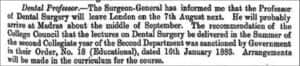
Arrival of a dentist at MMC from London. ‘Surgeon-General’ referred here was William Robert Cornish (1880–1885).
A government memorandum dated 17 September 1883 signed by the Director of Public Instruction, Madras (Henry Bidewell Grigg) addressed to the Acting Chief Secretary to the Government of Madras, Madras (Edmund Foster Webster) refers to the arrival of a dentist holding a recognized diploma from London to take on the role of the professor of dental surgery in MMC (see Box 1). Details reproduced in Box 1 adequately clarify that the person, who arrived in Madras in 1883 to take on the chair (i.e., professorship) of dental surgery was not an Army-Dental Assistant, but a qualified Dentist holding a Licentiate in Dental Surgery (LDS) issued by the Royal College of Surgeons (RCS). See box below:

Gould’s teaching schedule in MMC.
James Keess, Principal, MMC (1873-1884) clarifies Gould’s teaching schedule to students of senior-class MBCM at MMC. See box side:
In the report of the academic year 1883-1884, Keess explains that the teaching programme in dentistry to outgoing (i.e., final year) students of the Second Department (i.e., Senior Department that included students preparing to sit the final MBCM examinations held by the Faculty of Medicine, University of Madras. The University of Madras was fully operational from 1857. Practical classes for the senior-department students were conducted in the allocated wards of MGGH. Keess, as the head of MMC compliments Gould as a ‘competent professor’ and the teaching of dentistry was a new and satisfactory feature in the history of the college. See box below:

Dentistry-teaching in M.M.C. by Gould.
We could determine the full name of Gould as Horace John Gould. Unfortunately, all available government of Madras documents, including the annual reports of MMC only refer to him as ‘Gould’. Hence, we struggled to obtain his full name through various documents archived in Britain. Gould qualified the LDS RCS (London) diploma in 1882; his formal professional registration was completed on 12 August 1884. His postal address shown in the same register is ‘Madras’. As the ‘dental surgeon’ at the MGGH, he must have treated people with teeth and gum problems, because his role is not articulately spelt out in any government document. But what is clearly said is that he taught dentistry to MBCM students at MMC as the conjoint-professor of dental surgery. (Table 1 below)
The second British dentist in Madras, with an affiliation to MMC–MGGH
The 62nd volume of the Indian Medical Gazette (IMG), published from Calcutta (presently Kolkata), includes an article ‘The need for an indigenous profession of dental surgery in India, with a brief history of the efforts to meet it made under the auspices of the Madras Medical Department,’ authored by one ‘CF Badcock’. In this article, Badcock indicates his professional affiliation as ‘lately professor of dental surgery, Medical College, Madras’. The ‘Medical College, Madras’, is unquestionably MMC. The term ‘lately’ suggests that he must have recently retired from MMC.
We could determine the full name of CF Badcock as Christopher Frampton Badcock of Endsleigh Garden, London. He qualified LDS RCS (London) in 1891. The same register also indicates his postal address as ‘Casa-Major Road, Egmore, Madras’ from 1892, which confirms that he was in Madras from the specified year. What is unclear is whether he replaced HJ Gould as the professor of dental surgery at MMC at some point of time. Most likely he was a private dental practitioner in Madras. Many British-medical personnel practiced medicine in Madras as private practitioners from mid-19th to early 20th centuries. One example will be Joseph William Turner Johnstone, a British-qualified physician with an MD and LRCP, who practiced medicine as a private practitioner on Pantheon Road, Egmore, Madras in 1840s. In a publication titled pyorrhœa alveolaris, Badcock identifies himself as ‘dental surgeon, General Hospital, Madras’ – the post of a full surgeon with the government of Madras. From another publication – communicated as a short letter to the editor of IMG, he speaks of pyorrhoea in the late 19th and early 20th centuries – a common oral problem in India in the 1960s as well, recorded to continue in the 2000s. He also published the paper The prevalence of supernumerary and supplemental teeth among the natives of India: note on models showing supernumerary teeth in the Proceedings of the Royal Society of Medicine, most likely after his return to England.
We will now go briefly into what Christopher Badcock says in his article that consists of two parts: (1) a critical but suggestive commentary on the need for professionally trained dentists in India and the need for setting up new dental schools, (2) the efforts made by the department of dental surgery of MMC–MGGH to establish a teaching institution (referred as ‘school’ by him, which would be a ‘college’ in the present Indian context; therefore, in the present article we use ‘college’ instead of school).
Christopher Badcock’s article in Indian Medical Gazette
Badcock’s article is based on his work experience in Madras, specifying the imperative need for a formal academic programme in dentistry in India. He speaks of the pressing need for trained and licenced dentists, mainly because many untrained, unqualified persons (‘quacks’ according to Badcock) practiced dentistry in India then.
This section relates to Badcock’s thoughts, comments, and remarks. At the start, he mentions that no university-affiliated college for dental surgeons, no recognised dental hospital, where trainee dentists could gain firsthand practical experience, and no registrable diplomas conferred by the presidency governments and/or recognised universities in Madras, Bengal, and Bombay existed. He recounts how Britain had regularised and monitored dental profession with the ‘Dentists Act 1921’ aiming at quality. The British Dentists Act 1921 mandatorily required new dentists to register with the UK Dental Board and restricted the use of titles such as either ‘Dentist’ or ‘Dental Surgeon’ only to those who were appropriately trained and qualified. However, a ‘Dentists Act’ existed in Britain from 1878, which obviously was not strong enough to monitor the profession and practitioners. Badcock alludes to how the revised and stronger Dentists Act 1921 of the British Government was quickly followed in the dominions and colonies of Britain, promulgating similar Acts. He specifically laments that such an action was not initiated in India. According to him, India was the haven for quacks in dentistry.
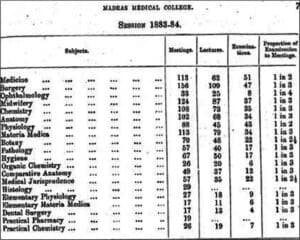
Table 1: The 18th row clarifies the number of lectures delivered and practical work supervised in dental surgery for MBCM students in MMC.
Badcock then speaks of other contextual aspects, justifying the need for a robust training in formal dentistry for Indians. He enumerates many reasons why a trained-human power in dentistry was critical. Wide prevalence of diseases of teeth and their skilful treatment for the larger-Indian population was the key. He vehemently and repeatedly criticises that the discipline of dentistry and its practice in India severely lacked pertinent regulatory Acts in restricting the practice of self-declared dentists. He speaks of the creation of a ‘chair (i.e., professorship) in dental surgery’ at MMC and its conjoint role as the ‘dental surgeon’ in the rank of a ‘civil surgeon’ at MGGH in addition to proposals developed (by him?) for an exclusive dental college and hospital, and issuance of diplomas to trainees, supplemented by formal registrations. Importantly he refers to the movement of the then department of dental surgery in MMC–MGGH to another site within Madras-city limits. The last-referred element has been totally lost in the pages of medical history of Madras.
Badcock articulates a strongly worded grievance that public services in general in India, and particularly those pertaining to the practice of medicine, surgery, and other sub-specialties, such as radiology, dermatology, nursing, hygiene, and sanitation, were reasonably regulated for long; but he wonders how and why dentistry had escaped such a public-service monitoring and regulation. That, according to him, was glaring, given that dentistry — a surgical branch of medicine — was widely exploited by quacks. He adds on that the British-qualified dentists practising in India regarded this exclusion from the scope of and regulation by the Indian Medical Act specially referring to dentistry, as a gross injustice to their professional training and qualification.
At that point of time, the government of Madras did not go beyond teaching basic dentistry to senior university-level students of general medicine and surgery (MBCM, MBBS) and establishing a dental department within MGGH. From the end of World War I, a few general-medical practitioners (holding MBCM or MBBS or LMP or LMS titles) working as civil-assistant surgeons in government-funded public hospitals in the districts of Madras presidency were trained in dentistry for a ‘short’ period (‘short’ — not explained) in the department of dentistry, MGGH. The trained civil-assistant general surgeons also practiced dentistry and treated people with dental ailments in different district hospitals of the presidency. Importantly, Badcock openly accuses that the government of Madras in 1920-1930 (George Joachim Goschen II, Governor 1924-1929; Panaganti Ramarayaningar, Premier, 1921-1926; Paramasivan Subbarayan, Premier, 1926-1930) preferred to ignore the need of creating well-trained dentists and a regulated dental profession.
According to Badcock, a clearly structured professional training leading to a university diploma in dental surgery was on the table in India from the 1910s. The limitations – both perceived and real – of traditional medical practices in India, coupled with the increasing influence of Western-medical practice and its rapid-pain-relief philosophy (René Descartes’s Cartesian Dualism ) and the convictions of the then ruling masters of India greatly influenced Indians to actively seek support and advise from Western-medical practitioners. For several years the Government of Madras approved teaching of basic dentistry to students pursuing MBBS (previously MBCM) in MMC. The maximum the government preferred to do was to offer a training in dentistry to selected civil-assistant surgeons practicing general medicine and surgery from different district hospitals.
Badcock provides details of how the teaching department of dentistry and dental wards functioned. The professor of dental surgery at MMC was appointed in 1883 (i.e., Horace John Gould). In 1888, a dental clinic was started at MGGH for practical instruction in basic dental-surgical procedures to students of MBCM (MBBS) class. This clinic formed the foundation for a better-organised dental department in MMC in later years, which included a full professor and five assistant professors of dental surgery in 1956-1957, which subsequently evolved into the independent MGDC&H. For the remainder of the story of this college moving out of MMC–MGGH precinct to nearby Muthuswamy Road, opposite to the Fort suburban train station, refer to Nasser.
Lectures in dental anatomy and surgery were delivered as part of teaching to medical students. A dental clinic was open for patients in the mornings of three week days, managed by the professor of dental surgery, who was also the conjoint dental (civil) surgeon. The patients who came for treatment were mostly from economically marginalized families in Madras; occasionally soldiers of the Madras Army’s station hospitals (i.e., small hospitals and infirmaries within military cantonments) were also referred for better treatment. Badcock indicates that the department of dentistry was located in a room in the MGGH (not traceable). One ward-boy assisted as the subordinate medical staff. No patient and treatment records are available between 1883 and 1894, although records from 1895 are: 900 patients treated in 1895; 2200 in 1916-1917. In July 1918, a second dental surgeon was appointed to assist the first dental surgeon and the numbers of in-coming patients gradually increased. The total number of patients treated in 1924 was 4585.
Extractions of teeth were the main treatment to manage dental caries and their sequelae, impacted lower-third molars. This facility also helped treating pyorrhœa alveolaris with appropriate dental prophylaxis. Between 60 and 100 fillings were completed each year. Badcock speaks of occasional fixing of Hammond splint (= arch-bar splints, first used in London in 1871; these splints were used in bridging maxillary and mandibular fractures), in addition to dealing with a few regulation cases, treating gingivitis and mouth ulcerations. Only by 1905, the regular use of ethyl chloride as a general anaesthetic started, replacing the widely used chloroform. Badcock specifically mentions the use of ethyl chloride in extractions of caried teeth done on British soldiers. Further to ethyl chloride, occasionally a combination of ethyl chloride and ether, chloroform, and cocaine were also used. Close to 3200 procedures are recorded using the ethyl chloride in these years and Badcock reports of no mishaps. A full-time dental anaesthetist appointed into the department of dental surgery in 1923, strikes as a milestone.
In 1910-1912, dental-surgery classes for students pursuing either MBCM or LMS came under the administration of a newly created Medical-Education Department of the Government of Madras led by two successive ‘Secretaries’ of the Department of Public Health from Indian Civil Service (Sonti Venkata Ramamurthy and Christopher Masterman). The numbers of contact classes for dental surgery, however, reduced from 30 to 15 — reasons unknown. Nevertheless, the silver lining in teaching dental surgery in the new format necessitated every student to attend the dental wards for 15 days with no interruption. With the onset of World War I, the dental ward at MGGH remained open every day through the year exclusively for the military personnel.
— by Anantanarayanan Raman, Anantanarayanan Parameswaran and Ratna Parameswaran, anant@raman.id.au
(To be Continued)